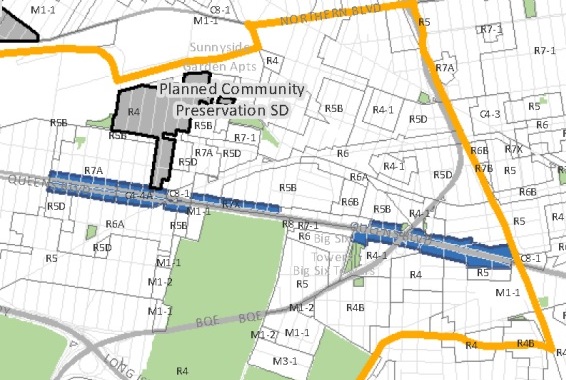
Blue line indicates where an additional 2 stories could be built if proposal is adopted
Sept. 25, 2015 By Jackie Strawbridge
A swath of Queens Boulevard could see taller buildings and reduced parking if a Department of City Planning proposal moves forward as written.
DCP is proposing two amendments to the City’s Zoning Resolution, which the agency believes will promote affordable housing and better quality buildings City-wide.
One proposed zoning amendment, called Zoning for Quality and Affordability, involves a slew of modifications to current zoning regulations that DCP considers outdated and restrictive.
The modifications that would impact most of Sunnyside and Woodside would involve building height and parking requirements.
Along Queens Boulevard, from 39th Street moving east, residences created through the City’s existing, optional inclusionary housing program could stretch and extra 20 feet, which would translate to two extra stories for below-market-rate housing.
The extra space would give developers more flexibility in design and make it easier to participate in inclusionary housing, therefore incentivizing the creation of affordable units, a DCP spokesperson said.
Similar tweaks to zoning law would incentivize affordable senior housing along Queens Boulevard, and stretching a few blocks north and south in the area east of Calvary Cemetery.
Developers who build affordable senior homes could build 10 or 20 feet higher than currently allowed, depending on zoning district. In a wider swath of the neighborhood, certain types of senior long term care facilities would also be allowed greater height and floor area.
DCP would also bring up the maximum height of standard residential buildings in much of the district by five feet. As described in DCP documents, this increase is intended to give builders more flexibility within existing zoning rules, to encourage new housing construction with more engaging architecture.
Community Board 2 chairman Pat O’Brien said he is concerned about encouraging added density in these neighborhoods.
“Some of the things that they’re doing, which are creating the opportunity for additional bulk and density in an area that’s so built out, are problematic for all the reasons that we’ve been speaking of for an awfully long time,” he said. “There is no infrastructure to support it.”
“[There is] the notion that even the people who are intended to benefit from these new developments would not benefit, because they would suffer from the same lack of infrastructure,” he added.
“I support building more affordable housing in our district, absolutely. But where and how are questions that have to be answered,” Councilman Jimmy Van Bramer said. “We can’t have any more large scale development in my district without transportation infrastructure improvements, schools and parks.”
“Zoning for Quality and Affordability will address longstanding concerns about our zoning rules to help make the City more affordable to a wide range of New Yorkers, and foster diverse, livable communities with buildings that contribute to the character and quality of neighborhoods,” DCP chairman Carl Weisbrod said in a statement.
One zoning change that would affect a large portion of Sunnyside and Woodside would be the elimination of parking requirements at affordable housing and affordable senior housing.
DCP argues that in areas such as western Queens, where public transportation is available, low-income households own fewer cars and the off-street parking provided to them goes to waste.
By removing the requirement, DCP said, it will remove an unnecessary cost to affordable housing developers.
“Being in proximity to a train line doesn’t necessarily mean that you have the kind of transportation opportunity that you should,” O’Brien said in response to this proposal. “[In CB2], those train lines are so overcrowded.”
The elimination of the parking requirements generated significant skepticism from Queens’ Community Board chairs in April when it was presented to the Queens Borough Board.
DCP’s other proposed zoning amendment, called Mandatory Inclusionary Housing, would require that new developments of 10 units or more include 25 or 30 percent permanently affordable housing when a rezoning to increase housing capacity occurs.
Therefore, if a private developer built a residential tower in western Queens, and asked the City for a rezoning of the property to permit construction of more units, MIH would be triggered.
MIH will also be incorporated into City-planned neighborhood upzonings, such as DCP is preparing for Long Island City in the future.
The community board has 60 days to review DCP’s proposal.
O’Brien said that DCP will present its proposals to CB 2’s Land Use Committee in October, and it will be considered by the board throughout the public review period, which he called “very short” considering the issue’s complexity.
He will discuss the zoning text amendment’s before the full board at its October 1 meeting, per the CB 2 agenda.
“Our [job] is to make sure our district is getting City services and the right stuff,” he said.