
Elected officials and Venezuelans across Queens have offered mixed reactions to the arrest of Venezuelan President Nicolás Maduro, who was arraigned on U.S.-issued narco-terror charges in New York on Monday.
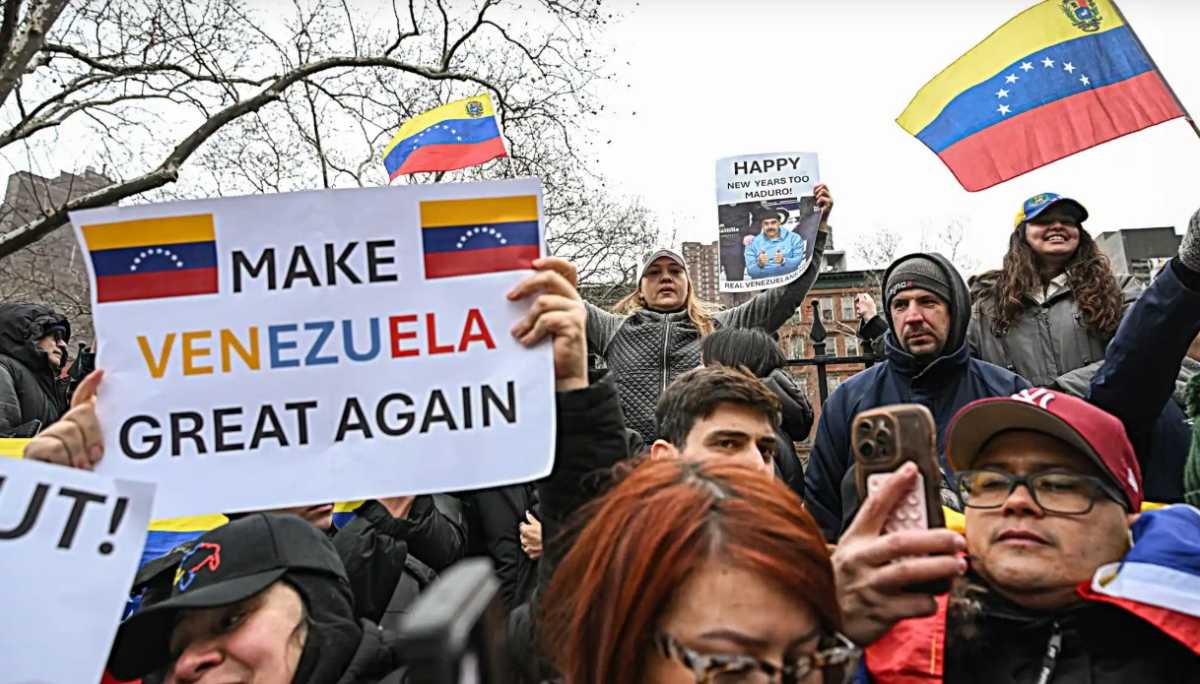
Venezuelan New Yorkers gathered outside the Daniel Patrick Moynihan United States Courthouse in Manhattan on Jan. 5, with many people singing, crying and smiling as Maduro and his wife Cilia Flores faced charges of narcotics trafficking and machine gun possession.
Maduro and Flores pleaded not-guilty to the charges during their arraignment on Monday, with Maduro alleging that he had been “kidnapped” by US forces.
“I am innocent. I am not guilty of anything mentioned here,” Maduro said in court. “I am a decent man.”
Maduro and Flores were arrested Jan. 3 after U.S. forces invaded Venezuela and seized the couple in their home in a military base in Caracas, an unprecedented move that caused shockwaves across the international community.
It was the nature of that arrest which caused elected officials across Queens to react with mixed emotions to Maduro’s capture.
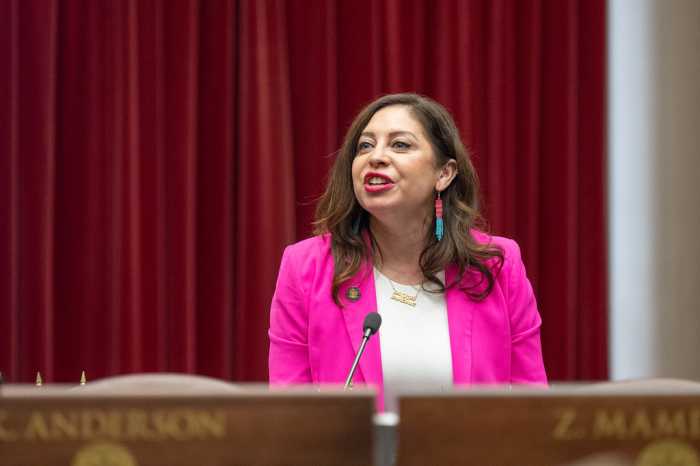
Assemblymember Jessica González-Rojas, for example, described the arrest of Maduro as “toppling a dictator” but added that it is “deeply concerning” that President Donald Trump had allegedly violated international law.
Russia, China and other Venezuelan allies have accused the United States of violating international law, but Trump has insisted that the capture of Maduro was legal because the U.S. is an “armed conflict” with Venezuelan drug cartels, according to the Associated Press.
González-Rojas, however, said the operation sets a “terrible precedent,” noting that Trump had placed Colombia on notice a day after capturing Maduro.
“The illegal and unauthorized actions of the President are deeply concerning,” González-Rojas said. “We should definitely be very, very cautious about what’s happening and how the President proceeds next. He’s already looking at other countries to take over, and I think this is a terrible precedent.
“But we have to acknowledge that this is very complicated for Venezuelans living here in New York and across the country, as well as those that are back home.”
Rosa Maria Bramble Caballero, the founder of Woodside non-profit the Venezuelan Alliance for Community Support, described Maduro’s arrest as a “quiet victory” for Venezuela.
Cabellero, a social worker who specializes in migration trauma, said Maduro’s arrest represented “one step toward democracy,” describing Maduro as someone who has violated human rights during his 15 years in power through political retribution and repression of the freedom of expression. However, she cautioned that “what comes next” is equally as important as Maduro’s capture.
“It’s not enough to just take one person down when there is a full regime in place,” Caballero said. “There’s nothing in the past 48 hours that tell us otherwise… it still feels to us like the regime continues in place.”
Caballero added that there is still a “lot of fear” among Venezuelan communities at home and abroad despite Maduro’s arrest and voiced concerns that Venezuelans remain in danger of political retribution.
She called on the U.S. to facilitate fair elections in Venezuela by acing as an independent witness and expressed disappointment that the Maduro regime remained in power three days after the President was captured by U.S. forces. However, she did not criticize the Trump Administration for potentially violating international law during the operation.
“Justice has been served,” Caballero said. “There’s still political prisoners in Venezuela simply because they’re in opposition… something needed to be done.”
On a stretch of Roosevelt Avenue known as “Little Caracas,” members of the Venezuelan community in Queens also expressed relief that Maduro had been apprehended but worry about the future of the country.
Aaron Barrios, a 17-year-old Venezuelan native now living in Jackson Heights, said Tuesday that Venezuelans were happy following Maduro’s arrest but added that Venezuelans are now praying for peace.
Barrios said he left Venezuela when he was 11 years old because there was “no food at home.”
“Almost all of my family left,” Barrios said. “They are in different countries because of the situation.
“As Venezuelans, we’re happy that Maduro has been captured, but we also worry about what’s going to happen next with our country,” he added. “We just ask for peace and freedom.”
Rashell Cabarcas, who arrived in New York in 2023 after leaving Venezuela, similarly said Venezuelans are “happy” after Maduro was arrested.
“I left (Venezuela) because of the situation,” Cabarcas said. “We couldn’t go out to protest. We’d be arrested.”
Some elected officials in Queens criticized the Trump Administration for the attack on Venezuela, including Astoria Council Member Tiffany Cabán, who described the action as an “illegal, unconstitutional and unprovoked act of war.”
“This attack was for oil and power. To distract from the Epstein files and the Trump Administration’s assault on democracy. And it violated international law,” Cabán said in a post on X.
U.S. Rep. Alexandria Ocasio-Cortez similarly alleged that Maduro’s arrest was about control of Venezuela’s oil reserves rather than narco-terrorism. Ocasio-Cortez also referenced Trump’s decision to pardon former Honduran President Juan Orlando Hernandez in December while Hernandez was serving a 45-year sentence on cocaine distribution charges.
She added that Maduro’s trial offers Trump a distraction from criticism over release of the Epstein files.
“It’s not about drugs,” Ocasio-Cortez wrote on Twitter. “If it was, Trump wouldn’t have pardoned one of the largest narco traffickers in the world last month.
“It’s about oil and regime change. And they need a trial now to pretend that it isn’t. Especially to distract from Epstein + skyrocketing healthcare costs.”
However, other elected officials welcomed news that Maduro had been detained after running what is widely described as an authoritarian regime marked by alleged extrajudicial killings and political imprisonment.
State Sen. Jessica Ramos said in a post on social media that she stands with the Venezuelan community in Jackson Heights that had long championed “peace, democracy and human rights.”
“The Venezuelan community here has never stopped advocating for a free and democratic future for their country. I stand with them and remain committed to supporting the Venezuelan people,” Ramos said on social media.
Assemblymember Jenifer Rajkumar said Maduro’s arrest represents an opportunity for Venezuelan people to begin the “difficult work” of national renewal and democratic restoration.
“My Venezuelan constituents approach this moment with cautious hope,” Rajkumar said in a statement. “For years, they have witnessed their homeland endure profound suffering under a government that dismantled democratic institutions, hollowed out the economy, and drove millions into hunger, poverty, and displacement. The consequences of this instability have extended well beyond Venezuela’s borders.”
Rajkumar also called on the United States to be “clear and consistent” in its role in Venezuela and to support democracy “for and by the Venezuelan people.”
“Not through force or unilateral intervention, but through principled diplomacy, humanitarian assistance,and close coordination with international partners. Any action that risks military escalation must be transparent and authorized by Congress,” Rajkumar continued. “Lasting democracy cannot be imposed from the outside.”