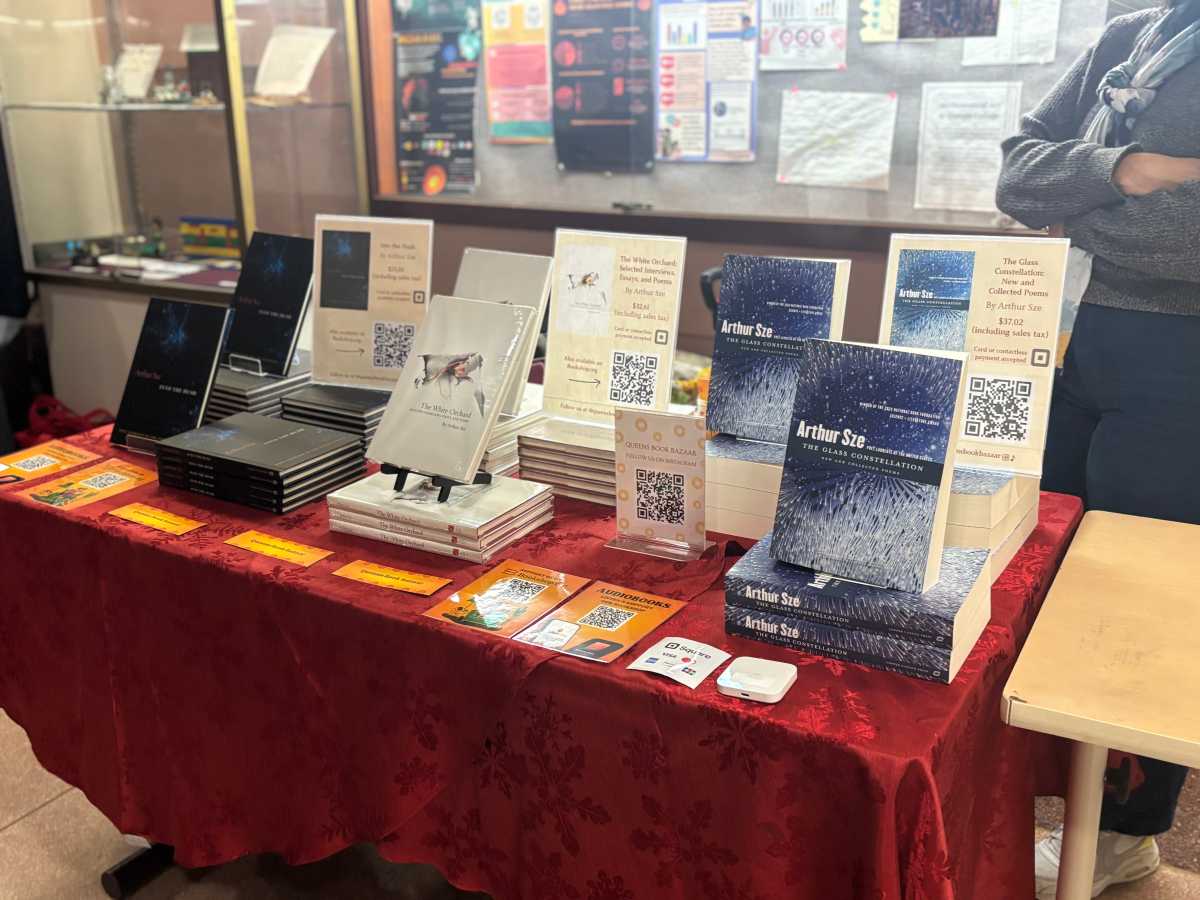

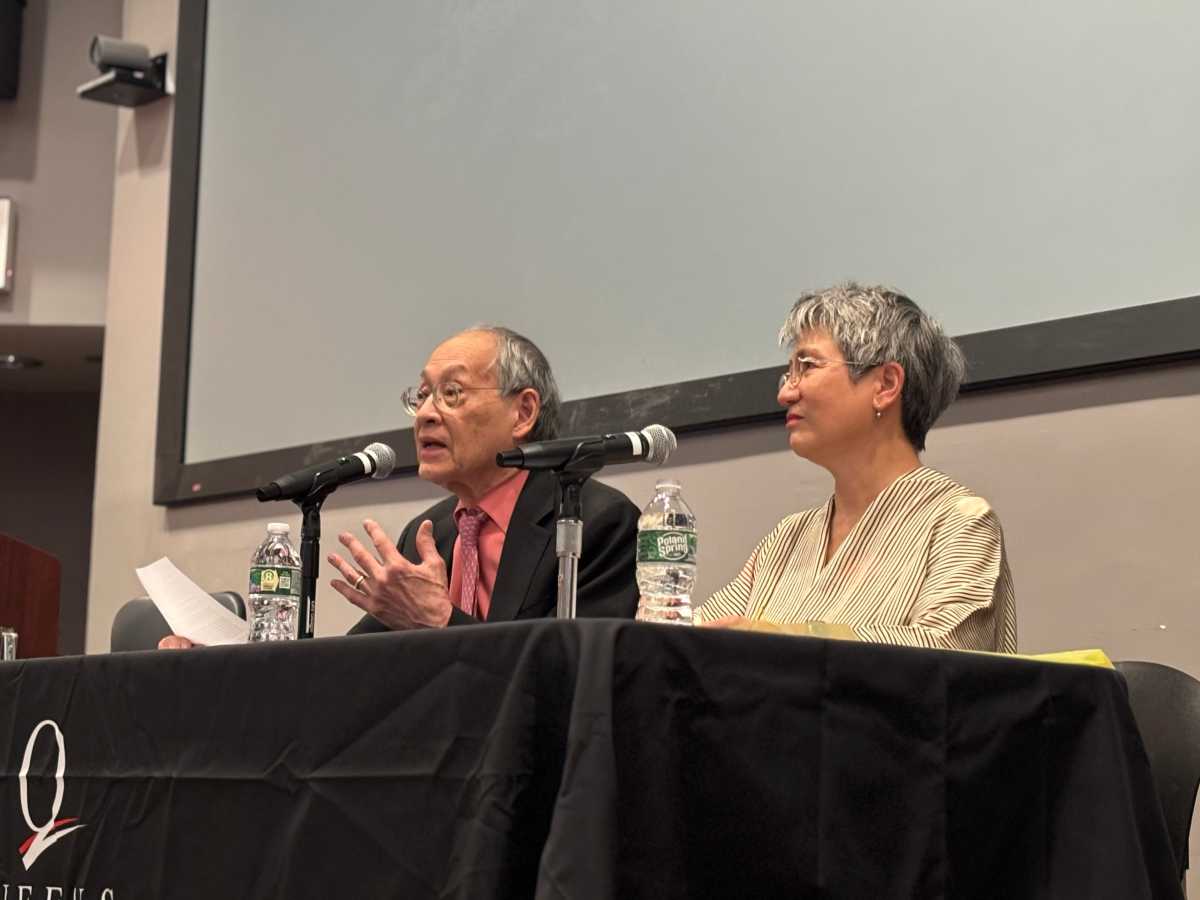
Arthur Sze, the national poet laureate appointed by the Library of Congress last month, visited Queens College, in Flushing for a poetry reading on Dec. 8. Sze was joined by NYS Poet Laureate Kimiko Hahn, a distinguished professor at the college, who both read several poems and discussed the art of literary translation.
“Translation builds bridges and makes connections,” Sze said. “Great poetry ignites and reignites our shared humanity over time and the transient worlds of poetry translation.”
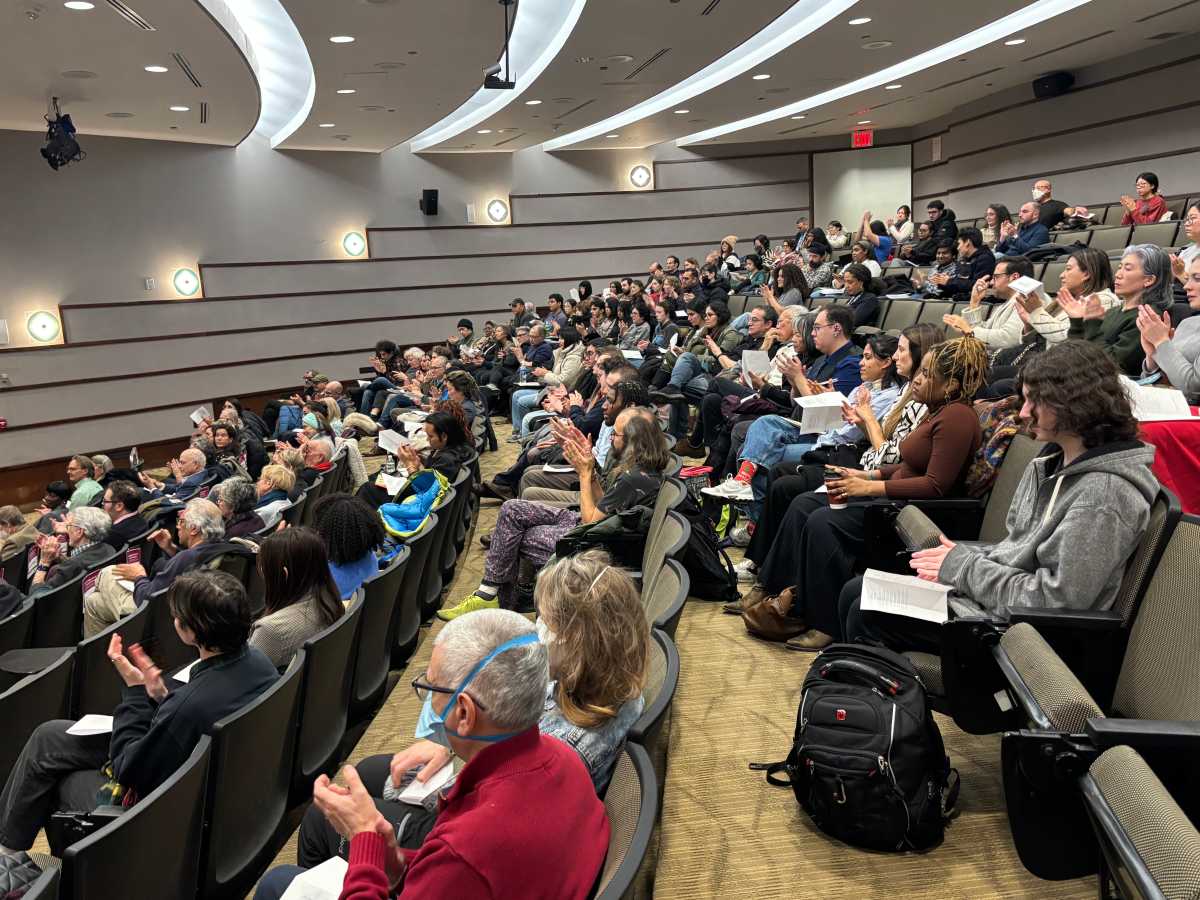
Over 100 guests gathered in the Benjamin S. Rosenthal Library Lecture Room 230 at 7 p.m. for “Words Bridging Worlds: On Poetry and Translation,” for the hour-long presentation in which Hahn and Sze discuss how poem translations can vary widely from language-to-language.
After the reading, a reception was hosted outside of the lecture hall where guests could purchase books and enjoy light refreshments.
Félix Matos Rodríguez, chancellor of City University of New York, welcomed the distinguished poets, noting that this was the first time the national and state poet laureates united for a singular poetry reading.
“That’s the great thing about the power of poetry here in Queens,” Rodriguez said. “It’s a distinct honor for me and for all of us.”
Sze is a second-generation Chinese American and Manhattan native, born to immigrant parents in 1950, and raised in Queens and on Long Island. Rodriguez said prior to the event, Sze shared that he was excited to be on the Queens College campus due to its linguistic diversity.
“It’s fitting to have [Sze] here today,” Rodriguez continued. “We all know that magic happens because of the wonderful people that work on our campus.”
While it was the first time the national and state poet laureates joined together for a poetry reading, it was not the first time the poets appeared together to share their work.
Both attended the 1998 “Readings in Contemporary Poetry,” which was hosted in New York City. During the event, Hahn read her poem “In Childhood” and Sze read “Before Sunrise.” Both poets read these selections again during the Dec. 8 event at the college as an homage to their shared history.
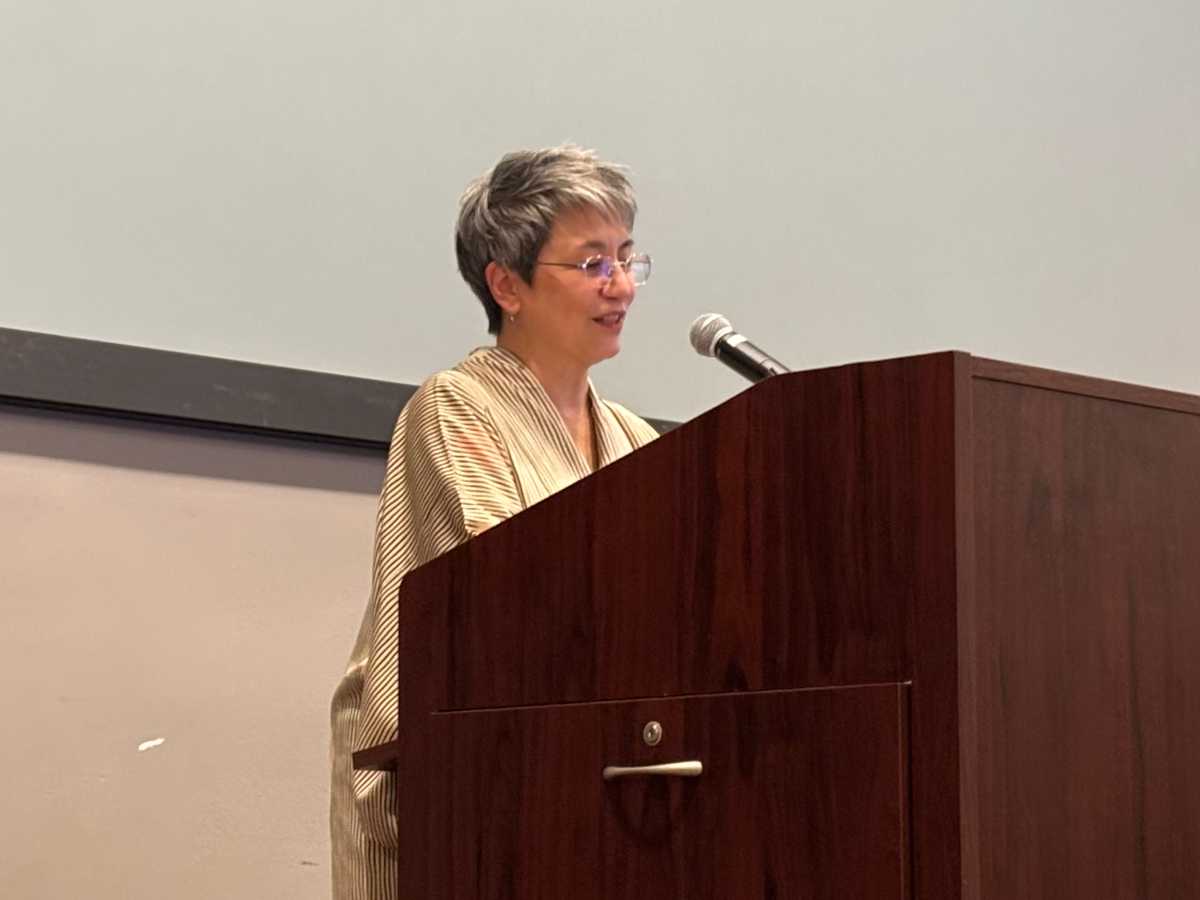
Throughout the poetry reading, Sze and Hahn shared thoughts and reflections about literary translation — the technique of interpreting works of art from one language to another, often without translating it word-for-word.
“Translation is a deeply humanizing endeavor,” Sze said. “It makes the ancient contemporary; the foreign accessible; and the emotional, intellectual and spiritual music of the human universal.”
Because many languages use different alphabets and characters — Chinese uses Hanzi and Japanese uses Kanji — there is often no direct translation between those languages and others that utilize different characters. Syllables may differ from word-to-word once translated, as well, which bears impact on poems that follow very particular forms and structures.
For example, Sze explained, the Navajo language is built around the verb “to-go” and the English language is built around the verb “to-be,” which results in drastically different translations. When translating a visual poem in particular, he continued, it can be challenging for translators to describe a concept conveyed by either language in the same amount of words, meaning it can be difficult to maintain its structure without word-for-word equivalents.
As a result, there are several meanings readers can interpret from poetry written in different languages, resulting in endless opportunities to construe these written works and pull different meanings out of each word or character. Sze said his “signature project” is assembling a book that can be used in classrooms specifically to teach this concept.
“Rather than present a poem in Chinese to one translation in English,” Sze explained, “I open by presenting three different translations of the same poem from Chinese and talk about how each translator found something of value to carry over to English. I see it very much as a hands-on guide.”
Hahn, a granddaughter of immigrants, said literary translation is an essential and forward-looking art. While she herself is not bilingual or a translator, learning about the art of translating poems is a concept she revisits often. “Translation is transformative for the individual and for the culture,” Hahn explained.
In particular, Hahn said she loved that Sze’s poetry “talks back,” or appears to have a conversation through his literary translations in a way that honors the original and creates something new. “There’s looking back, acknowledging and quoting,” Hahn said of Sze’s work. “But then there’s a real, forward motion. I love that.”
She added Sze was a dear friend of hers and commended the extraordinary measure of his craft and ability to express emotions, ideas and integrity.
Sze has published 12 poetry collections since 1972, winning numerous awards including the National Book Award for Poetry, awarded by the National Book Foundation in 2019, and becoming a Pulitzer Prize finalist, awarded by Columbia University in 2015. The poet was also a recipient of two lifetime achievement awards — the 2022 Ruth Lilly Poetry Prize for Lifetime Achievement from the Poetry Foundation in 2022 and the 2025 Bollingen Prize for American Poetry for Lifetime Achievement from Yale University.
In addition to his accolades, Sze served as a teacher, administrator and organizer at the Institute of American Indian Arts in New Mexico, and he is now a professor emeritus.
Hahn said what gives Sze’s accolades more meaning is that Sze’s work “speaks for itself.” His extraordinary breadth of experimentation and kindness, she explained, allows audiences to pause and appreciate current events, history and personal joy.
“Could I have known decades ago that we would find ourselves here?” Hahn pondered. “Not really — and absolutely yes.”
As for Sze, literary translation will always remain a relevant art that will serve as a bridge between cultures and foster human connection.
“Language is always evolving,” Sze said. “Speech patterns, syntax, vocabulary — it’s always shifting. Translations are, by nature, ephemeral, and they play a vital role in bringing us together.”