
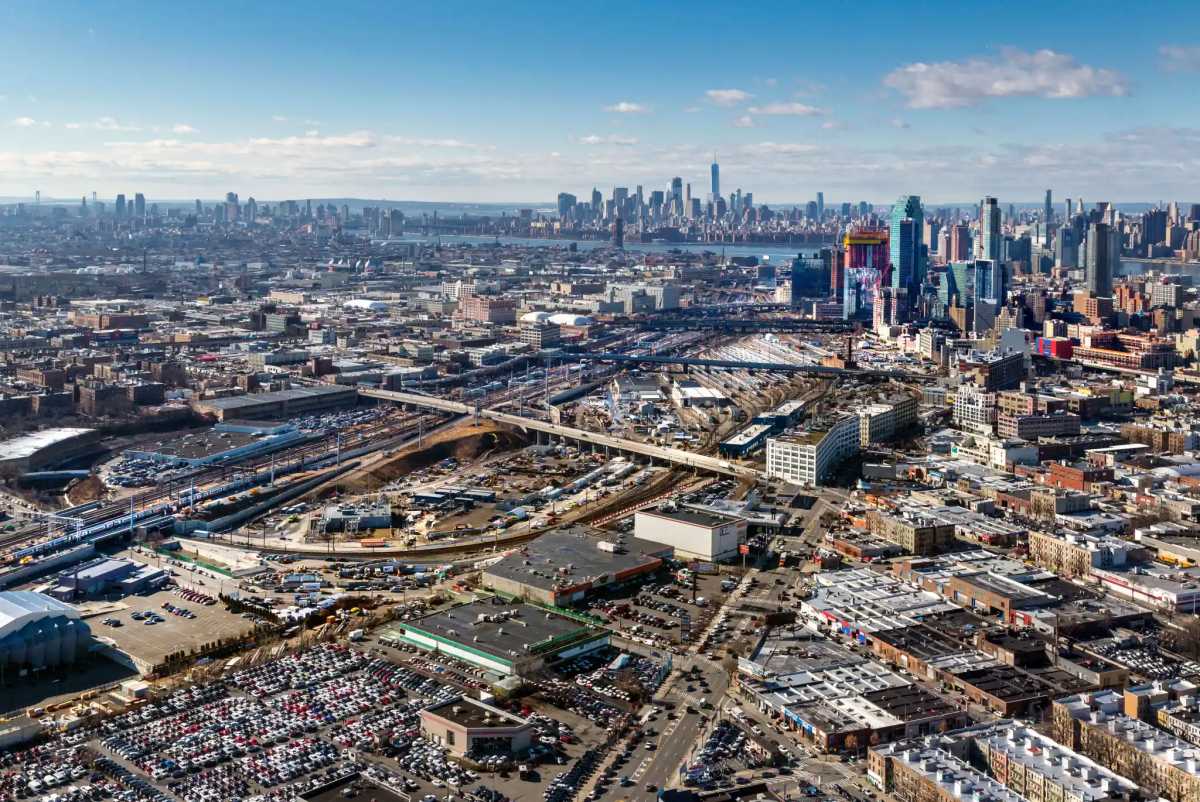
Mayor Zohran Mamdani last week revived plans for the long-stalled development of Sunnyside Yards, prompting a mixed response to a project that once invited sharp public criticism.
Mamdani made the surprise announcement on Feb. 27, less than 24 hours after making an unannounced trip to Washington to meet President Donald Trump, where he proposed a partnership with the Trump Administration on a roughly $21 billion plan to deck over the railyard and build 12,000 new homes — half of them under the Mitchell-Lama program — alongside parks, child care center and other infrastructure.
But while many local figures expressed hope that the project would deliver truly affordable housing and address the city’s housing crisis, several elected officials and opponents to the original plan raised concerns about the influence of the Trump Administration and the impact the project would have on infrastructure.
Original Sunnyside Yards plan draws fierce local pushback
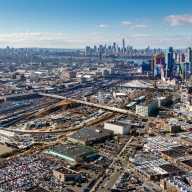
Prior to the COVID-19 pandemic, New York City’s Economic Development Corporation (EDC) and Amtrak had proposed the Sunnyside Yards development, calling for a 115-acre deck across Sunnyside Yards and 12,000 homes.
The project, unveiled in the aftermath of the failed Amazon HQ2 bid, met fierce local pushback, with elected officials raising concerns that Sunnyside Yards would displace many long-term residents and lead to the gentrification of the surrounding area.
But Mamdani’s revived plan has been met with cautious optimism, even from elected officials who raised concerns about it seven years ago, including U.S. Rep. Alexandria Ocasio-Cortez, who resigned from the Sunnyside Yards steering committee in January 2020 over concerns that the EDC was not listening to the concerns of her constituents.
Ocasio-Cortez no longer represents the area covered by the development following a the redistricting of NY-14 in 2023, but she said the level of investment proposed would be “transformational” for the area.
Her press secretary, Karla Santillan, said AOC supports the plan if it can expand the city’s affordable housing supply and address the cost-of-living crisis.
“The Congresswoman looks forward to working with the mayor to expand the supply of affordable housing in New York and lower rents across the city,” Santillan said in a statement.
Mamdani is resurrecting a ‘failed housing project’: Won
However, Council Member Julie Won, whose council district covers the development area, criticized Mamdani for “re-proposing a failed housing project in my district.”
Won, a candidate to succeed U.S. Rep. Nydia Velázquez in NY-7, noted that Ocasio-Cortez, State Sen. Michael Gianaris and her predecessor, former Council Member Jimmy Van Bramer, helped end a prior version of the plan, and said there are currently “no public approvals in place for this project.”
“City Hall should commit to a ULURP process with the Council and the community for such a significant change for a project of this scale,” Won said.
While she said she welcomes “the opportunity to build more deeply affordable housing and other federal investments,” she added that “it cannot be done behind closed doors unilaterally.”
She added that any proposal to develop Sunnyside Yards “must begin with the neighbors who live here” and said City Hall cannot advance the project unilaterally.
Brooklyn Borough President Antonio Reynoso and Assembly Member Claire Valdez, Won’s fellow candidates in the race to succeed Velázquez, also weighed in on the development.
Valdez, who represents the 37th Assembly District, similarly called for community input in the project but said the development represents an opportunity to “build a significant number of affordable homes.”
“There’s no question that meeting the scale of the housing crisis will require federal investment, and Sunnyside Yards is an opportunity to not only build a significant number of affordable homes, but also to deliver major mass transit improvements and create much-needed new public space,” Valdez said in a statement.
Concern over Trump involvement
Reynoso, on the other hand, expressed concerns over Trump’s involvement in the project, noting that the President has pulled federal funding for other projects in New York, such as the Gateway Tunnel Project and the Second Avenue Subway.
“If he wakes up one day and he doesn’t want to do it anymore, we’ll be left with a half-built project. So we just got to be careful about who’s at the top making these decisions,” Reynoso told reporters last Sunday.
Several other elected officials and prominent community figures said the plan would represent a major step toward addressing the city’s housing crisis.
Assembly Member Steven Raga, who is running to succeed Gianaris in the 12th Senate District, said the project has the power to create affordable housing and good union jobs, but only if the city “gets it right.”
“I applaud the Mayor for advancing innovative thinking around how we confront the housing crisis at the scale this moment demands,” Raga said in a statement. “At a time of deep housing insecurity, we need serious proposals that meet the scale of the housing crisis, but it has to be done responsibly and in a way that delivers for working families.”
Raga added that any plan for Sunnyside Yards should be judged on whether it creates truly affordable homes and includes meaningful community engagement.
“If done right, Sunnyside Yards could be a transformative investment for Western Queens and a meaningful step toward addressing New York City’s housing crisis.”
Aber Kawas, who is also running to succeed Gianaris, said the project provides an opportunity to build social housing that provides affordable homes for working-class communities. She added that any plan should include new green spaces, public schools, transit options and community land trusts, as well as including significant community engagement.
“We have a housing crisis in New York City that urgently needs to be addressed, and New Yorkers are sick and tired of luxury developers coming in, buying up our city blocks, and pricing us out of our homes,” Kawas said.
‘A big swing at a time when we need big swings’
Community Board 2 Chair Anatole Ashraf said much has changed since the city shelved the plans for Sunnyside Yards six years ago, noting that there was a high degree of suspicion in the wake of the failed Amazon HQ2 bid.
The revived project, Ashraf said, comes shortly after the city approved the OneLIC Neighborhood Plan, a massive rezoning which would bring up to 14,400 new homes to Long Island City. He believes “opinions have shifted” in the wake of OneLIC, adding that more residents believe that the city needs to be build more housing in order to address the housing crisis.
“Any development has to center the community and be from the ground up,” Ashraf said. “But those 6,000 Mitchell-Lama-style housing units, that’s a compelling tool.”
Ashraf conceded that the addition of over 26,000 housing units to the local area, including 14,000 through OneLIC and 12,000 through Sunnyside Yards, would place a massive strain on existing infrastructure but said the development would take place gradually, allowing for infrastructure to catch up.
He further described efforts to revive Sunnyside Yards as Mamdani “taking a big swing at a time when we need big swings to solve the housing crisis.”
However, Mitch Waxman, a local historian who opposed original plans for Sunnyside Yards, believes that the area does not have the infrastructure to match the development, especially with the addition of 14,400 new homes through OneLIC.
Waxman, who has since swapped New York City for Pittsburgh, said he left the city due to declining infrastructure and amenities in the neighborhood and said the proposed Sunnyside Yards developments would drive more locals out of the area.
He also doubts whether Trump will follow through on promises to provide federal funding for the project and the 6,000 Mitchell-Lama units.
“Does that sound like the kind of thing that Donald Trump would do?” Waxman said.
Waxman believes that the city is using Queens to solve a housing problem that exists in Manhattan, adding that the area does not have the capacity for 26,000 homes.
“They’re trying to cram 20 pounds of s*** into a 10-pound box,” he said.
Sunnyside Yards will only succeed if the city commits to drastically increasing the number of school seats, hospitals, parks, fire houses and police desks to match the development, Waxman said. He also believes that the MTA will need to greatly increase capacity along the 7 line, which is already one of the busiest subway lines in the city and frequently operates at near-capacity.
Meanwhile, long-time civic activist Pat Dorfman, who also opposed the original project, called on Mamdani and Trump to spread the development across the city rather than attempting a feat of “world-class engineering” to build the deck.
Dorfman and Waxman also questioned whether $21 billion would be sufficient to cover the cost of the project.
Dorfman, however, did praise Mamdani for attempting to help “New Yorkers of low and middle-income find a place to live.”
She added that Mamdani had shown “prescience” by courting Trump to help fund the project but expressed skepticism that the development could be completed without getting “big real estate” on board.
But Long Island City Partnership (LICP) President Laura Rothrock believes that there has been a shift in “general thinking” about the development of major housing projects.
“I think realities have changed,” Rothrock said. “We really need more development of housing in order to make the city affordable overall, and there are very few places where we can build more housing in the city.”
Rothrock similarly agreed that the city would need to greatly expand infrastructure to match the massive influx of new residents created by OneLIC and Sunnyside Yards. However, she noted that the planning stages for OneLIC included significant opportunities for public engagement, which could offer a blueprint for how the planning of Sunnyside Yards.
“This could be an opportunity,” Rothrock said. “But it has to come with infrastructure to support that housing.”
Rothrock also believes that the development could have an enormous impact on local businesses by greatly increasing foot traffic in the area, particularly on the eastern side of the yards around Northern Boulevard, which she described as “desolate” and disconnected at present.
“By building over Sunnyside Yards, it would provide connectivity in the neighborhood.”