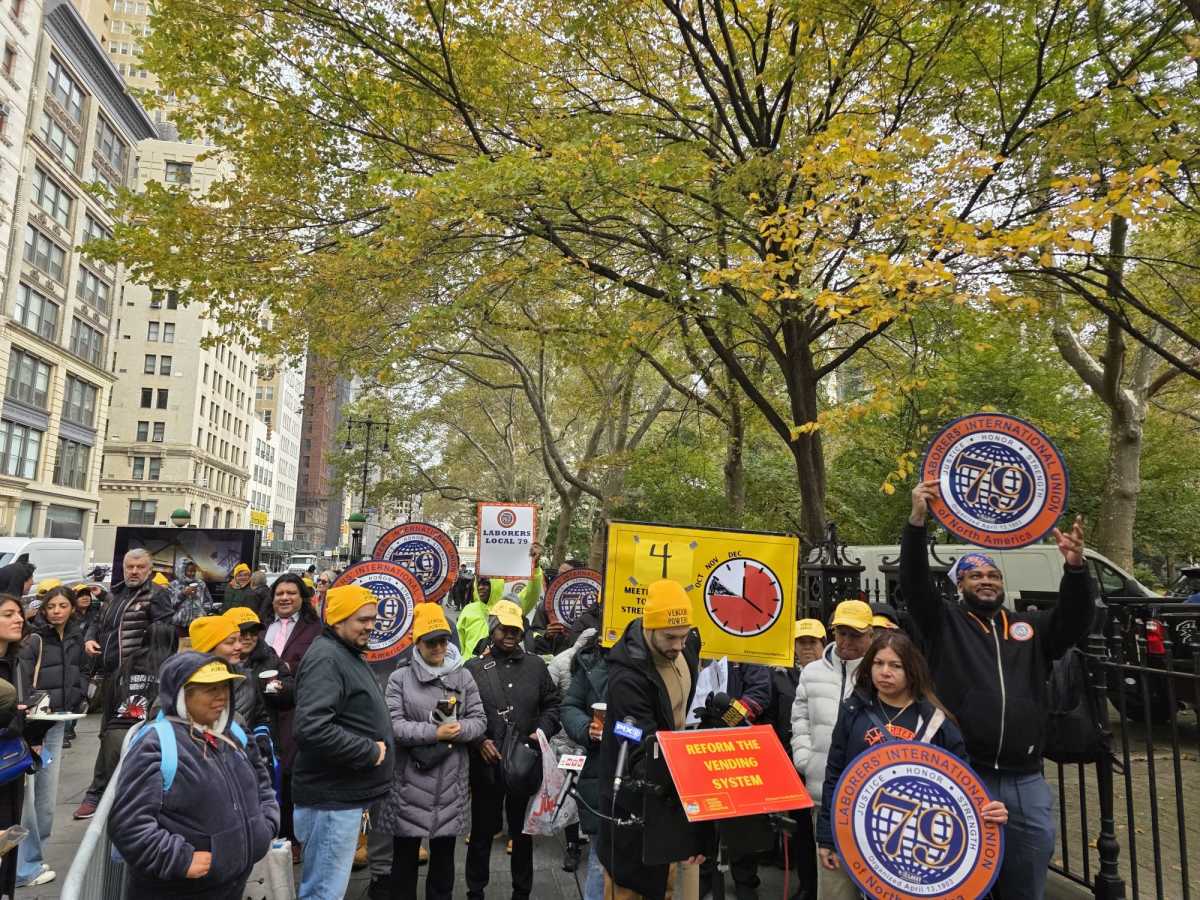

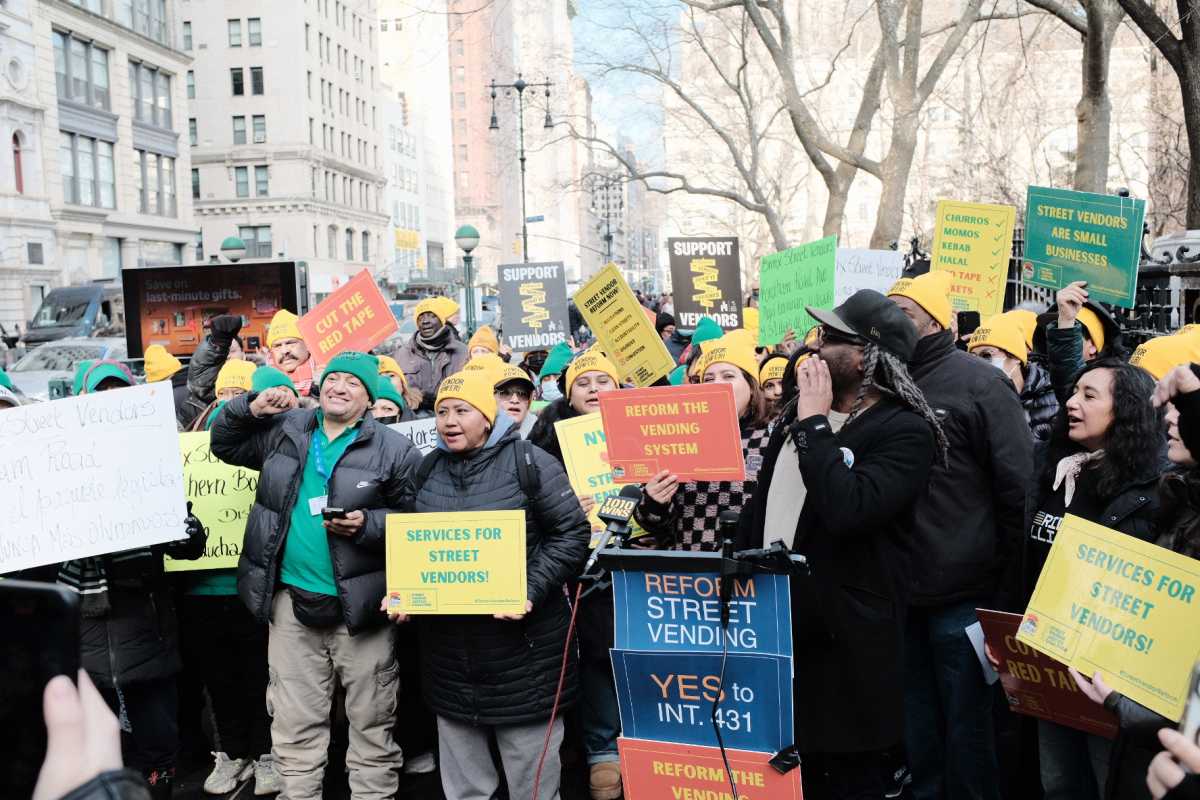
The Street Vendor Project, an organization advocating on behalf of vendors throughout New York City, has criticized former Mayor Eric Adams for vetoing 19 Council-approved bills on his final day in office, including legislation that would lift the cap on the number of street vending licenses available in the city.
Adams, who issued the 11th-hour vetoes just hours before he left office on New Year’s Eve, said the 19 bills ran “directly counter to [his] North Star of lifting up working-class New Yorkers,” stating that a series of bills known as the Street Vendor Reform Package would “undermine” small businesses in the city with a “new licensing regime for street vendors.”
The reform package includes Intro 431-B, which makes an additional 21,000 vending licenses available over the next five years, and Intro 408-A, which calls for the creation of a Division of Street Vendor Assistance within the Department of Small Business Services. The package also included Intro 1251-A, which aims to combat administrative delays in the licensing process.
Adams’ last-minute vetoes draw criticism
Adams vetoed the three bills on Wednesday, along with 16 other Council-approved bills, including legislation that would prohibit federal immigration authorities from keeping an office at Rikers Island and a bill aimed at protecting ride-share drivers from unjust deactivations from their app.
The former mayor said he had worked in “good faith” with the Council throughout his term in office but accused the Council of approving what he described as “reckless legislation.”
“My team has worked diligently and in good faith to find common ground with the City Council on our shared priorities, but the Council, once again, proved unwilling to temper its reckless legislation,” Adams said in a statement before departing office.
The Street Vendor Project, which had consistently advocated for the Street Vendor Reform Package, strongly criticized the former Mayor over the move, describing the vetoes as “anti-working-class.”
“Street vending reform is not just about permits – it’s about economic justice, community vitality and whether our city makes room for working-class entrepreneurs to succeed,” Street Vendor Project said in a statement.
The Council passed almost all of the 19 pieces of vetoed legislation with a veto-proof majority last month, including the three bills that make up the Street Vendor Reform Package. The incoming Council is set to meet for the first time in early January and will have 30 days to overturn the vetoes.
Incoming Council Speaker Julie Menin, a co-sponsor of all three vendor reform bills, also criticized Adams over the move and has stated that she will “consider next steps” about how to respond to the vetoes. She also accused Adams of “sidelining the legislative process” rather than working collaboratively with the Council throughout his time in office.
“For years, agencies failed to provide basic data, commissioners skipped hearings and meaningful negotiations were pushed to the last minute,” Menin said in a statement. “The Council will consider next steps on these vetoes to uphold our legislative priorities that focus on a wide range of topics.”
Outgoing Speaker calls on Council to defend vetoed legislation
Outgoing Council Speaker Adrienne Adams similarly criticized the former Mayor over the vetoes and called on the incoming Council to defend the legislation when it meets for the first time. Adams accused the former Mayor of putting special interests over opportunity for working-class New Yorkers.
“It is unsurprising that this mayor is ending his term by demonstrating, once again, that protecting and supporting working-class New Yorkers is not his priority,” Council Speaker Adams said in a statement.
She said the Council’s legislation would ensure that working families would have the resources they need to remain in the city.
“The mayor’s vetoes also continue his administration’s disregard for accountability, good government and transparency that are necessary to improve public safety and ensure trust in city government,” Council Speaker Adams continued. “These bills represent sound policies that the next Council should defend, protecting the Council’s legislative and policymaking authority.”
The Street Vendor Project called on Menin and the incoming Council to override the vetoes when the Council meets later in January, describing the legislation as “long-needed.”
Why vendors want the legislation
Advocates say the legislation would help combat a significant backlog that has forced vendors to “operate in the shadows” because they cannot legally obtain a license from the city.
Vendors have repeatedly stated that it is currently impossible to obtain a permit from the city because they cannot join the lengthy and closed waitlist to secure a permit. That backlog has made it impossible for new vendors to legally start a business, advocates say, leaving small business owners at risk of fines or of having their merchandise confiscated and destroyed.
Intro 431-B, introduced by Bronx Council Member Pierina Ana Sanchez, has been significantly altered since it was first introduced in order to address concerns raised in a marathon public hearing last May. Those concerns included fears that raising the cap would lead to congested sidewalks and have a negative impact on brick-and-mortar businesses.
The amended legislation now requires the city to increase the number of enforcement personnel to ensure that licensed street vendors are operating safely. Individuals and businesses found to be committing serious or persistent violations would risk losing their license under the terms of the legislation.
The legislation was also amended to cap the number of new food licenses at 2,100 per year in order to ease the fears of brick-and-mortar businesses. Previous iterations of the bill contained no cap on new licenses.
A number of small business advocates had touted the significance of Intro 431-B prior to the Council vote last month, including Queens Economic Development Corporation Executive Director Ben Guttmann.
Guttmann told QNS on Dec. 5 that QEDC has surveyed vendors in Corona Plaza and nearby Jackson Heights, reporting that 79% have lost revenue in the last year. Of those vendors, 84% have reported a loss of over $1,000, Guttmann added, pointing to uncertainty surrounding licenses and fears over ICE raids.
He said the legislation would remove some of the uncertainty facing vendors by addressing some of their fears. Although the legislation would not alleviate fears surrounding immigration enforcement, it would address concerns surrounding local law enforcement, Guttmann said, removing some uncertainty.
“There are thousands of street vendors who call Queens home, and they are the type of entrepreneurs that make our neighborhoods the envy of the world,” Guttmann said. “They add eyes on the street, which make it a safer and more family-friendly place to be. They make some of the most delicious, amazing food, which makes our neighborhoods world-class tourist destinations. These proposed reforms are the kind of things that will help them fully realize the American dream.”
However, Queens Council Member Sandra Ung, who represents Flushing, Fresh Meadows and Murray Hill in the 20th Council District, voted against Intro 431-B over fears tied to unregulated street vending.
Ung pointed to parts of Downtown Flushing that have become “severely congested” by unlicensed street vendors, creating “hazards” for seniors and other pedestrians.
She said unlicensed vending has “continued unabated,” even with increased enforcement from the NYPD, and added that she is concerned that the legislation does not go far enough toward addressing unlicensed vending.
“I want to be very clear: I understand the rationale of Intro 431-B. That by expanding access to licenses, vendors will have an incentive to follow the rules, and that increased enforcement and higher penalties will deter illegal activity,” Ung said. “However, in my own district, we have seen that even with increased enforcement, illegal vending continues unabated. Expanding the total number of licenses does not address the fundamental issue of how to manage persistent unlicensed vending.”
Other high-profile bills Adams vetoed include those that would:
- Require co-op owners selling units to acknowledge a prospective buyer’s application within 15 days and inform the applicant of their decision within 45 days.
- Create a city land bank to acquire and manage vacant, abandoned, tax-delinquent and foreclosed properties and allow the city to sell tax liens to it.
- Prohibit rideshare services like Uber and Lyft from deactivating drivers without reason.
- Require security guards working on city buildings to be provided a minimum wage, paid vacation time and supplemental benefits that meet or exceed required compensation for private sector security guards.
- Require the NYPD to get consent from a child’s parent, legal guardian or attorney before collecting a DNA sample.
- Require the NYPD to provide the Civilian Complaint Review Board with officer body cam footage to investigate alleged police misconduct.
- Require the city to establish standards and procedures to determine conflicts of interest for city contracts over $100,000.