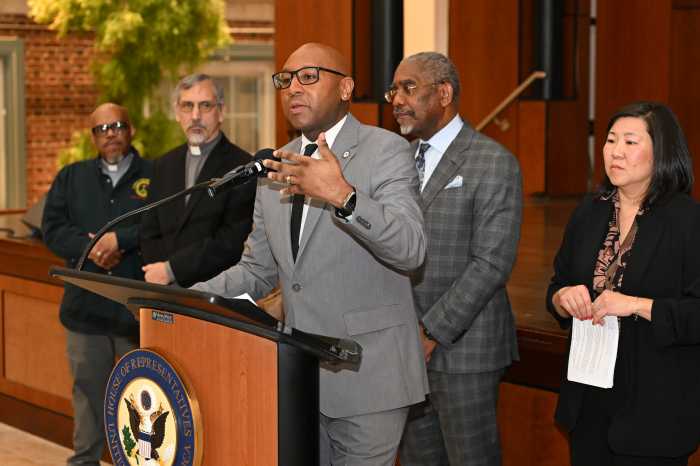


Over 100 advocates from the AAPI Equity Budget Coalition rallied in support of $54.35 million in funds for New York State’s Asian American and Pacific Islander communities, gathering in front of the New York State Capitol’s Million Dollar Staircase in Albany on Feb. 10.
Funds would be used to support critical social and health services, including 150 nonprofits, as well as community programs that promote safety in communities and combat bias and hate throughout NYS.
Queens officials joined the coalition to champion equitable funding for AAPI communities, including State Sen. John Liu and Assemblymember Grace Lee, who amplified the call to Gov. Kathy Hochul and both houses of the New York State Legislature to include the proposed funds in full in the 2027 fiscal year New York State Budget.
Other Queens assembly members who attended the rally included Sam Berger, Ed Braunstein, Ron Kim, Steven Raga, Jenifer Rajkumar and Nily Rozic.
According to a news release from Liu’s office, the AAPI Equity Budget is a holistic assessment of New York State’s AAPI community’s needs and has been included by Hochul, Senate Majority Leader Andrea Stewart-Cousins and Assembly Speaker Carl Heastie in the state budget since 2023.
The rally marks EBC’s recommitment to pushing for even greater budget parity in order to achieve true equity within AAPI communities, the news release said.
Catherine Chen, Chief Executive Officer of the Asian American Federation, said federal funding cuts and freezes have created confusion and hardship to vulnerable Asian New Yorkers, making it more difficult for residents to qualify for assistance.
She said many families are unsure if they are going to receive their SNAP benefits and are at risk of losing their healthcare coverage.
That is why, she continued, it’s essential the AAPI Equity Budget is included in this year’s state budget.
“The AAPI Equity Budget is how we make an affordability agenda truly equitable — ensuring that our nonprofits can help low-income, immigrant, limited-English-proficient, older adults and other vulnerable Asian New Yorkers navigate changes in policies and get the support they deserve,” Chen said.
Wei Qin, president and founder of Asian Arts New York, said the AAPI Equity Budget takes a comprehensive approach to supporting the rapidly growing AAPI community.
She said it funds more than 150 nonprofits providing culturally responsive, language-accessible services, while supporting mental health, addressing social inequalities and strengthening language, arts and cultural programs.
“This investment is essential to the well-being of the AAPI community, and we are proud to be part of this effort,” Qin said.
Farrah Mozawalla, the founder and CEO of Asian American Institute for Research and Engagement, echoed Qin’s urgency, stressing that Asian American communities cannot afford to be invisible in state funding decisions.
“Every day, we support families navigating language barriers, accessing mental health care, securing food and immigration assistance,” she said. “This budget represents investment in culturally responsive, linguistically accessible services that our communities rely on.”
Asian Women’s Alliance of Kinship and Equality, a recipient of the AAPI Equity Budget Community Development Fund grant, provides counseling, job training, social services referrals, interest-free loans and/or financial assistance to more than 2,000 women and children who are struggling in abusive conditions.
“I can tell you firsthand what a game changer this funding has been for our ability to change life-affirming and changing services to our South Asian victims of domestic violence,” said Bhavana Pahwa, vice president of development and media at AWAKE.
Myoungmi Kim, CEO of Korean Community Services of Metropolitan New York, said the organization sees firsthand the consequences of underinvestment in AAPI communities, which impact services such as behavioral health, social services, workforce support and civic engagement.
“As the needs of our community continue to grow, culturally and linguistically responsive organizations like KCS are being asked to do more with fewer resources,” she said. “We urge state leaders to act with urgency and fully fund the AAPI Equity Budget so our communities are not left behind.”
Sakhi for South Asian Survivors, a survivor-led organization serving South Asian and Indo-Caribbean communities for over 37 years, is also a lifeline for members of AAPI communities experiencing domestic violence.
Kavita Mehra, executive director of SAKHI, noted that the AAPI population grew nearly 38% in the last decade — which is five times faster than the overall population — with Bangladeshi and Pakistani communities among the fastest-growing in the state.
AAPI-led organizations like SAKHI, she continued, provide services that are not provided by mainstream systems that were never designed to offer communities such support.
She said the AAPI Equity Budget ensures New York’s investment finally matches these communities’ presence and contributions to the state.
“We know that safety looks different for our communities — where immigration status can be weaponized, where family is both lifeline and pressure point, and where healing must happen in our own languages and cultural contexts,” Mehra said. “We are proud to stand alongside our legislative champions Senator John Liu and Assemblymember Grace Lee and the APA Legislative Caucus in fighting for the resources our communities need and deserve.”
Liu said New York’s immigrant communities are facing unprecedented threats, and community-based organizations are on the front lines ensuring they are protected.
“In the face of growing hostility from the Trump White House, this investment is more critical than ever to ensure the Asian American community is not left behind and our support systems are able to continue meeting the growing needs of the families, workers, and small businesses who need it most,” he said.
According to Liu, the AAPI Equity Budget has filled a crucial role in ensuring New York’s historically underfunded Asian American communities have the resources needed to keep delivering services, defending civil rights and uplifting its immigrant communities.
Lee, chair of the Asian Pacific American Task Force, said AAPI communities are often overlooked and chronically underfunded. By fully investing the coalition’s proposed funds in the AAPI Equity Budget, she said the state can ensure immigrant communities are seen, heard and valued.
“This funding will deliver real, tangible support from after-school programs for at-risk youth and nutritious meals for our seniors, to lifelines for struggling small businesses and protections for our immigrant neighbors,” Lee emphasized. “New York must match its values with its budget and fully fund the AAPI Equity Budget to show that we truly stand with Asian American communities across our state.”
Rozic said last year’s historic $30 million AAPI Equity Budget made a difference in the communities it supports with resources such as mental health services, programs combating anti-Asian hate, food access initiatives and community-based organizations that serve thousands of New Yorkers.
“As we look toward the FY27 budget, it is critical that we continue investing in AAPI communities across New York State,” she said. “I proudly stand with the AAPI Equity Budget Coalition in urging continued and expanded investments to ensure AAPI New Yorkers are safe, supported, and can access the resources they need.”