
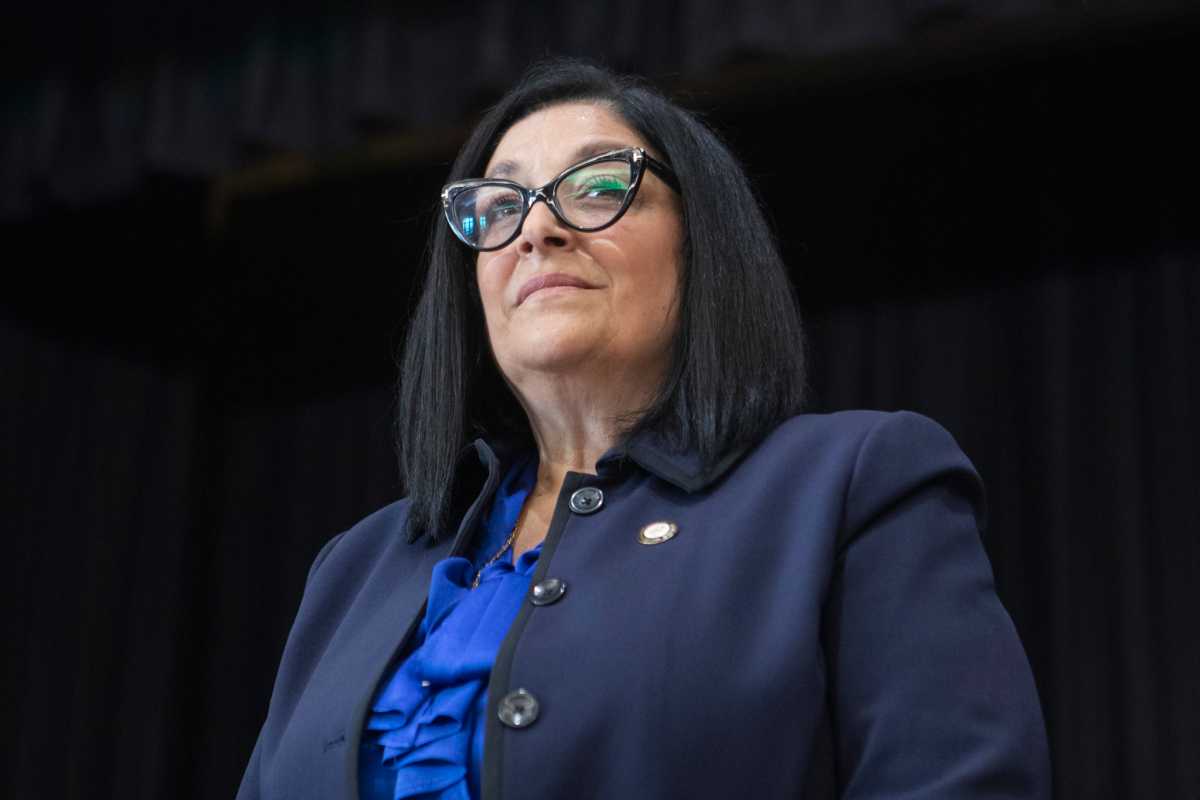
Council Member Joann Ariola and the Council’s Republican Caucus are calling on Mayor Zohran Mamdani to provide details about the decision-making process behind the revocation of two executive orders related to Israel and antisemitism issued by former Mayor Eric Adams.
On his first day in office, Mamdani issued an executive order revoking all Adams-era executive orders issued after the former Mayor was indicted on federal corruption charges, including one order that adopted the International Holocaust Remembrance Alliance (IHRA) definition of antisemitism.
That definition, which equates some anti-Israeli criticism with antisemitism, including denying Israel’s right to exist, has drawn some criticism, with critics arguing that it stifles legitimate criticism of Israel.
Mamdani also revoked an executive order barring city agencies from boycotting investment in Israel, a form of non-violent protest that the Mayor has openly supported in the past.
Mamdani, however, said he would not revoke Adams’ executive order establishing the city’s Office to Combat Antisemitism. In a separate order, Mamdani also reinstated part of another revoked Adams directive, which mandates that the NYPD create better policies to keep protesters at a distance from synagogues and other houses of worship.
The Mayor stood by his decision to revoke the two executive orders, noting on Jan. 2 that a number of Jewish organizations have “immense concerns” about the IHRA definition of antisemitism. In an unrelated press release issued earlier in January, he asserted that his administration would be “relentless in its efforts to combat hate and division,” including the “scourge of antisemitism.”
City Hall did not respond to a QNS request for comment on this story.
City Council Republicans want to review ‘drastic measure’
Still, Ariola and other Council Republicans have signed on to a FOIL request submitted by attorney Jack Lester to review the decision-making process behind the revocation of both orders.
Lester, who has represented the Council’s Common Sense Caucus in several legal battles against the city, described Mamdani’s revocation as a “drastic measure” taken inside his first hours in office, adding that the move “highlights the fears” that some members of the New York Jewish community expressed during the 2025 mayoral election.
“Why did he choose to do this as his very first act in office?” Lester said.
In revoking all Adams-era orders issued between Sept. 26, 2024, and Dec. 31, 2025, Mamdani explained that he sought to give the city a fresh start after Adams’ indictment “marked a moment when many New Yorkers decided that politics held nothing for them but more of the same.”
On Jan. 2, at a Brooklyn event, he reiterated his commitment to protecting Jewish New Yorkers from antisemitism.
“My administration will also be marked by a city government that will be relentless in its efforts to combat hate and division, and we will showcase that by fighting hate across the city,” he said. “That includes fighting the scourge of antisemitism by actually funding hate crime prevention, by celebrating our neighbors and by practicing a politics of universality.”
Lester added that Mamdani’s retention of the Office to Combat Antisemitism will not allay the fears expressed by some Jewish New Yorkers if there is “no teeth” behind the office.
“It could be window-dressing,” Lester added.
Ariola similarly asserted that the Office to Combat Antisemitism would not protect Jewish New Yorkers if it were not properly staffed or if the city relaxed its enforcement of antisemitism.
Like Lester, Ariola believes that the revocation of both executive orders “confirms the fears” of Jewish New Yorkers who expressed concerns about Mamdani during the election last year. Mamdani’s criticism of Israel, including his refusal to recognize Israel as a Jewish state, had caused concern among some Jewish communities in New York during the 2025 mayoral election. Mamdani consistently stated that he would stand up for Jewish New Yorkers throughout the mayoral campaign.
Lester, meanwhile, argued that the measures emboldened protesters at a recent anti-zionist protest outside a synagogue in Kew Gardens Hills, where some individuals were filmed shouting pro-Hamas chants in one of the most Jewish neighborhoods in the city.
“That’s an example of what could occur if there’s a relaxed enforcement to curtail antisemitism,” Lester said. “You could have widespread outbreaks of these kinds of demonstrations with no pushback from the government.”
Rabbi Mayer Waxman, executive director of the Queens Jewish Community Council, also criticized Mamdani for revoking the executive orders, arguing that individuals have “masked” antisemitism in the past through anti-zionism. Waxman pointed to a number of reported attacks on Hasidic Jews in Brooklyn, noting that the IHRA definition describes holding Jews collectively accountable for the actions of Israel as antisemitic.
“When Hasidic Jews in Brooklyn are being beaten or spit on, are we really to believe the perpetrators confirmed the Hassid’s Zionism before attacking?” Waxman said.
“For Mayor Mamdani to focus on limiting protections for Jews as one of his first actions as Mayor conveys, or at least suggests, to Jews not just that this Mayor does not have the back of Jewish citizens, but worse, that he has a target on the Jews’ backs.”
Both Lester and Ariola said the FOIL will help to “shine a light” on the decision-making process of the Mamdani Administration and help hold City Hall accountable. Both asserted that they will take matters to the Supreme Court if the FOIL reveals any unlawful acts.
Lester further asserted that he aims to challenge the Mamdani Administration in the “court of public opinion” if the FOIL fails to showcase any unlawful acts.
“Even if it’s lawful, it still should be known to the public,” he said. “There’s the court of law, but there’s also the court of public opinion to expose anything he’s doing that could be antisemitic.”
Support for Mamdani’s revocation of Adams’ orders
However, several groups, including the New York Chapter of the Council on American-Islamic Relations (CAIR-NY), welcomed Mamdani’s decision to revoke the two Adams-era executive orders.
CAIR-NY Executive Director Afaf Nasher described the executive orders as an “unconstitutional” attack on free speech, describing the IHRA definition as an “overly-broad definition” that would have limited New Yorkers’ ability to criticize Israel.
“This unconstitutional, Israel First attack on free speech should have never been issued in the first place. We applaud Mayor Mamdani for immediately overturning it,” Nasher said in a statement.
Jews for Racial and Economic Justice (JFREJ) criticized Adams for issuing the executive orders last year, arguing that the order would inflict “punitive measures” on New Yorkers speaking out against Israel.
“It does nothing to address anti-Jewish bigotry, discrimination, or hate violence. Rather, it makes Jews the face of state repression,” JFREJ member Hadas Binyamini said last year.
Lester, however, argued that over 40 nations have adopted the IHRA definition of antisemitism, including the United States and most EU nations. Efforts to codify the definition are ongoing in the United States.
“What he’s done is an attack on the Jewish community, the largest Jewish community outside of Israel in the entire world.”