
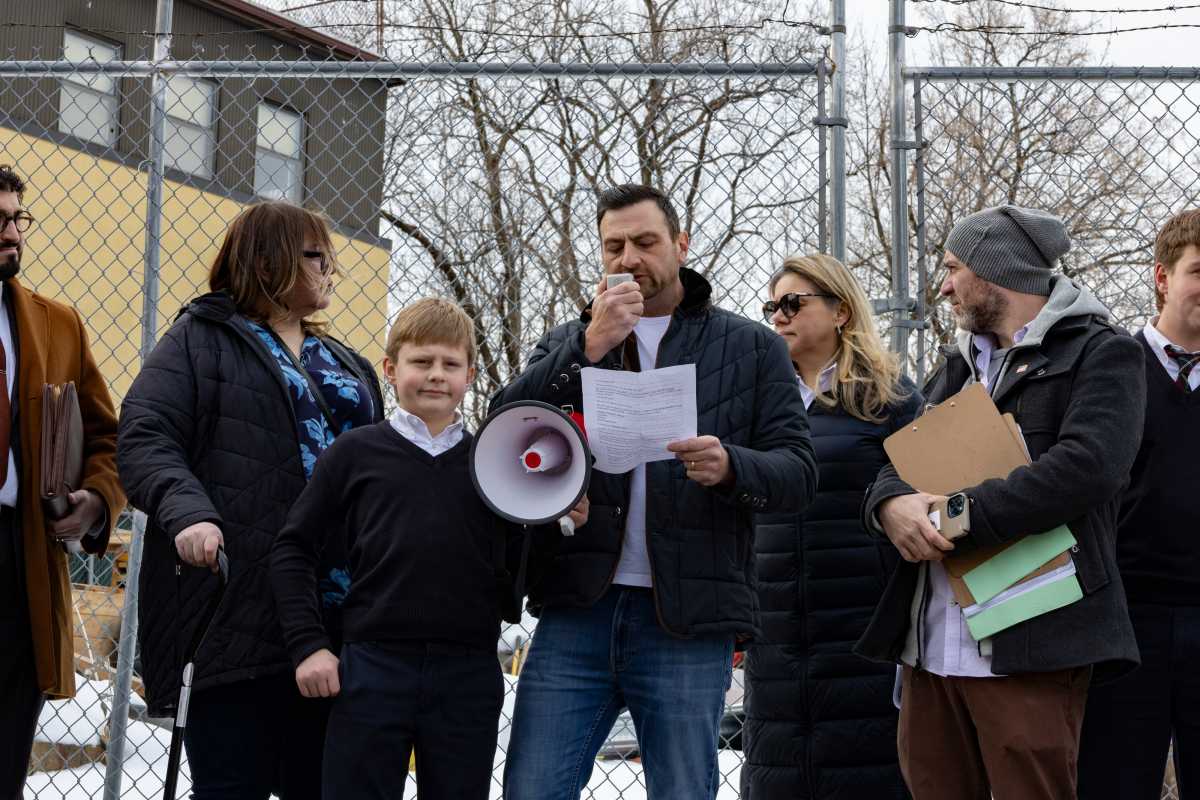
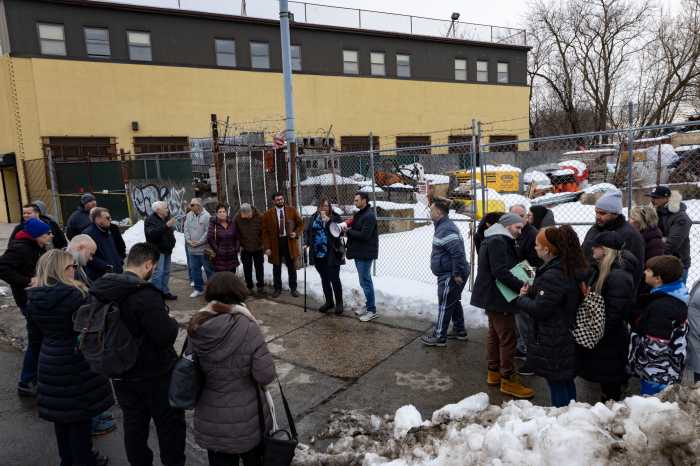
The Middle Village Residents Association (MVRA) gathered across the street from PS/IS 128 in Middle Village to protest the battery energy storage system (BESS) that NineDot Energy is in the process of installing in the vacant lot.
MVRA President Paul Pogozelski publicly called for a representative of NineDot to attend a community group meeting to answer questions and address safety concerns that he, local Council Member Phil Wong, state Sen. Joseph P. Addabbo Jr. and other Queens leaders have raised about such facilities being built next to schools and in residential areas.
“They can provide a full public presentation and answer questions, not pre-screened, but from both leadership and residents,” Pogozelski said. “Because our community deserves real answers… Until the community receives clear, documented, enforceable guarantees, our message is simple: not here, not like this.“
NineDot has confirmed a representative would not attend an upcoming MVRA meeting, but will continue to hold smaller ones with interested parties and answer questions submitted on their website.
“All it takes is one incident to burn down this whole neighborhood,” said Wong. “We have seen the fires. FDNY cannot even put them out. They just let them burn.”
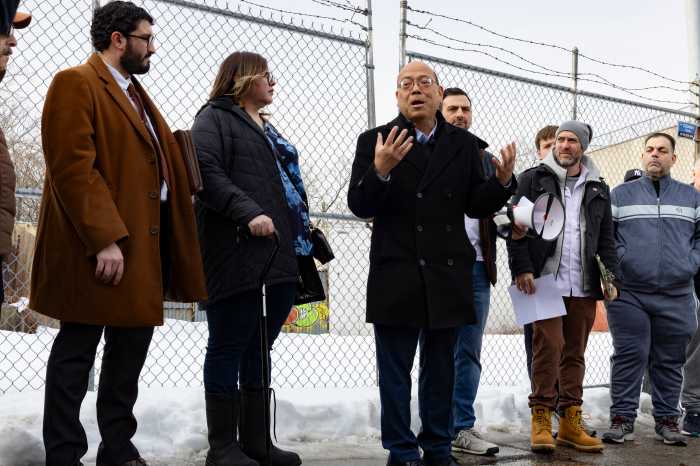
Wong is actively seeking a non-residential site as a replacement and is in talks with a private resident to purchase the lot from NineDot, but did not meet with FDNY to discuss the safety code before releasing a joint statement with other Queens politicians and community leaders demanding BESS not be placed across from the school.
“I’m disgusted because why did we have one rally last year, then it went dead, then suddenly we’re here again,” said Connie Altamirano, a local Queens community leader and special education advocate. “When you want to protect our children, it doesn’t take one rally. You’ve got to be on top of people, you should have done more rallies, you have to call the offices of elected officials and have to demand a meeting. And this falls on everyone.”
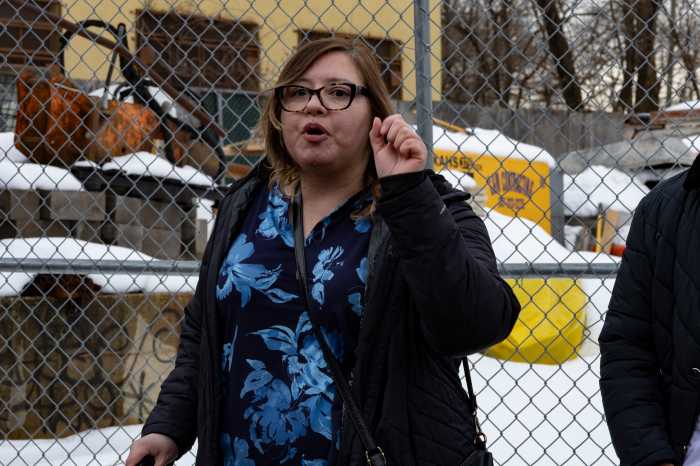
Two parents with children who attend PS/IS 128 were present at the protest, though one teacher crossed the street to ask Pogozelski and Altamirano on how best to inform other parents of future events. Several other attendees questioned if a protest should be held at NineDot’s headquarters in the future.
ineDot is located in the NYU Urban Future Lab in Brooklyn, a space designed as a “climate incubator” for start-ups, which the founders chose during the COVID-19 pandemic.
“We squished into this co-working space, now there are 80 people because it’s kind of the ethos of where we are, and we’re sort of embedded in the community, but we are not a large utility,” said a NineDot spokesperson. “We are not, you know, a big traditional fossil fuel plant. We are a group of people who actually really reflect the city that we operate in.”
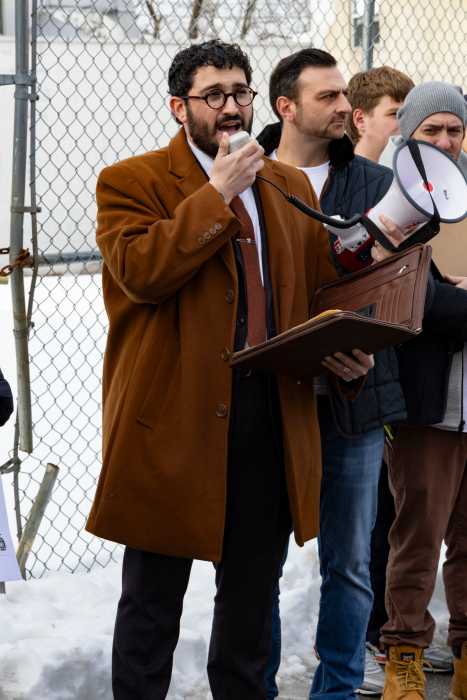
“Residents deserve a meaningful input before major infrastructure is placed in their immediate environment. We can support clean energy goals and still insist on prudent planning,” said Raimondo Graziano, chief of staff to Addabbo. “We can respect regulatory approvals and still say that placement across from an elementary school is not appropriate.”
Addabbo sponsored a bill that would require all BESS to be placed 300 feet away from residents, which protest attendees supported. According to several experts, the rule disqualifies 90% of available sites in the City. Con Edison estimates 4,000 will need to be built all across the City, including residential areas, to be able to meet their energy needs due to rising demand and Climate Act requirements.
Safety expert speaks out
No matter what NYC’s energy needs are, the concerns parents have for their children’s safety is real and over 100 have already signed a petition NineDot’s BESS, which states it poses a “severe fire risk.” QNS asked retired FDNY Hazardous Materials Lt. Paul Rogers, who tested and helped write the NYC fire safety codes for lithium-ion battery facilities, to answer the questions Pogozelski, Wong and Middle Village residents asked at the protest.
According to Rogers, a BESS fire has and could never burn down a neighborhood.
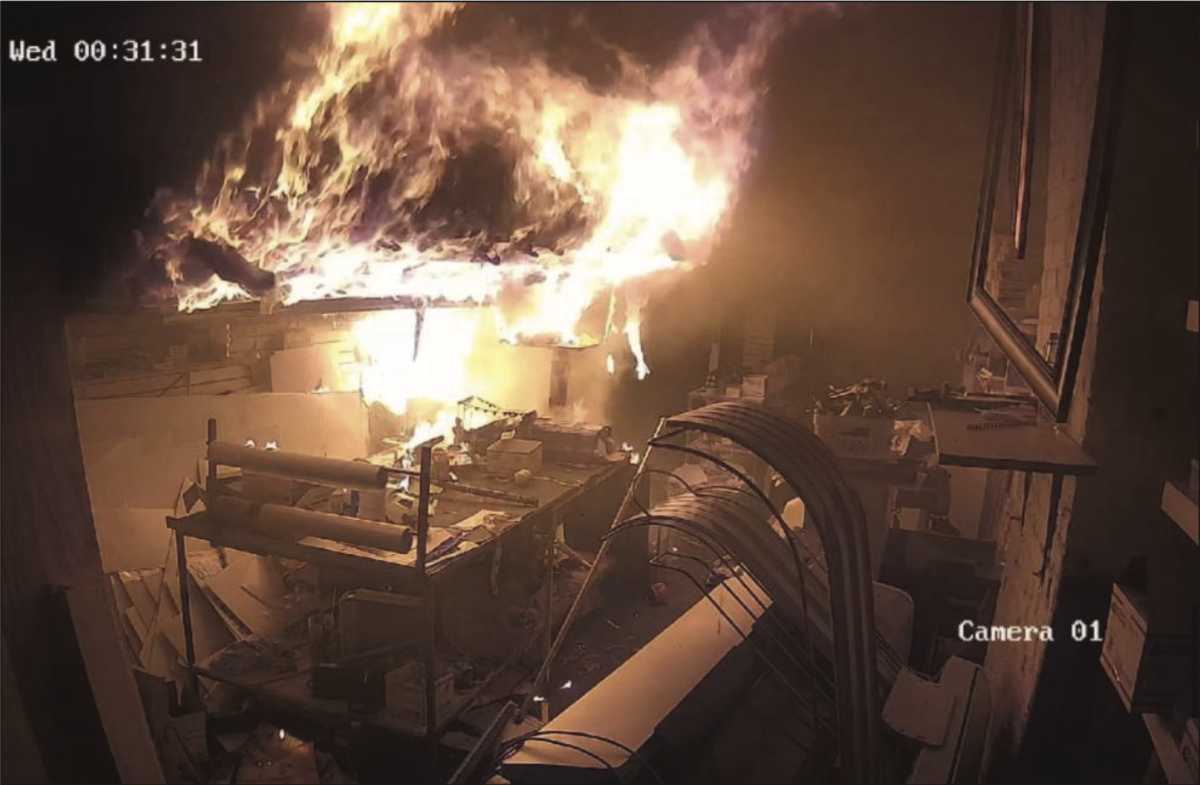
The compartments the batteries are housed in, which look like shipping containers, are designed to contain any fire, including a worst-case scenario in which all batteries ignite. About 10 years ago, while the BESS industry was burgeoning, Rogers and the FDNY were tasked to test their safety over a period of five years.
FDNY started by testing individual cells and extrapolating the data for the entire container, which Rogers stated was “inconsistent.” At Rogers’ request, an entire container was intentionally set on fire to ensure it would not spread. The practice has become the standard to test any changes to the distance between batteries or containers, which currently mandates 3 feet of space to ensure heat doesn’t transfer.
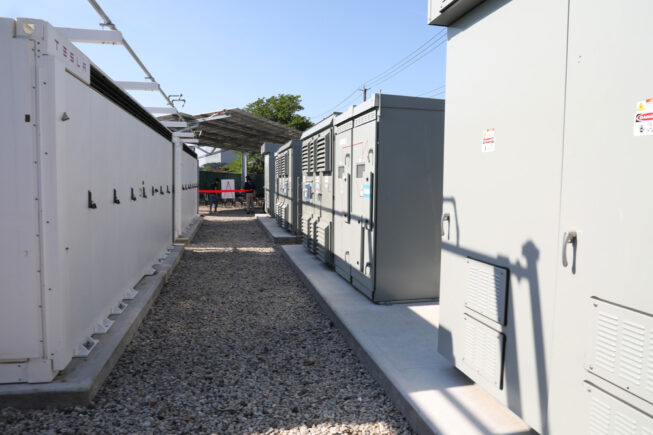
According to Rogers, a BESS fire, even the largest seen at the Moss Landing facility in California, has never left “the perimeter of the installation.”
“They looked at us like we were crazy… and said, ‘We’re not doing that, it‘s a fortune to do that.’ And [FDNY] told them, ‘Then you’re not doing work in New York City,'” Rogers said. “These are the lengths that we went through to try to make sure it was safe. Because we understood the need, which was big, and then we understood the ‘built-in’ environment in New York City… And I would say the risk associated with it, or the potential of a fire, are extremely low. You can never eliminate it, but I would say it’s extremely, extremely low.”
‘There’s nothing exotic that we haven’t seen in every fire’
During the individual cell tests, FDNY used air quality monitors, called gas chromatograph-mass spectrometers (GC-MS), that identify a gas’s composition by breaking it down into individual particles. Data showed “there’s nothing exotic that we haven’t seen in every fire,” according to Rogers.
The energy stored in a battery “needs to go somewhere,” and will simply reignite if first responders douse the flames, which is why a BESS fire lasts so long. FDNY equipment only allows for 35-40 minutes of clean breathing when in close proximity to smoke, so the NYC code mandates the perimeter be cleared and nearby residents stay inside to avoid exposure.
An expert in hazardous materials, Rogers was on the scene of the BESS fire in Warwick, NY, last December and wore no personal protective equipment (PPE), such as a gas mask, and observed the site from outside the fence for several hours in just his street clothes.
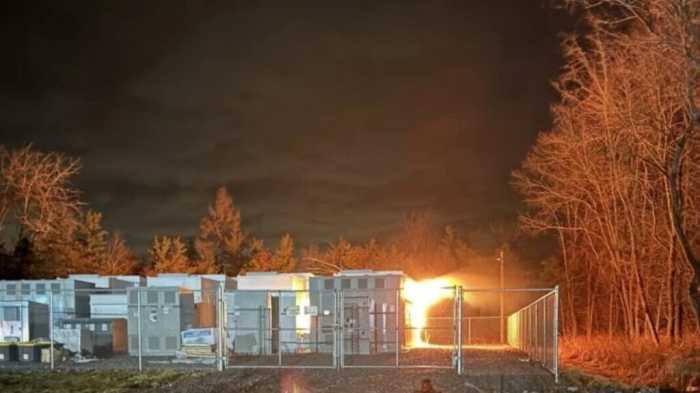
“All smoke is toxic. The gas that comes out the back of your car, it’s toxic, right?” Rogers said. “So of course you’re going to have [toxic gas] in a fire. Smoke will travel, but as it leaves the point of origin, it will start to reduce in its concentration, which will reduce in the doses that are in the hazardous in association with people.”
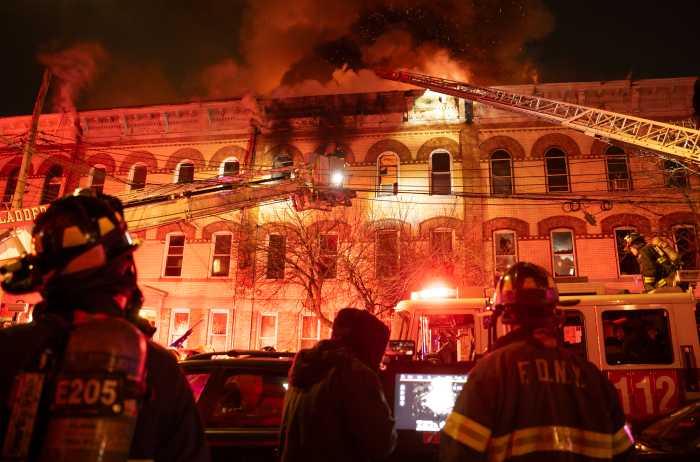
A report by American Clean Power found that of the BESS fires studied, including two of the three total that have occurred in the state, long-term environmental impacts were minimal compared to other large industrial structural fires. The chemicals used within lithium-ion batteries are not easily dissolved in water, meaning the groundwater contamination risk is low.
“Water and soil samples did not reveal hazardous contamination,” the report states, and standard storm water management systems prevented hose run-off from reaching natural bodies of water, though Rogers calls the use of water “counterproductive” due to the difficult nature of reaching an individual cell and running a hose through an electrical system.
The containers themselves are waterproof and require them to reach the National Electrical Manufacturers Association’s (NEMA) standard to prevent any rain or flood water from reaching the system. Rogers and the ERGB received a call from a local fire department about flooding nearby a BESS, which he inspected immediately and found no abnormalities. The systems themselves are monitored 24/7 by thermal imaging cameras, and checked daily for any anomalies that would warrant they be turned off and inspected on site.
“They had the presence of mind to call to make sure they stayed out of the BESS. The [BESS] itself was not affected by any of the water,” Rogers said. “Even though it didn’t hit that, they wanted to make sure there were no underground leaks that may have come up through the actual piping itself. It was a heads up play on their end.”
And to dispose of the batteries at the end of their life, about 15 years, NYS Energy Research and Development Authority (NYSERDA) requires all BESS owners maintain a fund or bond, payable to the local government, for the decommissioning process.
During his remarks, Pogozelski also questioned whether coolant, a mix of water and ethylene glycol, could ever contaminate the groundwater. Ethylene glycol is toxic to humans, but the coolant is localized inside the waterproof container.
“We’ve never had a leak from our systems, there are no hoses [for coolant] coming out of our systems and we are fully compliant with all DEP, EPA and other safety rules for our systems,” said a NineDot spokesperson.
Risky BESS-ness
In a city with electric transformers hanging above our heads, explosive and toxic natural gas cooking our food and a lithium-ion battery in every pocket, Rogers questioned why BESS receive such backlash.
To the retired firefighter, the greater risk lies with New Yorkers taking their energy needs into their own hands. In 2016, FDNY discussed the potential of private residences building their own, smaller BESS to save on the rising cost of electricity.
“And if they made their own, they weren’t going to be listed. They weren’t going to have the performance test. They weren’t going to have the battery management system. They were going to take old car batteries and use them as a battery energy storage system,” Rogers said. “And they’re not going to be compliant to the code, installed according to the code or have the oversight according to the code.”
Rogers lamented the time a man in Tennessee showed him one such jerry-rigged BESS, made out of car batteries, during his travels as a leading BESS industry safety consultant. A fire with one illegal BESS could prove harmful to the industry, which he called an unfair comparison because:
“During my time with the fire service, I’ve never seen anything that had more regulatory safety parameters built inside of it.”