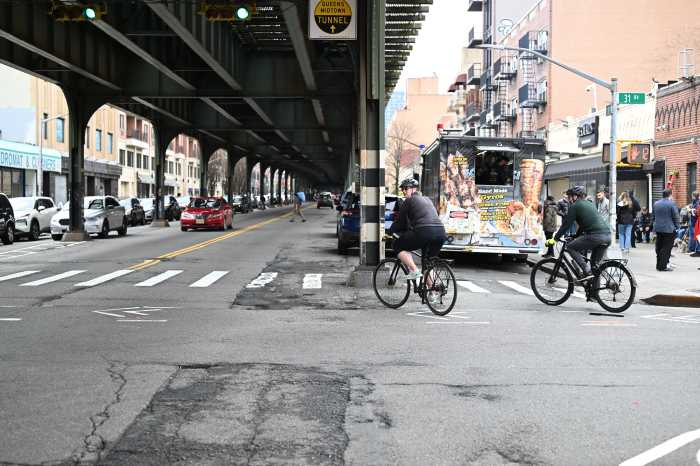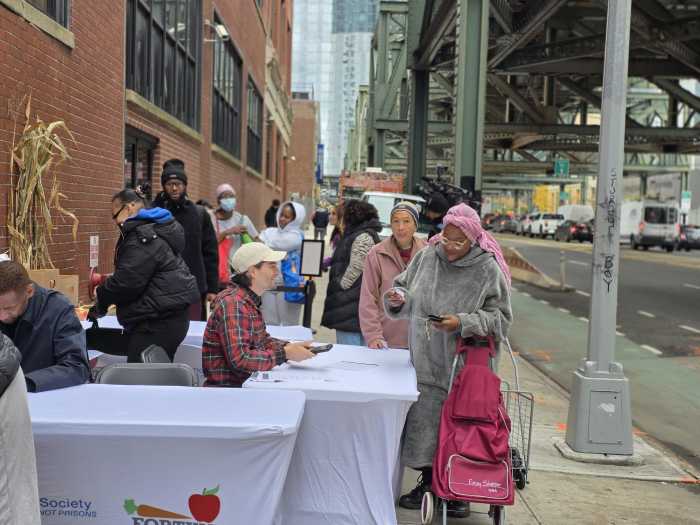

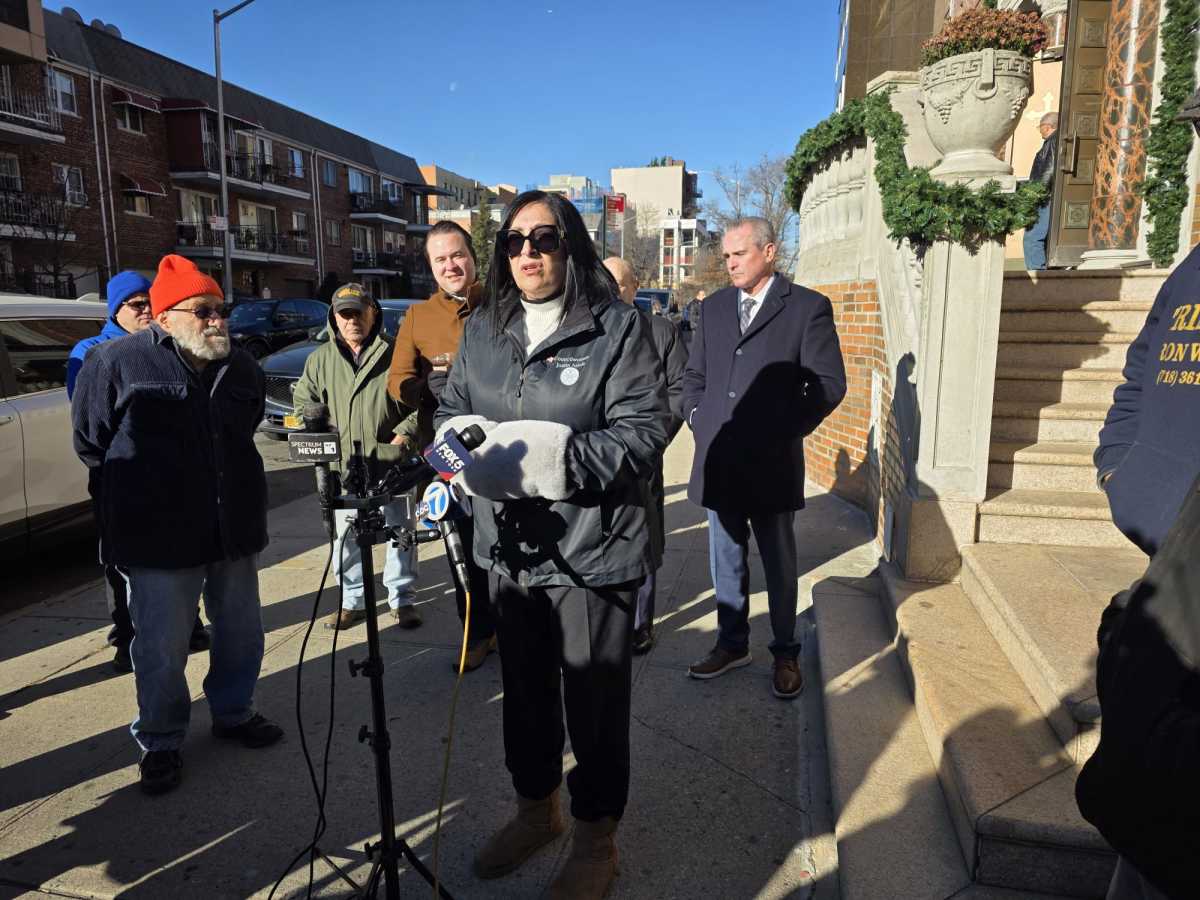
A coalition of Astoria residents and business owners gathered outside the St. Demetrios Greek-American School Tuesday morning to celebrate a court ruling ordering the Department of Transportation to halt plans for a protected bike lane along 31st Street.
Queens Supreme Court Justice Chereé Buggs issued the ruling on Dec. 5, siding with a number of local businesses and residents who argued that the mile-long bike lane would prevent emergency services from operating at “full capacity” on 31st Street. Others had raised concerns that the infrastructure would negatively impact local businesses and create safety hazards for students at St. Demetrios Greek-American School, located at 30-03 30th Dr.
The 31st Street Business Association, which joined the lawsuit against the DOT, held a press conference outside the school Dec. 9 to celebrate the ruling as a “victory for the residents and businesses of Astoria.” Association President Joseph Mirabella also described the ruling as a “victory for commonsense.”
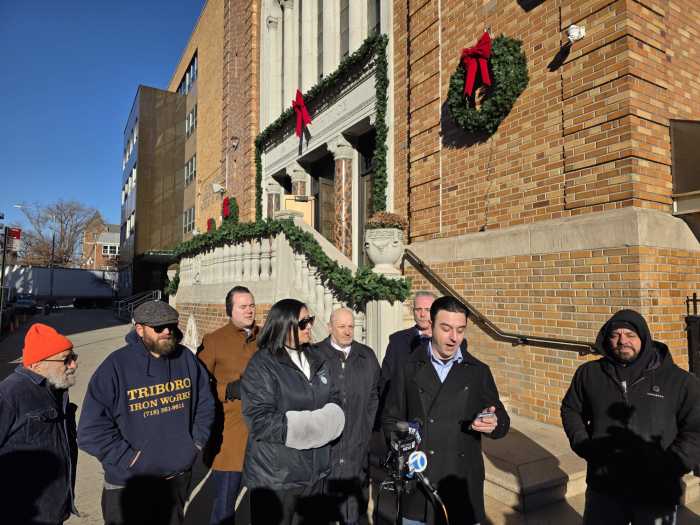
Council Member Joann Ariola, minority leader of the NYC Council Republican Delegation and chair of the Council Committee on Fire and Emergency Management, also joined Tuesday’s event to celebrate a victory for the rule of law.
Ariola stated that the DOT’s attempts to install a protected bike lane across a mile-long stretch of 31st Street between Newtown Avenue and 36th Avenue did not adhere to Local Law 6, which mandates that the DOT must consult with local firehouses before implementing street design changes.
A number of elected officials and public transit advocates criticized the ruling, however, pointing to DOT data naming the stretch as one of the most dangerous corridors in Queens. Council Member Tiffany Cabán, who represents the area covered by the proposed bike lane, said the ruling would threaten road safety in the neighborhood.
The DOT stated that it is reviewing the decision and evaluating its next steps.
In her ruling, Buggs cited concerns raised by the FDNY after the Fire Department informed the DOT in July that the street redesign would not permit it to operate at “full capacity.” The Fire Department further warned that the implementation of the redesign would “negatively impact FDNY emergency response and fireground operations, delaying Fire Department personnel and their resources for fire suppression.”
The DOT had insisted that emergency vehicles would be able to make use of an eight-foot bike lane and a three-foot buffer to reach the curb and respond to emergencies. Buggs said the DOT had provided no “concrete rebuttal” to the FDNY’s concerns.
Ariola said Tuesday that Local Law 6 had helped protect local residents and ensure that emergency services could do their jobs.
“The DOT did not comply with the law as written, which meant that had to go to local firehouses and do outreach and get input from those firehouses,” Ariola said.
At present, cars are frequently double-parked along 31st Street, restricting curbside access. Ariola conceded that conditions on the street are “very challenging” for emergency services but said the installation of a protected bike lane would have exacerbated those challenges.
“When they’re going to reconfigure a street, they need to know that our firefighters can navigate those streets to reach the homes so that they can save people’s lives,” Ariola said.
Mirabella, on the other hand, said the 31st Street Business Association had asked the DOT to implement alternative measures to make the corridor safer for all road users, stating that the association had asked the agency to install more speed cameras and reduce the road’s speed limit to 20 mph. He said the association did not receive an adequate response from the DOT.
Buggs noted the allegations in her Dec. 5 ruling.
Mirabella added that the organization has also asked the DOT to install a protected bike lane on a residential corridor running parallel to 31st Street such as 33rd Street, where there are fewer storefronts and less traffic.
Buggs also ruled that the DOT’s response to concerns raised by St. Demetrios School was “insufficient.”
School representatives had stated that the proposed bike lanes would run directly through drop-off and pick-up zones used by parents and students, adding that the bike lanes would create “unacceptable risks.”
The DOT had argued that it engaged with the school on several occasions to address those concerns, but Buggs ruled that the agency had failed to show that it had “practically resolved” the core concern.
Adam Wittenstein, a math teacher at the school, said the bike lanes would have created hazardous conditions for children being dropped off at school, while also creating a “major blind spot” for the school’s parking lot on 31st Street.
“We are all for safety, but the dangers of this project unfortunately outweighed the benefits,” Wittenstein said Tuesday. “I happen to be a bicyclist, but I would not use the 31st Street bike lane if built as designed because I don’t find it safe.”

Hartley Bernstein, who represented the 31st Street Business Association in the recent law suit, described Buggs’ ruling as an “early Christmas present,” adding that it is important for the DOT to respect the wishes of everyone in the community.
“While the proposed bike lane was an interest that served one constituency, DOT has to serve all constituencies,” Bernstein said.
Mirabella, on the other hand, accused the agency of making “unilateral, ill-advised” decisions that impact the local community. He called for “true collaboration” between the DOT and the local community going forward.
Buggs’ ruling has ordered the DOT to halt plans to install a bike lane on 31st Street in addition to giving the agency 30 days to remove a section of the bike lane it had already installed on one side of 31st Street between 31st Avenue and Broadway.
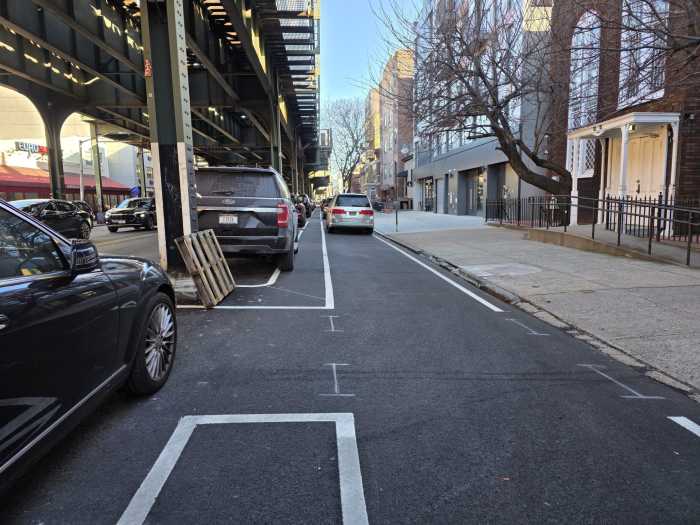
Not everyone has welcomed the ruling, however.
Transportation Alternatives, a non-profit advocating for more walking, cycling and public transit infrastructure, will hold an “emergency rally” alongside Cabán in Astoria’s Athens Square Park Tuesday evening to call on the city to “save the 31st Street safety project.”
Cabán, along with State Sen. Kristen Gonzalez, Assembly Member Jessica González-Rojas and Mayor-elect Zohran Mamdani, unveiled the Western Queens Street Safety Plan in 2023 as part of a “multi-year planning process” aiming to make Western Queens safer for all road users. Efforts to install a protected bike lane on 31st Street formed part of that safety plan.
In a statement issued to QNS on Monday, Cabán contended that the ruling “puts lives at risk” by removing plans for proven safety measures.
“This project would save lives. It would make our neighborhood safer for every person who walks, bikes, takes the bus, or drives. Astoria has waited too long for basic protections. My office will continue to fight for street safety on 31st St and every street,” Cabán said in a statement.
Gonzalez, meanwhile, stated that the ruling would “increase the likelihood of accidents” along the corridor.
“DOT previously rated the corridor as among the top 10% most dangerous streets for serious injuries in Queens,” Gonzalez said in a statement. “Abandoning progress now will only increase the likelihood of accidents.”
The mile-long stretch of 31st Street is among the most dangerous roads in Queens, according to DOT data, with a total of 178 injuries recorded on the corridor over the five-year period. DOT data cites “multiple instances” of cyclists getting “doored” – referring to when a cyclist collides with a car door that has been opened– while over 30% of pedestrian injuries have been caused by left-turn crashes.