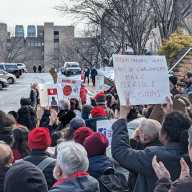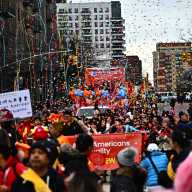


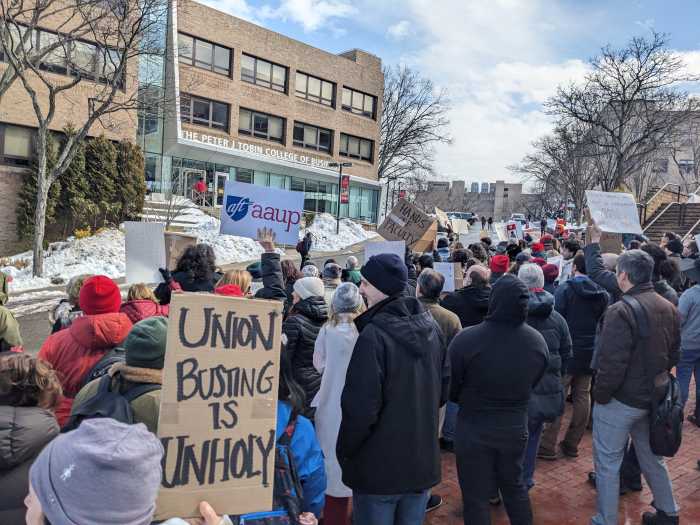
Over 200 St John’s University faculty and students rallied on campus Wednesday afternoon to protest against the university’s decision to end recognition of the long-standing faculty union, which protesters say represents a threat to working conditions at the university.
On Feb. 19, St. John’s University President Rev. Brian Shanley informed faculty via email that the university would no longer represent two unions formed in 1970 – the St. John’s University chapter of the American Association of University Professors (SJU-AAUP) and its partner union, the Faculty Association (FA).
Protesters added that faculty had been working without a contract for almost eight months prior to the decision after St. John’s stalled contract negotiations.
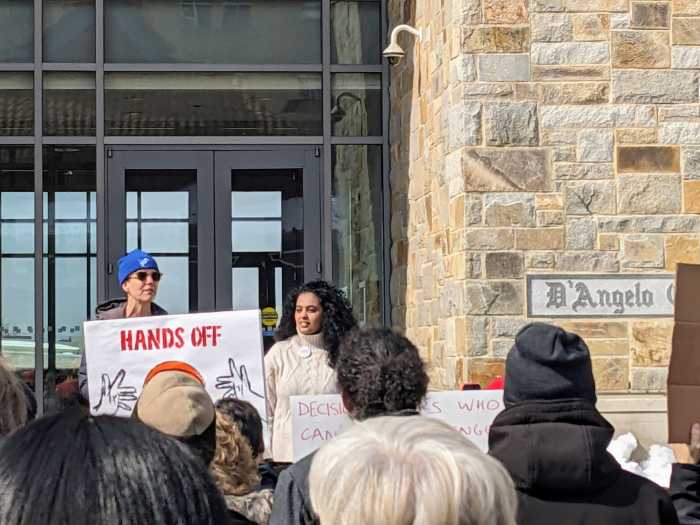
Faculty and students gathered outside the D’Angelo Center at St. John’s University on Feb. 25 to protest against the decision, arguing that the university’s refusal to recognize the two unions would lead to program elimination and “academic contraction.” Opponents say the move will prevent faculty from having a voice in academic decisions at St. John’s.
Protesters at Wednesday’s rally held placards blasting St. John’s over the decision, including slogans such as “union busting is unholy” and “decision makers who can’t be challenged make terrible decisions.”
A spokesperson for St. John’s, meanwhile, said the university did not take the decision lightly. However, the university said the decision was necessary to advance St. John’s “organizational mission.”
“This will allow St. John’s the flexibility required to innovate while continuing to support our faculty and, most importantly, deliver on our promise to our students,” a university spokesperson said in a statement.
The decision would allow St. John’s to remain “steadfastly” dedicated to its Catholic and Vincentenian mission, the spokesperson added.
“As the landscape of higher education undergoes a profound transformation, our commitment to providing an exceptional and sustainable educational experience consistent with our mission requires us to be agile and innovative.”
A spokesperson for the Association of Catholic Colleges and Universities (ACCU) said St. John’s reserves the right to invoke a religious exemption to union recognition.
“While ACCU does not take a position on unionization, the association respects the university’s choice, as a private, Catholic institution, to invoke its religious exemption, knowing St. John’s has made significant efforts to resolve internal differences collaboratively and in good faith,” the ACCU said in a statement.
The National Association of Independent Colleges and Universities (NAICU) also expressed support for the university, arguing that faith-based institutions have the right to invoke a religious exemption.
Still, faculty and students pushed back strongly, stating that union representation allows faculty to have a say in the academic direction of the university.
“Instead of faculty governance, you have consultants telling the administration what they want to hear,” Robert Fanuzzi, an associate professor of English at St. John’s, told QNS.
Fanuzzi said the decision to withdraw union recognition would “reproduce groupthink,” which he described as a “really dangerous” position for a university.
“With faculty governance, you have a strong counter argument and public review that submits every program contraction proposal to the highest academic standards. It’s the way a higher education institution should do business.”
Meghan Clark, a professor of moral theology at the university, said the fight to restore union recognition centered on “dignity” and the faculty’s right to form a union.
“It’s not just about a question of wages, it’s about participation and about faculty voice and how we shape curriculum, and how we shape the education that we are providing to our students,” Clark said.
Both Clark and Fanuzzi expressed concerns that faculty would lose vital job protections if union recognition is not restored, leaving them at risk of firings and program elimination.
“We have seen at colleges across the country that faculty handbooks and faculty guides do not have legal force of law,” Clark said. “So you lose real protections for your working conditions and your rights.”
Sophie Bell, acting president of SJU-AAUP, said the university’s decision represented a “terrible threat” to a “collective bargaining tradition” that has been established at St. John’s over the past half-century.
“(Collective bargaining) is essential to having rights and decent working facilities as faculty,” Bell said. “A faculty handbook is just not the same as a collective bargaining agreement.”
Bell said the university, communicating its decision to end the collective bargaining agreement, argued that collective bargaining “burdens” the university’s goals that “advance the common good.”
She added that the union had “caught a whiff” that St. John’s was about to end union recognition when the university made “a big push” at the bargaining table last year. The decision, however, was “out of the blue” and caught faculty by surprise, Bell said.
Clark, similarly, was “afraid” that St. John’s was preparing to end union recognition after noticing that the university was pushing arguments surrounding “religious freedom” last year. However, she said the decision to end recognition came as a “gut punch.”
“The email from the university felt like a massive gut punch,” Clark said. “It felt like a direct attack on what what myself and many of the faculty thought we were on the same page about – the mission of the university.”
Students also criticized St. John’s over the decision, stating that a lack of union recognition threatens their education by undermining faculty stability.
Sara Kirkman, an English major at the university, said students had joined the protest because they wanted to stand up for the quality and continuity of their education.
“I think the strongest part of our university is the relationship between students and professors,” Kirkman said. “When faculty feel secure and respected, they can show up fully for us. That directly impacts our academic experiences and our futures.”
Wednesday’s rally concluded with protestors marching to Bent Hall and delivering a petition signed by over 2,000 people to the St. John’s Board of Trustees. However, the union said it was denied access to the building and could not deliver the petition.

Jeremy Cruz, an associate professor of theology and religious studies at St. John’s, said the denial of access was “disturbing.”
“Campus security did not allow faculty to enter the building to deliver the petition to the Board of Trustees,” Cruz said. “This was disturbing to us in that faculty had campus I.D.s and some have offices in that building but were denied entry.”
He added that faculty currently lacks a means to communicate directly with the university’s board.
Clark, however, hopes that the board will “hear the calls” of faculty and “come back to the bargaining table.”
“What we want is the university to come back to the bargaining table, and we hope that the faculty might be given a path to have our voices heard by the Board of Trustees,” Clark said.