Every Sunday, the Sunnysidepost will publish an Op-Ed written by a member of the community pertaining to a topic of interest.
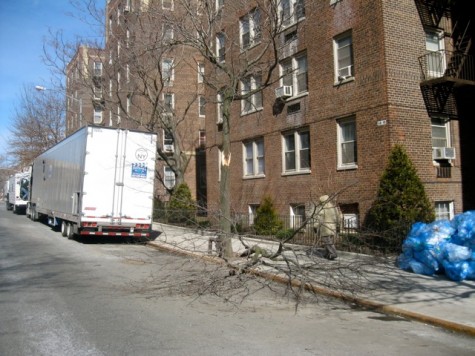
This week, a Sunnyside resident who works in the film industry responds to recent comments pertaining to an article about a tree branch that was knocked down by a film crew during the shooting of Blue Bloods. That article can be found at the following link.
Anyone interested in writing an Op-Ed, please forward your article to sunnysidepost@gmail.com
(Photo: George Burles)
March 30, 2014 By Sarah Maine
As a long time resident of Sunnyside and a member of the film crew that was shooting in the neighborhood on Thursday March 13th, I was saddened by the aggression present in many of the comments which followed Christian Murray’s article detailing the downed branch.
New York City is one of the most dynamic, exciting, beautiful and romantic cities in the world, characteristics that have drawn a continuous flow of new residents to our boroughs for centuries. They are also the characteristics that draw writers and film makers to use the city as a back drop for their tales.
There have been countless times when, as a proud New Yorker, I’ve been dismayed by films and TV shows using LA, Vancouver or Toronto as stand ins for the Big Apple. I get a sinking feeling watching those shows because I know that they represent lost jobs for New York City. On the other hand I’ve had many proud moments watching films and television shows when I’ve seen my city, the real New York City, and even my own neighborhood on screen.
I challenge you not to feel at least a little bit excited when you glimpse a familiar block in your favorite New York based shows.
The film and television industry supports 130,000 jobs in New York City and brings in around 7 billion dollars a year. Although crew members may not shop very much during the shooting day, we are doing our jobs after all, we are paid to work not to browse in stores, there is a river of money that flows into the city from all of us working in the film and television industry.
Take Sunnyside for example. Sunnyside is a peaceful, friendly, affordable middle class neighborhood; characteristics that make it an attractive place to live for many actors, directors and technicians. I am one of many film workers that make Sunnyside my home.
The living wage that we make as film workers allows us to live in nice places like Sunnyside. Three years ago I took a break from working in film and I had to cut back drastically on my discretionary spending. I spent that time working in a different industry, one that could not pay me very well and the difference in the amount of money I was able to spend in Sunnyside was stark.
Since returning to the industry last fall I have been able to spend a lot more money in the neighborhood, patronizing restaurants, specialty food stores, and other local vendors, something that I have always felt is important, I love supporting businesses in my community. But my personal spending is but a drop in the bucket. The cumulative effect of the dollars brought into New York City by the film business is much larger.
Film and TV productions spend money in a thousand different ways and New York State tax incentives encourage us to shop in state. We acquire furniture, clothing, make up and hair supplies, camera equipment, lighting equipment, catering supplies, trucking equipment, lumber and paint and many other things that it takes to make a production company function. We rent stages and locations, pay tolls and buy gas, and when we are on location many of us eat in local restaurants.
Queens in particular is the home of prop rental houses (some recently relocated from Manhattan), theatrical lumber and hardware suppliers, union halls, the Museum of the Moving Image, Silver cup Studios, and Kaufman Astoria studios, the oldest film studio in the Unites States. Queen’s film heritage predates Hollywood and has been sustaining working class families for a century.
Decorators, prop masters, gaffers, grips, camera crews, carpenters and scenics all have long standing relationships with their vendors in New York. These are business relationships that often develop into friendships, the thing that pulls us all together and makes us a community.
I have met vendors who told me that their film business customers carried them through the recession, without those film dollars they would have had to close up shop. In tough times when regular people are cutting back, production companies can keep spending, this is no small thing.
I know that a film crew in your neighborhood means less parking for that day, and you might have to cross the street while they are rolling. But this is a city, a complex community where lots of things are going on all the time. In the big picture the inconvenience that may be caused by a film crew falls into the same category as getting stuck in between stations on the subway, crawling along in your car behind a sanitation truck that is stopping every ten feet, and construction sites shutting down streets and sidewalks. These things are all annoying but we put up with them because we live in New York, a living, breathing, working metropolis.
In the comments of Mr. Murray’s piece someone mentioned that film companies should provide alternative parking under the 7 train. We don’t have the power to arrange that but your council person may. That is an issue to take up with his or her office.
In fact the best way to deal with any concerns you have related to a film crew in your neighborhood is to contact your council person or the Mayor’s Office of Film,Theater and Broadcasting (MOFTB). The film industry is such a vital part of our municipal economy that we have an agency dedicated to managing its presence in the city. The MOFTB also provides reports on the impact of the industry on the city’s economy. The 2013 report is available for free at http://www.nyc.gov/html/film/html/news/2013report.shtml
I agree that there is always work that productions can do to better relations with the communities in which they work. This is something we in the film industry need to work harder at incorporating into our industry culture. Mr Murray’s article and the ensuing comments have generated quite a bit of discussion on set for the past few days, it is what spurred me to write this piece.
I felt that it was important to share information about an industry that can seem foreign and opaque to people on the outside. We are New Yorkers just like you, and sometimes after a long day of shooting in very hot or very cold weather (mostly very cold these days) we get home to our neighborhoods and we can’t find parking because a film crew has taken up all the parking. So we deal with it too, just like we deal with all the other frustrations that come with an address within the five boroughs of New York City.
Leaving angry comments on a local news blog about a production that is permitted by the city to operate in your neighborhood is not an effective way to create positive change. In the end we all want film productions to operate in the least obtrusive ways possible.
Some things, like the size and numbers of our trucks, probably won’t change, but if you have some creative ideas about improving neighborhood parking I encourage you to share those ideas with local and citywide officials so they can work with production companies to make the experience of shooting film and television in New York better for everyone.
These are my personal opinions, I do not represent Blue Bloods or any other production company.