
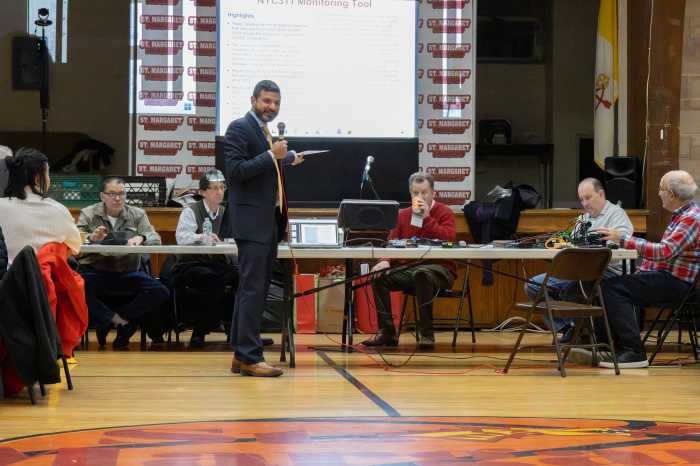
At the Queens Community Board 5 meeting held at St. Margaret’s Parish in Middle Village, a representative of New York State Comptroller Thomas P. DiNapoli’s office gave a short presentation debuting a new tool that tracks and maps out New Yorkers’ 311 complaints as an initiative to help residents better understand what’s going on within their neighborhoods.
Rahul Jain, the deputy comptroller for the City of New York and a resident of Queens, said the state comptroller’s office made the tool, called NYC311 Monitoring, to aggregate the data the city was already collecting and allow residents to view it for themselves without scouring through NYC Open Data themselves.
“[NYC311] was a little bit off our usual mission, but something that Comptroller DiNapoli really was trying to get a better handle on,” Jain said. “Because every time we would go out into the public, we’d get questions about quality of life.”
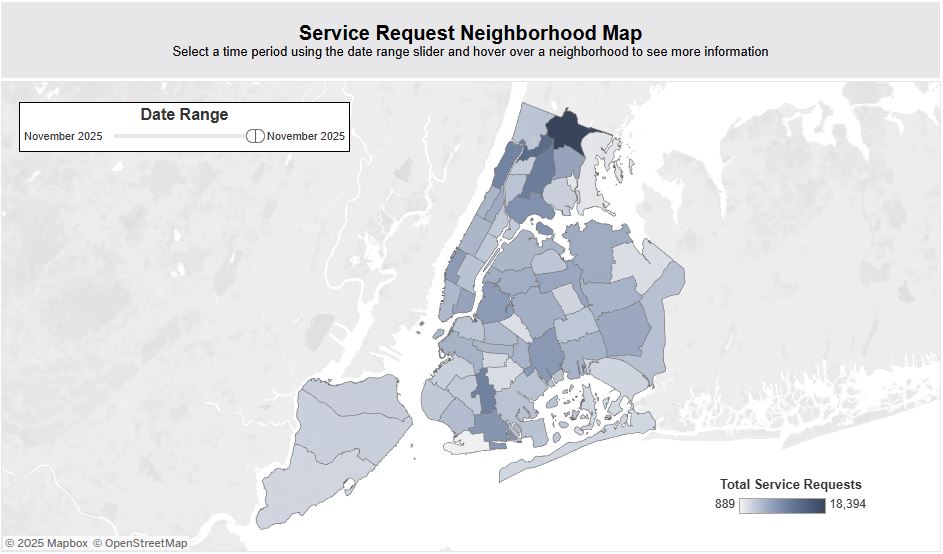
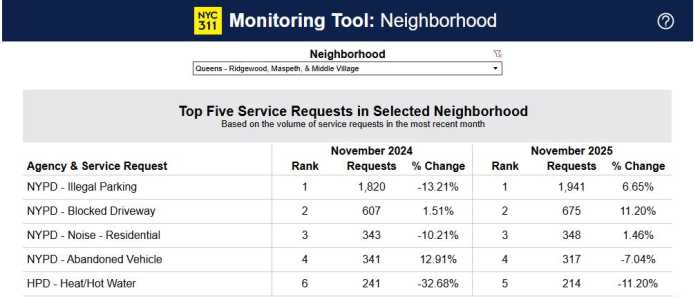
311, the city’s the non-emergency hotline service, allows individuals to report any issue present at home or in their neighborhoods to be addressed by one or more of over two dozen agencies in the city; cutting down on the time required to research which one to contact. The site is updated with the most recent data, currently November 2025, and goes as far back as 2019 with helpful graphs that display the total number of complaints and 180 categories for each type. The data is split up based on neighborhood and population, and though Glendale’s name is absent from the list, the data is still included under the “Ridgewood, Maspeth and Middle Village” tab for District 30.
District 30 made around 6,000 complaints to 311 in November, down by about 13% from the previous month, with illegal parking ranked No. 1, a citywide trend that has increased by over 150% since the end of the COVID-19 pandemic. The graph allows users to select each particular complaint to see its trend from month to month over the years. However, Jain made special note that while 311 complaints are a good indicator on the problems within a neighborhood, they are not a definitive evidence for a problems severity.
“It doesn’t necessarily mean things are worse, just that people are complaining more,” Jain said.
Jain stated the tool will also help agencies to better understand other trends and localized issues, but that it’s still not complete. The comptroller’s office was forced to clean the data to get rid of “messiness” that was present in many reports.
Board Member Daniel Heredia of Ridgewood asked Jain if NYC311 includes the agencies actual response to a complaint, or if it was left open. Jain said it was a common question, and that while the office hopes to be able to include the response times for each complaint in the future, many agencies closed things out immediately which was “not actually a resolution.” T
he State Comptroller’s office will continue to work on NYC311, and take the feedback given from each of the community boards to improve it.