
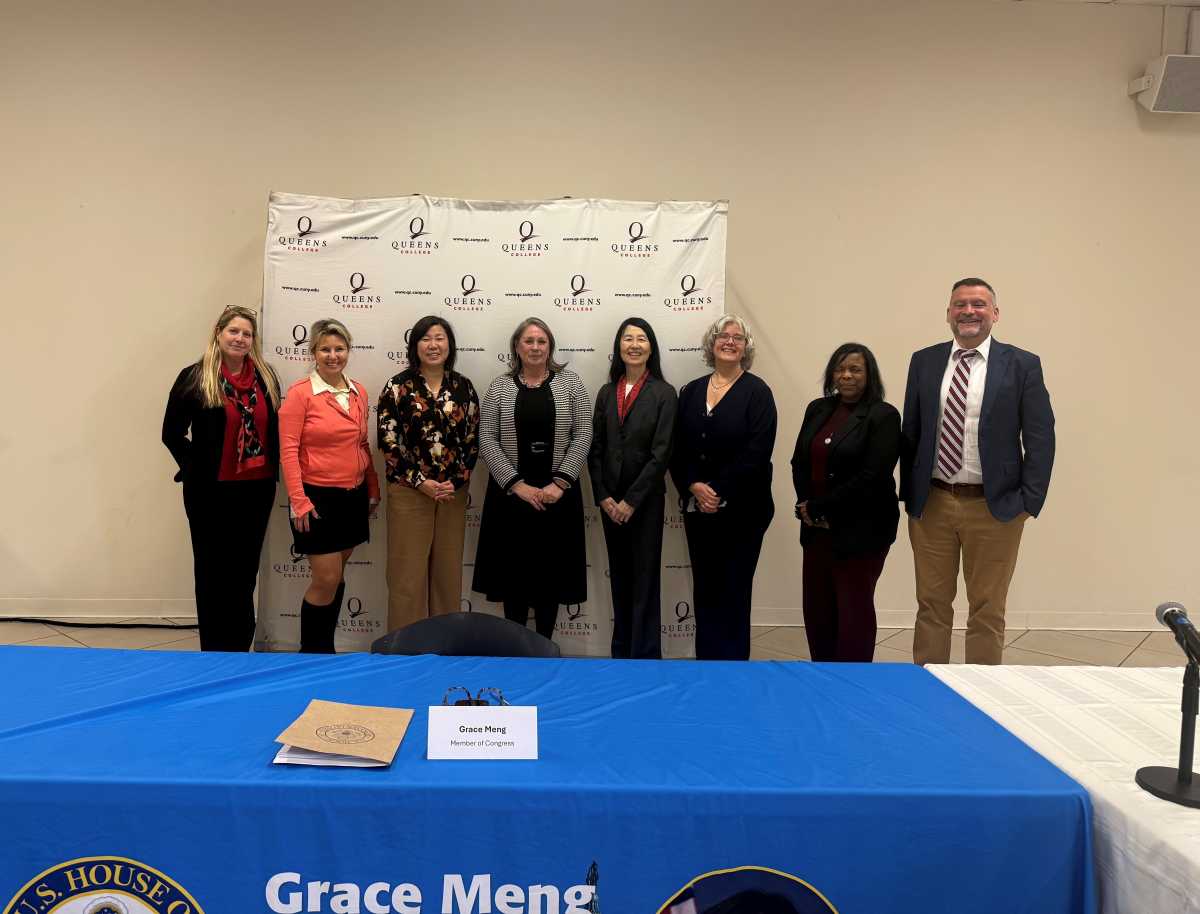
As funding cuts to Science, Technology, Engineering and Mathematics programs proposed by the Trump administration for fiscal year 2026 loom over the Queens community, U.S. Rep. Grace Meng hosted a hearing at Queens College in Flushing to discuss the fate of STEM education in the borough.
Trump’s proposed “skinny budget,” announced on May 2, includes reductions in non-defense discretionary spending by $163 billion, or 23%, from the 2025 enacted level. Defense spending would increase by 13 percent, however, and appropriations for the Department of Homeland Security would increase by nearly 65%.
According to the White House announcement, cuts to STEM programs are part of its agenda item, “Defund the Harmful Woke, Marxist Agenda,” which intends to cut $315 million for grant programs aimed at “addressing White Supremacy in the STEM profession.”
The statement also listed an agenda item in the budget, “Streamline K-12 Education Funding and Promote Parental Choice,” which the White House said “continues the process of shutting down the Department of Education.”
However, many studies have shown STEM programs have a positive impact on student learning outcomes, including a recent study in August by Frontiers in Psychology which shows positive outcomes across academic levels, particularly in high school students.
A March 2022 study published by ScienceDirect shows that STEM activities improved students’ career interest and motivation to enter STEM fields, which include critical professions such as biochemists, geneticists, physicists, engineers, medical scientists, nurse practitioners and more.
Meng is the top Democrat on the House Appropriations Subcommittee on Commerce, Justice, Science and Related Agencies, which provides the federal government’s funding for many STEM programs.
During the hearing, Meng emphasized the importance of STEM programs in New York and the negative impacts the proposed cuts could have across the region. Officials from local education, science and medical institutions in Queens, and the rest of New York City, also testified at the event.
Speakers included Phyllis Curtis-Tweed, provost and vice president of academic affairs at Queensborough Community College; Katie Culp, chief learning officer at the New York Hall of Science in Corona; Nancy Daneau, senior associate vice provost for research at New York University; Jason Lewis, deputy director of the Sloan Kettering Institute’s Office of Science Education and Training; Dianne Miller, senior director of federal relations at Cornell University; Irene Tsitko, vice president of grants management at the Intrepid Museum; and Jeannette Wing, executive vice president for research and professor of Computer Science at Columbia University.
According to Meng, the federal government’s investments in STEM programs are crucial. She said they play a critical role in educating children at local schools and advancing medical, technology and science research at area facilities.
However, she said as the president slashes and terminates key STEM initiatives, many in the borough and throughout the state are worried about future funding, continuation of these programs and its effect on local residents.
“In Congress, I am proud to be an ardent supporter of STEM programs across the nation including here in Queens,” Meng said, adding that she is currently trying to secure more funding. “Putting this money on the chopping block is wrong and unacceptable. It will hurt our city, state and borough and I will continue fighting against ongoing efforts to slash these vital funds.”
Meng thanked all witnesses who participated in the hearing for underscoring the importance of STEM funding in New York and talking about how it impacts the work they do to improve the lives of its residents.
For more information about STEM programs in NYC, visit Schools.NY.gov.