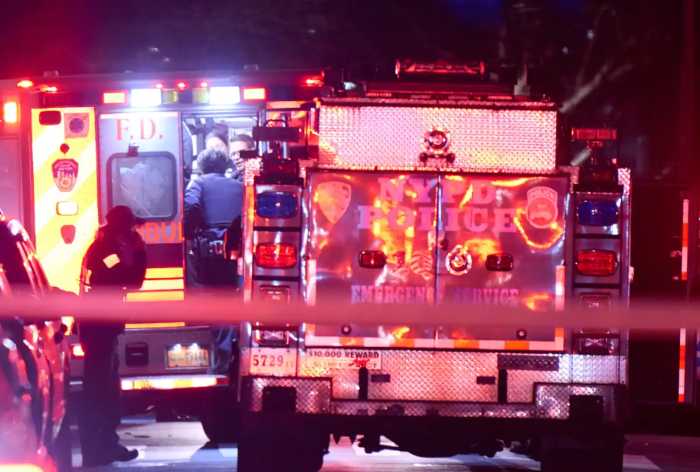

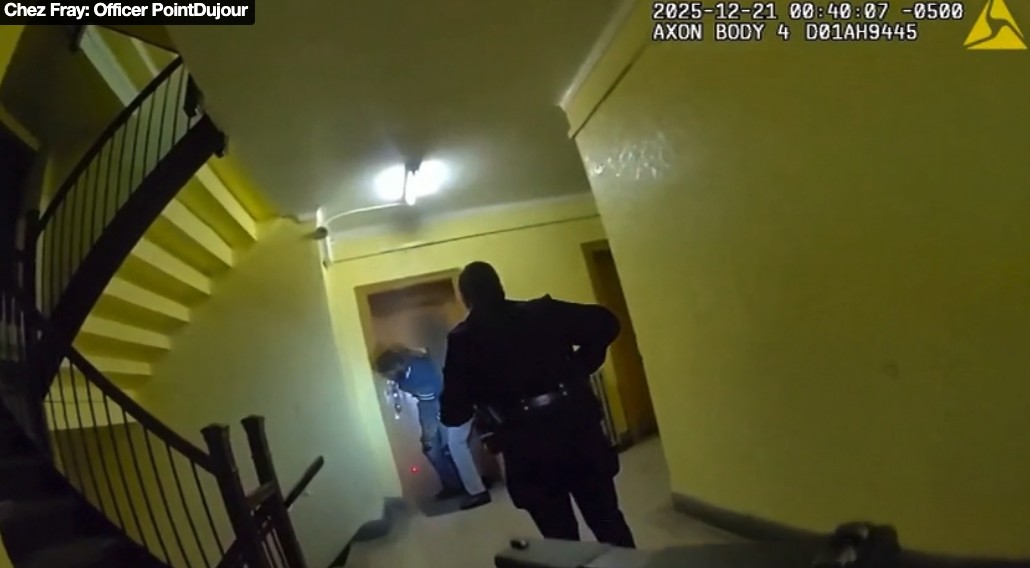
New York Attorney General Letitia James on Monday released body-worn camera footage that her office obtained as part of its ongoing investigation into the death of Chez Fray, a 29-year-old Far Rockaway man, following an encounter with two police officers from the 101st Precinct during the early morning of Sunday, Dec. 21.
According to the investigation, at 12:35 a.m. on Dec. 21, Officers Amanda DelaRosa and Rocharlie PointDujour, went to an apartment building at 1170 Nameoke St. in response to a 911 call placed by the man’s father Kevin Fray, who said he called cops for help after his son had smoked weed and was acting erratically.

The video shows the two officers meeting the father and Chez Fray’s mother, Sheanette Dunbar, in front of the building and after a brief conversation the officers and the parents went up to the family’s fourth floor apartment together, but the 29-year-old son was not inside. When they heard the father shouting in the hallway, the officers moved into the hallway where they encountered Fray who was holding a boxcutter. The officers instructed him to drop the weapon, but he did not comply. His father tried to intervene and wrestled with his son before the officers ordered him to get behind them. After ordering him to drop the weapon more than a dozen times, for more than a minute, Fray lunged towards them and one officer fired her Taser while the other cop discharged her service weapon, striking Fray once in the chest.

Fray was transported to Jamaica Hospital Medical Center, where he was pronounced dead.

The Attorney General’s Office of Special Investigation (OSI) released the footage from two body-worn cameras that officers were equipped with during the fatal shooting. The release of the footage follows the Attorney General’s directive that camera footage obtained by her office during an OSI investigation be released to the public to increase transparency and strengthen public trust in such matters.

Pursuant to New York State Executive Law 70-b, OSI assesses every incident reported to it where a police officer or a peace officer, including a corrections officer may have caused death of a person by an act of omission. Under the law, the officer may be on-duty or off-duty, and the decedent may be armed or unarmed. Also, the decedent may or may not be in custody or incarcerated. If OSI’s assessment indicates an officer may have caused the death, OSI proceeds to conduct a full investigation of the incident.
The release of the footage is not an expression of any opinion as to the guilt or innocence of any party in a criminal matter or any opinion as to how or whether any individual may be charged with a crime, according to the AG’s office.