
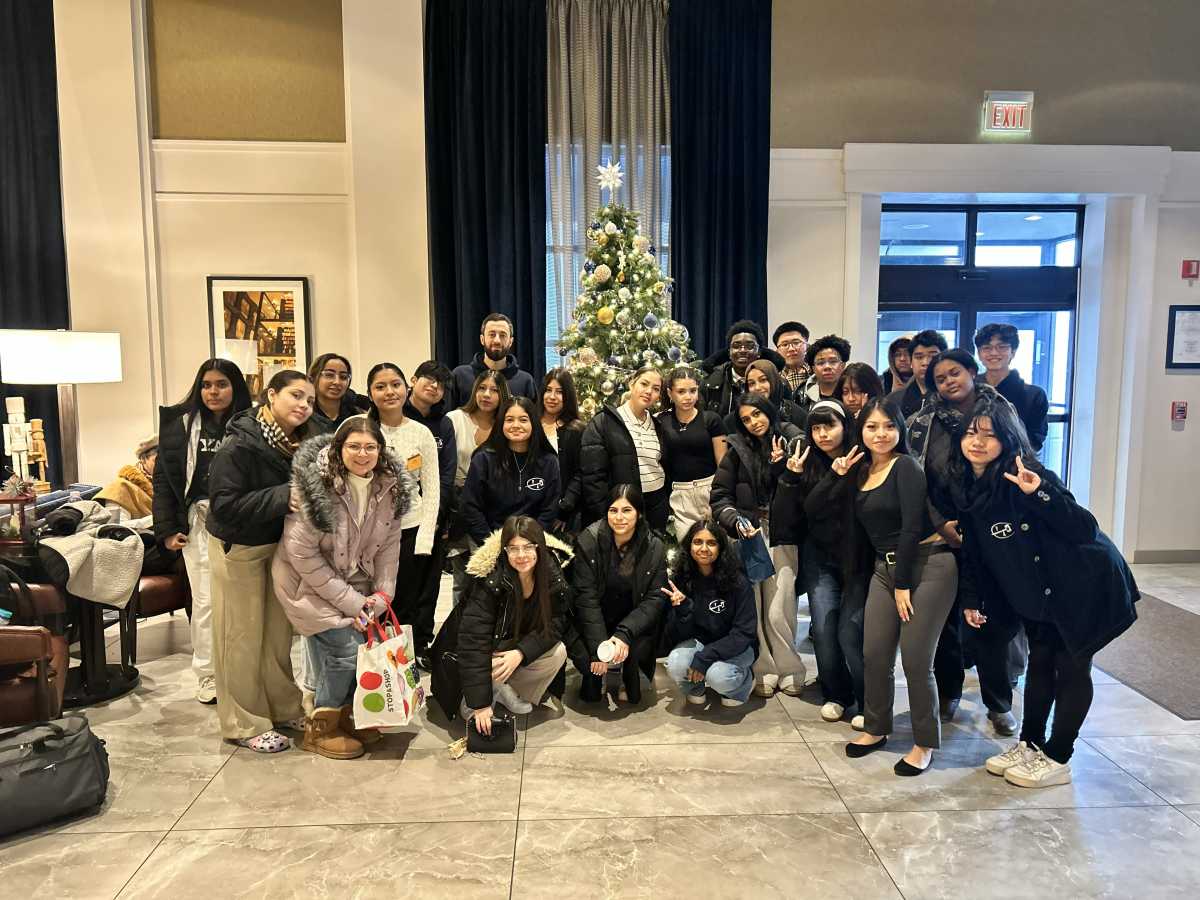
Veritas Academy in Flushing is producing the next generation of civically engaged citizens through its innovative civics class, which is spearheaded by the students themselves.
Civics students participate in mock legislative sessions, attend model congresses on college campuses, and even get a say in how funds in the school budget is spent.
Facilitated by teachers dedicated to elevating their students’ voices, the class has touched lives far beyond the school building. Students have brought their ideas directly to local elected leaders, community education councils and model congresses hosted by Yale University and Dalton State College.
The future leaders spoke highly of the program and said it has inspired and empowered them to continue fighting for the betterment of their communities.
How the civics class operates
According to Veritas Dean Haralambos Thomatos, who has worked at the school as a teacher for the past 11 years, he founded the civics class five years ago after learning about a district program called participatory budgeting.
The program provided funding — around $2,000 per year — for small projects around the school that would be decided by students. The program, Thomatos explained, is meant to teach students about budgeting and community values.
Thomatos signed up for the pilot program and started the civics class with just under 10 students.
“We had a big event here at the school,” Thomatos said. “It was great. I saw the kids interacting with their peers and the community. They really, really enjoyed it.”
Students in the civics class began meeting with community leaders, as well as local residents, and asked how they could help them. One of the first projects the civics students advocated for was a greenhouse, Thomatos noted. He said the students wanted to grow food to donate to local homeless shelters.
“We have really good kids here,” Thomatos said. “It’s the community values that we have here amongst our school. We try to take care of each other.”
Thomatos explained that students mostly run the class and he and the current civics teacher, Jesse Johnson, act as facilitators. The teachers reach out to politicians and other leaders to help elevate their students’ voices.
Taking an active role in the community

Alisha Jagesar, a senior at Veritas enrolled in the civics class, explained that students in the class often perform mock congresses to facilitate dialogues about current-day issues.
“We’re able to bring awareness to our future politicians because we are the future,” she said.
Learning to speak up for students’ needs is an important part of the civics class, Alisha continued.
She recounted several instances in which the civics students advocated for changes in their school. Last year, for example, the students attended legislative breakfasts with local politicians and advocated for funding for a new library, as well as major renovations to Leavitts Park, next to Flushing High School.
Diego Arenas-Barrios, a Veritas alumnus and current student at Cornell University, explained how the students advocated for things like new equipment, leveled playing fields and more access to water at Leavitts Park. He said he hopes the renovations allow students and the rest of the Flushing community who use the field to have a safer experience.
“It’s not just about one student,” Diego explained. “This is about public service. It’s also about the local government showing that they’re present here to help support our public schools and build equity.”
Thanks to their advocacy, library renovations are beginning on Friday and the Leavitts project broke ground on Dec. 11.
“It’s being able to help not only just us, but the community as a whole,” Alisha said. “It’s really nice our student voice gets us places, and we can actually see it happen.”
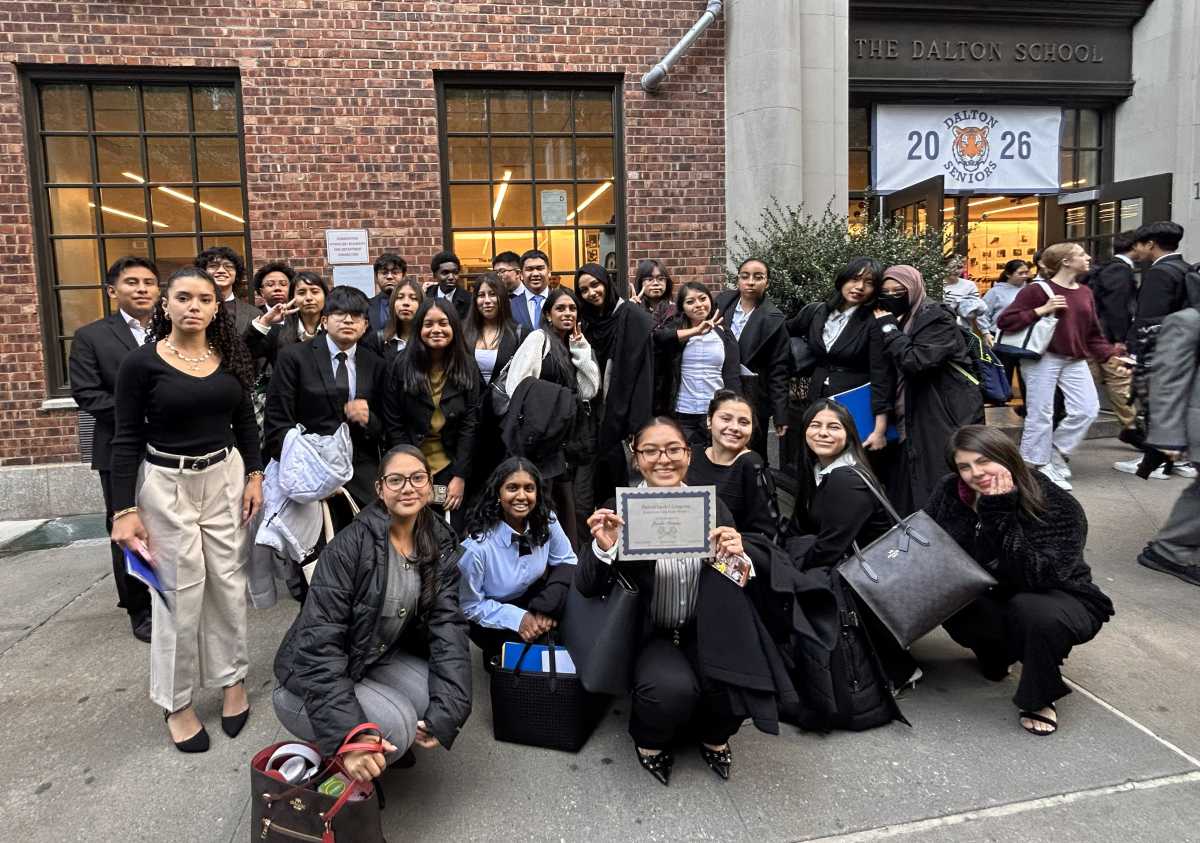
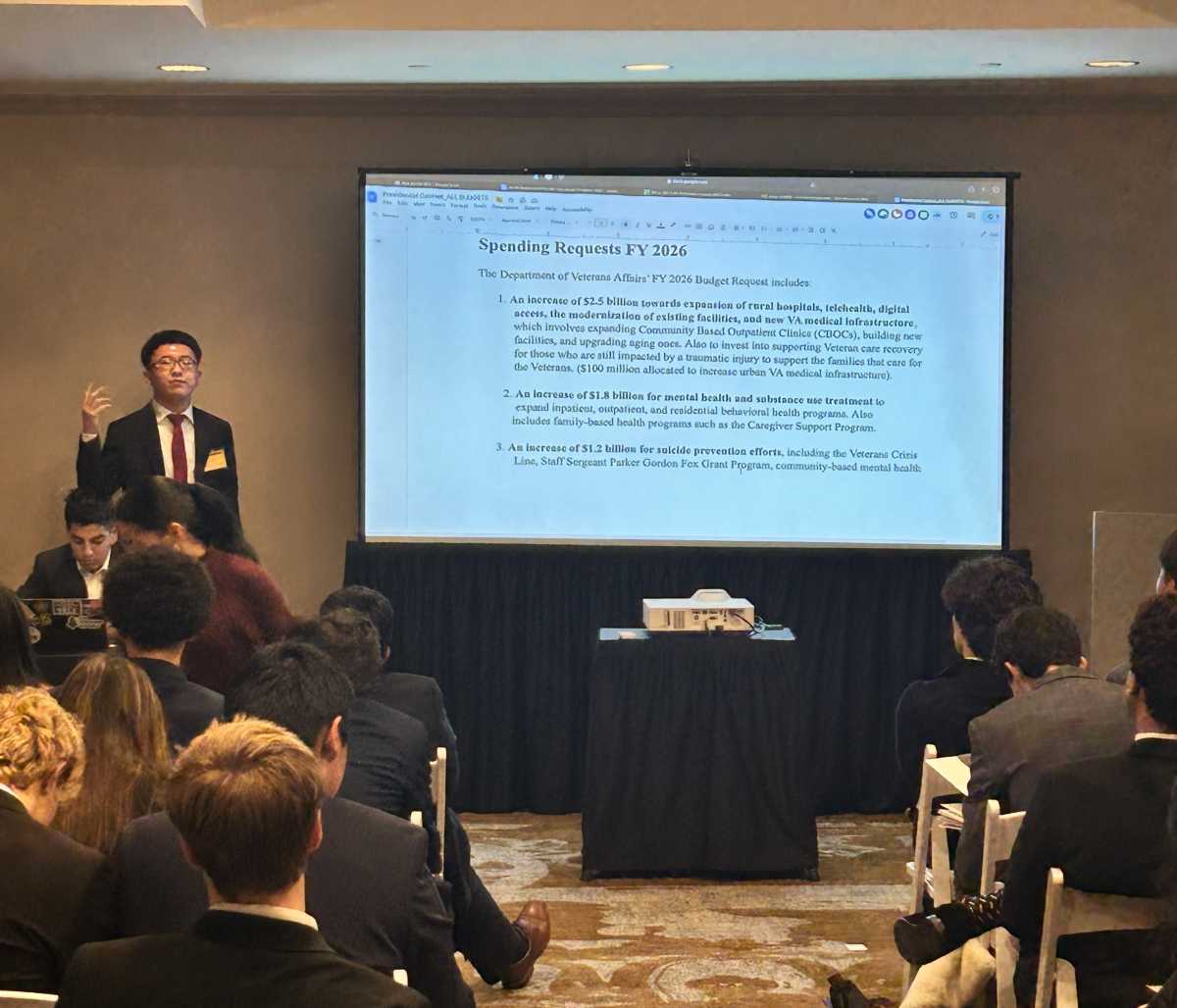
The students also visited Yale University and Dalton State College to participate in model congresses, where they simulated the legislative process by acting as legislators, drafting mock bills and debating them on the floor in order to get them passed through a final vote.
Alisha said the Yale Model Congress was incredibly encouraging and boosted her confidence. After returning from the event, she said it had an even bigger impact on the ways students spoke about the school budget.
“I think being able to speak about issues that are personal to us and personal to the community at something as big as Yale Model Congress was amazing,” she said.
Froiden Benjamin Ravelas, another student in the civics class that attended the Dalton Model Congress, said the experience was incredibly educational. Before joining the civics class, Froiden said he’d always wanted to advocate for the community. Now, being a part of the class, he said that’s precisely what he gets to do.
“I started in September, and I knew nothing about civics at all,” Froiden said. “Attending Dalton Mode Congress really helped me evolve my knowledge in civics overall. It really is a great opportunity for students.”
As for Natasha Loja-Molina and Benjamin Kong, both current civics students at Veritas, they have taken their role in civics beyond the classroom. Both are members of City Education Council in District 25 and sit in for meetings with the superintendent to discuss concerns they have about the school and the community.
“Out job as student members is to bring up issues we see in our own school building,” Natasha explained. “If there’s problems in our school, there could also be problems in other schools, so it’ll bring more attention to those issues.”
Benjamin said during their first CEC meeting, many parents were surprised at some of the issues brought forward by Natasha and other students. He said this type of testimony is important to addressing issues at the school because students offer first-hand experience.
“We brought a perspective they don’t really hear,” he said. “Not only do the parents advocate for their kids, but we’re there as student members to bring the students’ perspective.”
Drafting the participatory budget
Jesse Johnson, who has taught at the school for almost four years, took over the civics class after Thomatos was promoted to dean this school year. Johnson had participated in the participatory budget last year, and he said he enjoyed it so much that he agreed to take the reins.
“I liked seeing the kids actually have a voice,” Johnson said. “I’m very surprised how passionate these kids are about their beliefs and what they think needs to be changed around the school and the area.”
Right now, Johnson said students are still debating the participatory budget for this year’s funding, after which plans will be finalized and implemented into next year’s budget.
Johnson, who teaches civics and economics, divided each class into 2-3 groups to generate ideas for what they want the participatory budget project to be. This year, 11 projects will be proposed and presented to the entire Veritas staff and student body to be voted on by everyone.
Beyond the participatory budget, students advocate for many more projects for their school — some of which go beyond the budget’s $2,000 capacity. Johnson said teachers and faculty meet once a month to discuss student concerns and generate ideas about how the staff can help progress their advocacy.
For example, Thomatos recalled last year when students were asking for upgrades to the bathrooms at the Veritas campus. While a project like that is far more expensive than the participatory budget’s limited funding, Thomatos brought the idea to Queens Borough President Donovan Richards.
The students eventually took a tour of Richards’ office and sat down with him to advocate for new bathrooms.
“It was very nice,” Thomatos said. “He treated them like adults — like constituents. They had their voices heard and, lo and behold, we have a budget coming in for new bathrooms.”
Similarly, Thomatos continued, students advocated for a new library during a legislative breakfast with Richards, who once again provided funding requested by students for the renovations.
“That’s really what we want,” Thomatos said. “We want our students to be able to open up to these community members and say, ‘Hey, this is what we need to succeed. Can you help us?’”
The civics leaders of the future
Thomatos said the class has come a long way since he founded it five years ago, going from a handful of students to full capacity — 31 students. He said the class is so popular that students are ending up on a waitlist, and there could be a second class introduced sometime in the future.
Thomatos said in his experience, all the community leaders and politicians have responded well to the students and love speaking to them. He joked that BP Richards often scoots him out of the way when the class visits because he wants to hear their thoughts.
Alisha said she and her classmates feel empowered by Johnson and Thomatos because they don’t treat the students like kids — they treat them like real politicians.
Many students have pursued civics beyond the class, Thomatos added, and occasionally ask him to connect them with local politicians or write letters for internships. “No one’s run for office yet, but I’m really looking forward to it,” he said.
Froiden said he’s not sure what exactly he wants to pursue in college once he graduates, but he is interested in entering the field of either civics or government. Regardless, he said he is looking forward to watching their advocacy come to fruition with the new bathroom project.
Benjamin said learning to help the community as a whole is an important part of his goal in pursuing urban studies or government. He said he feels more prepared to pursue those fields after participating in the class and the CEC directly.
Without the civics class, Natasha said she never would have met other communities of students who share the same goals and bring up issues they care about. Making connections and networking, she said, is a valuable piece of experience she will take with her in future pursuits.
Diego said he hopes to expand the model congress to Cornell to allow students to engage in public discourse and potentially reduce political polarization. He said oftentimes, only the wealthy electorate are afforded representation in the government, so including the voices of low-income families and high school students can improve political outcomes.
“We are trying to expand it, hopefully nationwide, to allow high school students to see that they have a voice within their own government,” he explained. “We want to use our campus to empower these high school students to view Model Congress as a necessity to learn more about how our institutions work.”
“It’s going to be a difficult journey,” Thomatos said. “They’re going to be asking and coming up with ideas, and sometimes they’re going to be shot down because it’s too much money. But sometimes, things can happen. The one time things happen — it changes their experience about life. They feel like their voices are heard and they open up. It’s a beautiful thing.”