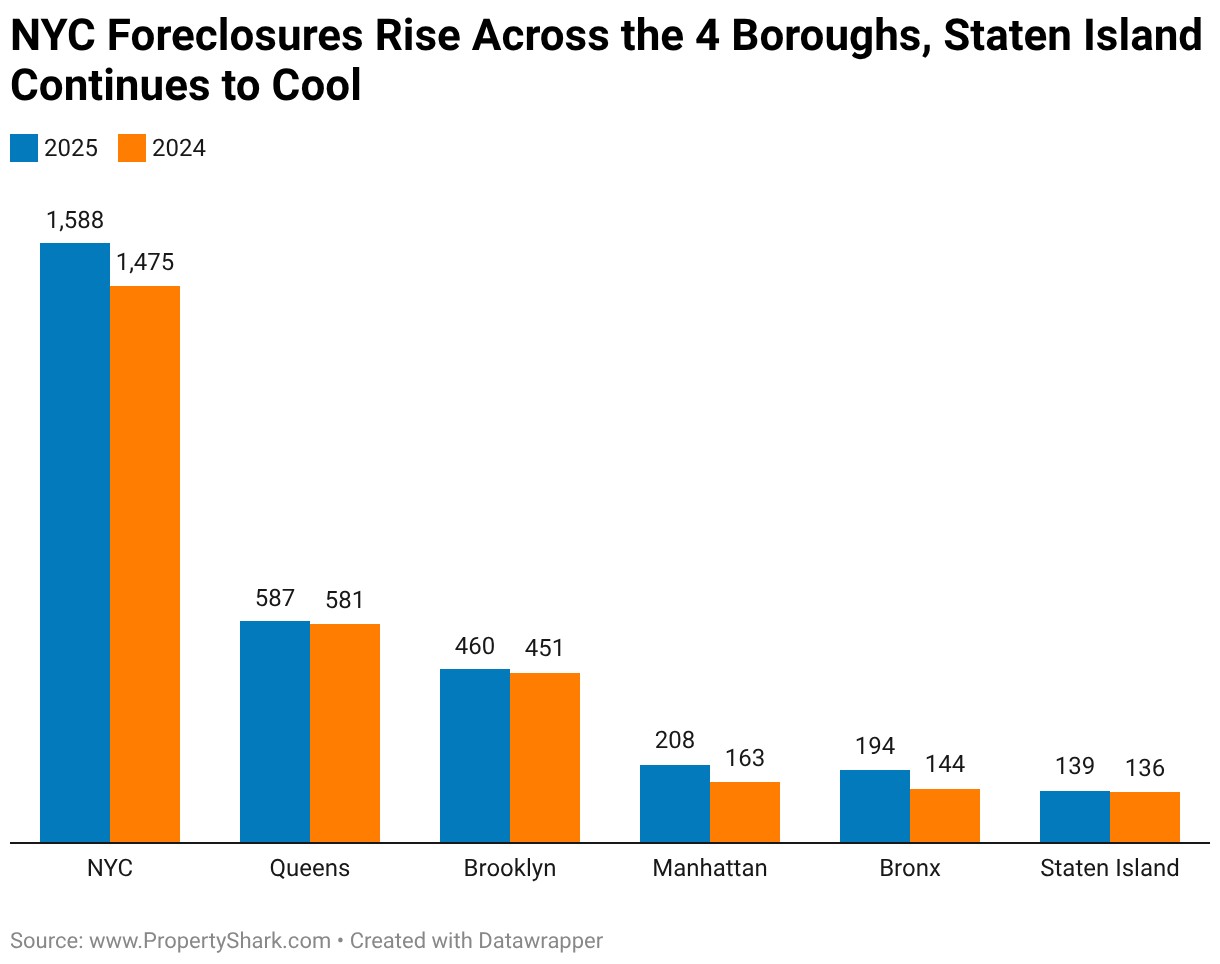
Foreclosures across New York City rose 8% year-over-year, from 1,475 in 2024 to 1,588 in 2025, with Queens accounting for the most foreclosures among the five boroughs, according to a report by PropertyShark.
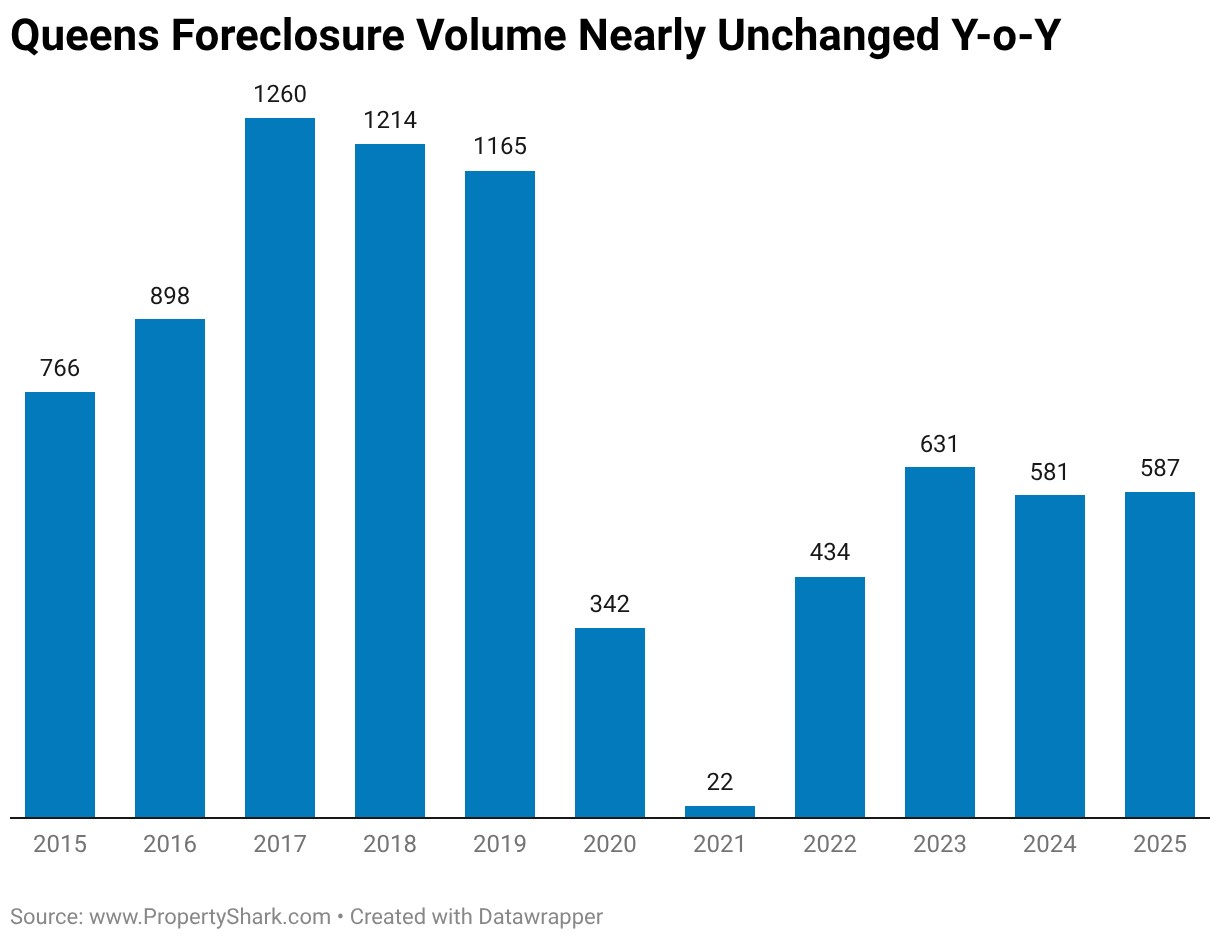
Approximately 37% of all New York City foreclosures were in Queens, according to PropertyShark. However, there was very little year-over-year change in the actual number in the borough, with foreclosures in Queens having gone up from 581 in 2024 to 587 in 2025.
The amount of foreclosures in Queens has yet to even come close to the levels seen before the COVID-19 pandemic. The 587 in 2025 is only a little over half of the 1,165 that occurred in 2019. However, it still marks a big jump from the 434 that occurred in 2022, as the pandemic came to an end.
A big reason for the minimal yearly change in Queens was the fact that, while foreclosures trended up by a decent amount in the last two quarters of 2025, they had previously gone down year-over-year in the first two quarters of the year. There was a 14% decline in the first quarter, from 191 in 2024 to 165 in 2025. This was followed by a 20% drop in the second quarter, from 160 in 2024 to 128 in 2025. Foreclosures began to rebound in the third quarter, with a 33% boost, from 124 in 2024 to 165 in 2025. In the final quarter, there was a 22% jump, from 106 in 2024 to 129 in 2025. Consequently, by the end of the year, foreclosures had evened out.
New York City’s foreclosure epicenter in 2025 could be found in the Queens zip code of 11434, which is comprised of the Springfield Gardens, Rochdale, Jamaica and St. Albans neighborhoods. This zip code had 50 foreclosure filings.
A five-parcel property package along Manilla Street in Elmhurst wound up having the third-priciest residential lean across all of New York City in 2025, at $4,793,648. The package deal, which was comprised of 51-99, 51-101, 51-105, 51-107 and 51-111 Manilla St., featured residences that were each two-family brick homes, ranging from 1,880 square feet to 2,080 square feet.