
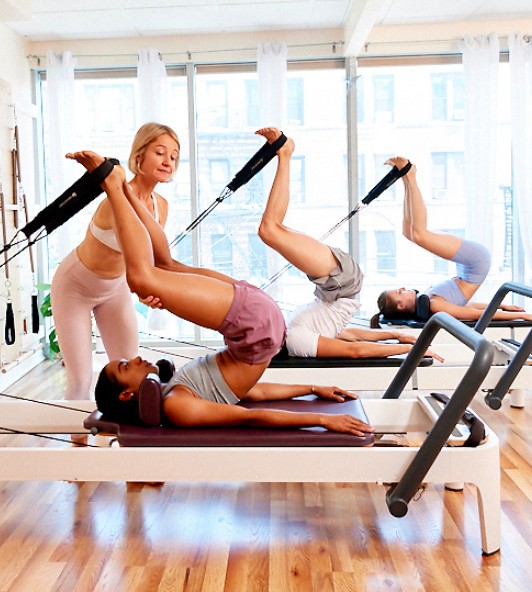
If you’ve been scrolling through social media lately, you may have seen and heard the words ‘reformer Pilates’ alongside images of rows of practitioners lying on machines that look like bed frames, wondering what this workout is really all about.
Whether you’re looking to explore something new for your fitness routine or you’re curious to see what the hype is all about, Perfect Posture Pilates owner and master instructor Vavara Kalinin offered her expertise to explain everything from where first-timers should start, what each piece of equipment does, and how the workout offers benefits beyond the physical. With over 25 years of instructor experience, including 11 years owning two studios in Astoria, the former professional dancer first discovered Pilates as the perfect complement to her training routine, helping her stay stable and strong throughout her dancing career.
When she moved to Astoria around 2005, she noticed a lack of facilities in the area and felt inspired to open her own to share the physical and mental benefits of Pilates with even more people. Since then, their two studios offer small classes with 6-8 participants to ensure they get the full attention and instruction they need, and they specialize in private classes, which help individuals get the full benefits of their sessions and continue to grow and improve in the art of Pilates.
If you’ve never done this type of Pilates before and have been curious to give it a try, here’s everything you need to know before you book your first class.
A reformer is just one type of Pilates equipment, not the whole practice
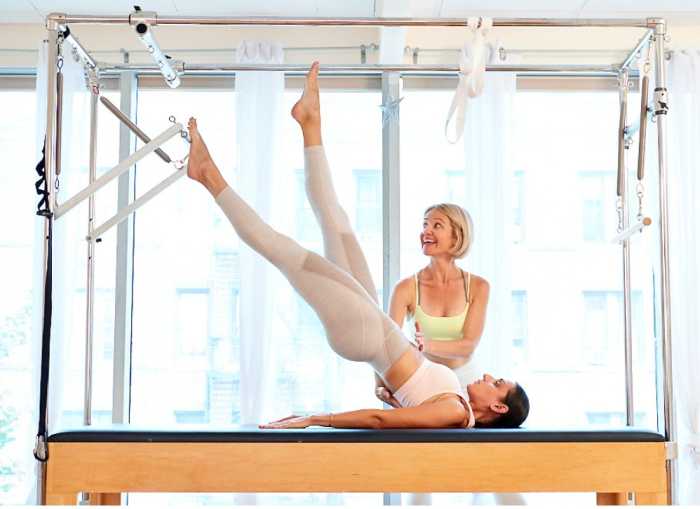
Some people have started referring to all Pilates equipment as ‘reformer Pilates’ when it’s actually the name of just one type of specialized equipment. Pilates, founded by Joe Pilates in the 1930s, emphasizes a mind-body-spirit connection, focusing on breath, balanced muscle development, concentration, control, and precision. It’s intended to include the mat, as well as equipment such as the Cadillac, the Wunda Chair and the Ladder Barrel, which all offer a range of benefits to improve your experience, whether you’re practicing at home on a mat or in class.
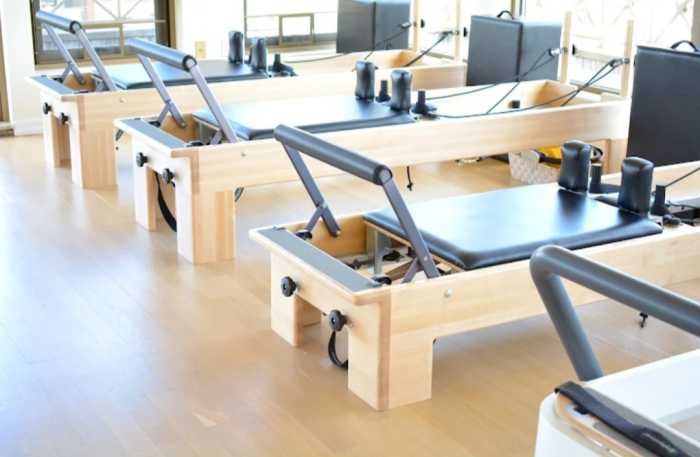
“The principles incorporate mat work, which is floor Pilates, and there are 34 exercises that are traditional and foundational, and then he developed the machines,” said Kalinin. “Reformers are just one apparatus; we have the Cadillac that looks like the bed, the Wunda chair, and other pieces of equipment, like the Ladder Barrel. We teach the Pilates method on all the equipment we offer, including the mat and reformer. They’re small classes, so we can correct students’ movements. We have six students in the reformer classes and eight in the mat, but our primary focus is to teach our clients all Pilates.”
What exactly is each machine for, and what are its benefits?
For those who haven’t practiced Pilates too often or at all, it can seem confusing seeing the options of mat Pilates and equipment, and wondering which equipment is best for your fitness level, especially if you’re recovering from an injury or surgery. Kalinin broke down what the equipment is for and its benefits.
“Pilates is a whole-body movement-every apparatus, and the mat, gives you different feedback and challenges for the same exercise,” said Kalinin. “But if someone is having trouble, there’s a reason behind all of these extra, added props, so eventually people can get stronger, more flexible, and then they’re able to do the full exercises.”
Kalinin further explained, “It’s like you’re doing the same exercise, but from a different perspective, and you’re always working with resistance or against resistance, so it challenges the body in a very different way. For example, for balance work, you’re getting a lot more on the reformer if you’re doing standing exercises, because it’s a moving carriage versus doing something on the mat. Other pieces of equipment, like the Wunda chair, the challenge is stabilizing the body; it’s almost like you’re doing a handstand against the pedal with very light resistance, and your core really kicks in. The Cadillac gives you more mobility, and you’re mobilizing all the joints. Without mobility, you can’t really strengthen, because the points are stuck. It’s really brilliant if you look at it from that perspective, and that’s why I opened my own studio to spread the benefit of doing Pilates.”
How does Pilates provide a full mind/ body workout?
“People think if a workout doesn’t feel like punishment, it’s not effective, but in reality, it’s quite the opposite,” said Kalinin. “If you’re not addressing and downgrading your nervous system from the sympathetic to the parasympathetic, you’re not creating any changes, and you’re always stuck in that fight or flight [mode]. We take a more holistic approach to exercise in Pilates, and that’s what makes us unique. There’s the mat work plus all of these props that we use, so you’re never bored if you’re doing the whole system, because after a while, if you’re only doing reformer, your body gets bored and it stops being effective, but if you’re incorporating all equipment, plus the mat, that’s when you’re getting strong and you’re able to do things you never imagined you could do.”

For a first-time visitor to your studio, where do they start?
“At our studio, we encourage them to start with a few private sessions so we can assess their body,” said Kalinin. “We assess if they have any scoliosis or if they have any restrictions in their breathing, and in the private session, we address some of their restrictions. We give them exercises on all equipment, just to give them a little taste, including the reformer and the mat. If they say they only want to get into reformer classes after their first few private sessions, we will teach them all the foundational reformer exercises, but at least they’ve had a few privates where they’ve gotten a taste of all the equipment and the mat.”
Does your studio offer memberships and packages?
“We have packages for private sessions and packages for group classes, which bring down the price if they buy one, but we also have a membership promotion that we run occasionally,” said Kalinin. “It’s a reformer package of eight classes a month for $250, but we run it a couple of times a year, so we’re mainly just packages.”
For those looking to earn their teaching certification, Perfect Posture offers a teaching training program, including phase 1 on anatomy & mat and phase 2 on specialized Pilates equipment and advanced Pilates concepts. The studio is presently accepting applications for its 2026 teacher training cycle. More details are available on their website.
Perfect Posture Pilates has two locations, including studio 1 at 23-08 30th Ave, 3rd Fl. Astoria and its rooftop location at 31-16 30th Ave., 4th Fl., Astoria. To learn more about Perfect Posture Pilates, visit their website or follow them at @perfectposturepilates.