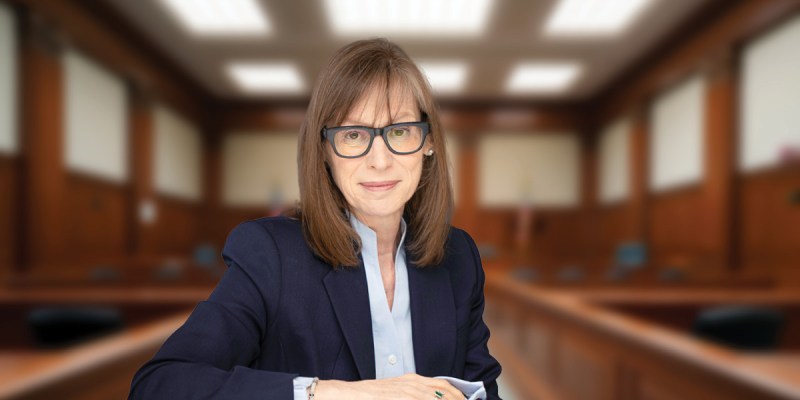
Robin Kawada
Nov. 9, 2014 By Kim Brown Reiner
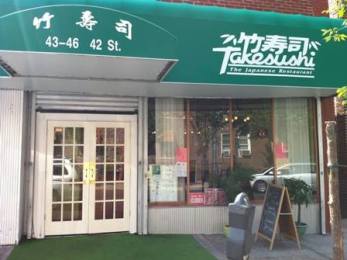
Although Takesushi opened in Sunnyside a little more than two years ago, food experts claim its owner established the first sushi restaurant in New York City nearly three decades ago.
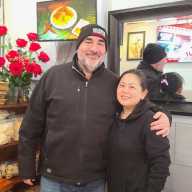
Woodside resident, chef and owner Robin Kawada–who at one time owned Takesushi restaurants in Manhattan, Washington D.C., Toronto and on Long Island– is quick to back up that claim.
“I have been in the restaurant business for 40 years,” said Kawada, 66. “Takesushi was the first sushi restaurant in Manhattan in 1975.”
Food expert and author of “The Secret Life of Sushi,” Trevor Corson, brought up that idea at a food panel in 2010. At the time it caused quite a stir, others claimed the distinction belonged to Hatsuhana or Nippon.
Whatever the truth, Takesushi, which means bamboo, was one of the first sushi restaurants in New York City. The current iteration opened in Sunnyside “accidentally” according to Kawada.
When the lease on his Woodmere, Long Island restaurant was up, Kawada looked for a place in Manhattan but couldn’t find the proper venue. At the time, Transylvania, at 43-46 42nd Street, had closed its doors so Kawada thought, “Why not Queens?”
He soon found out what Queens was like. Business was slow, his restaurant has yet to be reviewed by a major publication and he has had to lower prices by 20%.
Omakase, for example, a large variety of chef selected specialty sushi, like sea urchin, scallop and eel, costs $58 as opposed to $100 for a comparable dish in Manhattan. Most dishes are far less expensive.
But for Kawada, everything is secondary to the quality of fish, even profit.
“I’m open not to make money, but at least not to use up my savings,” he said.
Reverence for fish is something he learned growing up in Japan.
“In Japan each fish has a shrine,” he said. “Each fisherman prays for their fish. They live with that fish. They don’t want to waste it.”
 When he first moved to the United States in 1968, he worked in import/export and as a restaurant cashier, eventually running his own distribution business at the Fulton Fish Market until 9-11. For more than a decade afterwards, he had a business processing sea urchin in Maspeth and shipping it to Japan.
The success of his first distribution venture allowed him to open the original Takesushi and import not only high-quality fish, but a well-established chef from Japan. Working alongside the chef, Kawada received his own training.
“There is no school for fish. You cut it, you touch it, you taste it,” he said.
Back then, as now, his fish was praised for its excellent quality, but also simplicity.
“Each fish has a special taste. So many restaurants put something on the fish, like mayonnaise. It may taste good in your mouth, but it’s not good for this fish.”
More than forty-five years after starting to work at the Fulton Fish Market, Kawada stills goes to the New Fulton Fish Market in the Bronx every day to buy and clean fresh fish, not farmed fish, for Takesushi. He also works at the restaurant seven days a week, and has not taken a day off in 500
days, he said.
In addition, he owns a 15-seat restaurant in Japan.
Decades in the restaurant and fish distribution business have made Kawada more comfortable rattling off details about seasonal fish and his restaurant than his own four children, at least with this reporter.
Tuna is best at this time of year. In the summer, after a fish lays eggs, she is not as tasty. The November menu includes blowfish tempura, monkfish liver, and Miyazaki beef, delicacies rarely eaten outside of Japan.
His passion for quality food has frustrated him with people who care more about low prices and appearances.
“Anytime fish looks nice people think it’s good,” he said. And the desire for cheap prices has led to misunderstandings about the art of sushi.
“Some people think they don’t like sea urchin because they have never had good sea urchin,” he said.
Occasionally, customers will sit at the sushi bar and spend $300, but it’s rare.
Moreover, Kawada is unimpressed with competitors who don’t take the same pride he does in buying, cleaning and storing quality fish.
“Maybe they all wear gloves because they don’t know how to prepare fish,” he said.
The single-minded drive to serve quality fish has earned him a name among foodies on websites like Urbanspoon and Chowhound, as well as loyal customers throughout Queens.
A woman at the sushi bar on Tuesday night said she was a regular for a decade in Manhattan and has been at the new Takesushi every week since it opened in 2012. Another regular said it was important to mention Kawada’s fine character, in addition to his fine fish.
But quality fish above all else may be what’s keeping Kawada from mainstream success.
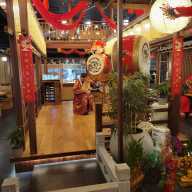
He does not care about the decorations in his restaurant–a fish net, some scarecrows, and witches in the window–or even the dishware.
“I don’t spend money on decorations because that means less for fish. I use cheap plates. I don’t use extra flowers,” he said. “I’m 66. Maybe the service is no good, but the fish is OK.”
The service is just fine.
The Michelin Guide may have skipped over Takesushi, however, because it doesn’t offer fine dining service.
While that omission is fine by Kawada, the lack of media interest is more confounding.
“I know I make the best quality food, I know it,” he said. “But no one comes to review it.”
Reviews usually mean more customers, which means more money to buy better quality fish, which is all that matters in the end.
“I try to use the best fish to make the best quality sushi,” he said. “That is all.”