June 16, 2015 By Christian Murray
Iconic mom and pops stores throughout Manhattan and Brooklyn have been disappearing at a rapid pace and the Sunnyside Chamber of Commerce is backing a city council bill that it believes will stop the hemorrhaging before development and rent hikes set in here.
The bill called the Small Business Jobs Survival Act aims to provide commercial tenants with more clout at the bargaining table when their lease comes up for renewal. Furthermore, it also requires landlords to provide greater notification if they don’t intend to renew a lease due to development.
The Sunnyside Chamber board unanimously decided last month to advocate for the passage of the bill.
The bill has recently been pushed by a group called #SaveNYC that claims that New York’s small businesses continue to close at unprecedented levels and are being replaced by big-box stores such as banks and retail chains.
Jeremiah Moss, who leads the SaveNYC campaign, told the Sunnysidepost: “I’m sick of New York turning into a suburban shopping mall.”
Moss, who goes by a pseudonym, claims that many family-run businesses that have been in operation for decades are being forced to close when their lease comes to an end.
 “They’re not closing because business is bad,” Moss said. “They’re closing because the landlords are doubling, tripling, even octupling the rents — or simply denying lease renewals,” he added, citing Manhattan examples.
“With no penalties to stop them, landlords leave the spaces vacant for months or years, waiting for a national chain, a bank or a high-end business to pay the asking price of $40,000, $60,000, $80,000 a month,” Moss said.
Moss told the Sunnysidepost that the Queens business community should watch out. “If the New York Times says Queens is the new Brooklyn then you are in real trouble because in five years time the chains will come in and mom and pops will be out.”
The Chamber is getting behind the movement for these reasons fearing that what has happened in Manhattan and in parts of Brooklyn is likely to come to Sunnyside.
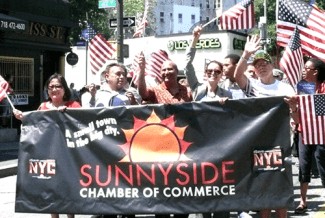
Chamber members such as the Sugar Room, UPS, Pronto and Stray Vintage recently put up “SaveNYC” signs in their window in solidarity of the cause. At Saturday’s Flag Day parade, the chamber marched behind a banner that included the #SaveNYC insignia.
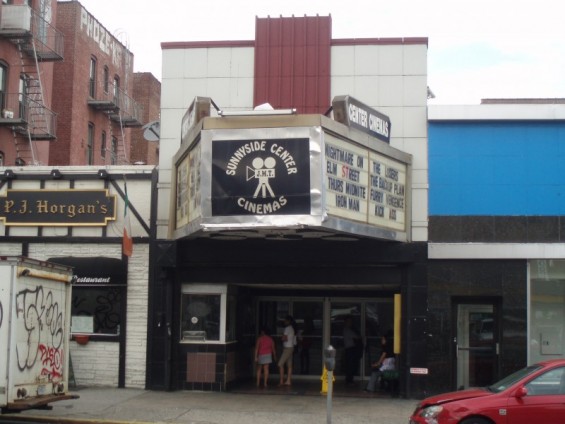
Rigo Cardoso, the president of the Chamber of Commerce, claims that had the bill been in place 12 months ago Sunnyside Cinemas might still be operating—or at least have received better notification prior to its departure.
Rudy Prashad, the former owner of Center Cinemas, said that while he was aware that the movie theater’s future looked bleak, he said that he was only notified five weeks before the lease ended that it would not be renewed. He said he would have liked to have known in advance so he could have planned better for his departure.
The bill, which has 20 council sponsors, is a form of commercial rent control. The bill only applies to commercial tenants in good standing, such as those that have paid the rent on time and have met the terms of their lease.
The significant provisions include (click here for bill):
1) The tenant has the right to renew the lease
2) The bill requires new leases to be a minimum of 10 years
3) If the landlord and tenant are unable to negotiate terms (such as the rent) a “mediator” will be brought in to render a “non-binding” opinion
4) If the parties are still unable to agree, the matter goes to arbitration
5) The arbitrator’s decision is final and is “binding”
6) If the tenant fails to pay the amount required by the arbitrator, he or she is able to stay until a landlord finds another tenant
7) The landlord must provide the existing tenant with the opportunity to match the terms of the prospect tenant
8) If the landlord wants to demolish a building or rebuild the premises when a lease ends, the landlord must notify a tenant one year prior to the termination of the lease so the business owner can make preparations to leave
9) If the landlord wants to operate his own business out of the location after a lease ends, he must notify a tenant 180 days before termination of the lease that it won’t be renewed.
The argument put forward by advocates of the bill is that it will help protect the owners of mom and pop stores, many of whom have put their life savings into their business.
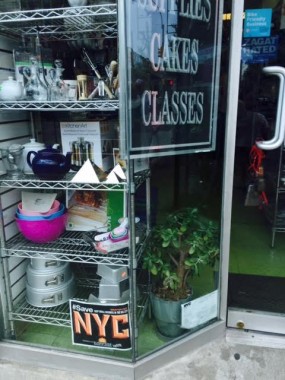
Sugar Room
The bill’s detractors
The real estate industry and a handful of public officials oppose the bill.
Some landlords argue that many commercial property owners struggle too. Many landlords—particularly the smaller ones– have put their life savings on the line to buy a building and they argue that it is not fair to block their ability to maximize the value of their property.
Furthermore, the real estate industry argues that a distorted rental market would also damage commercial property values that would hurt the city’s tax base.
The bill could also put many landlords in a jam if a tenant fails to abide by an arbitrator’s binding decision and does not leave the premises.
They claim that it would be hard to lure prospective tenants to a space currently occupied by an existing tenant—since they would know that they would miss out on getting the space if the existing tenant matches the terms of the lease.
Furthermore, some—such as Manhattan Borough President Gale Brewer– question whether the bill is even constitutional since it deals with property rights.
The supporters of the bill claim that it is constitutional based on the legal opinions they have sought.
Rezoning and development
Moss said the rezoning of many neighborhoods during the Bloomberg years has played a significant role in the closure of many mom and pop stores.
He said that property owners were suddenly able to build bigger buildings that made it much more feasible to knock down existing structures—often occupied by small businesses– and put up new developments.
The retail space that came with the new buildings, he claimed, was then priced at a level that only the chain stores could pay.
“Rezoning stacked the deck in favor of real estate owners,” said Patricia Dorfman, the director of the Sunnyside Chamber of Commerce, referring to this neighborhood’s 2011 rezoning. “The small businesses along Queens Blvd and Greenpoint are in danger to construction and higher rents.”
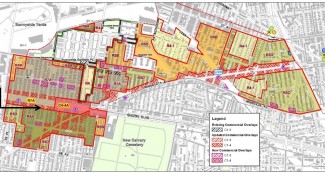
2011 zoning map (click here)
In the past year, a number of small businesses in Sunnyside have closed as a result of development.
King Boulevard, SSS Video and Azteca Restaurant all closed last year to make way for a development on the corner of 48th Street and Greenpoint Avenue.
Meanwhile, Center Cinemas and dentist Dr. Arthur Kubikian were notified that their leases would not be renewed in order for the 43rd Street/Queens Blvd development. Additionally, P.J. Horgan’s landlord has publicly said that he would not be renewing the bar’s lease come June 2018.
Other Queens Blvd property owners are in talks to develop—or sell to developers– their buildings.
Councilman Jimmy Van Bramer has not yet sponsored the bill although he said that he agrees with most of its provisions.
“I have to look at it more closely but I agree with giving business owners better notification and working out fair renewals for people who have paid their rent on time for years and years.”
“We know that there are a lot of successful businesses that have improved properties,” Van Bramer said. “You can’t just throw people out who have been paying the rent on time.”
“You get to know these men and woman who own these cafes, pubs and wine bars and they can be your friends and neighbors…places where good memories are made.”
However, he said that property owners too need to make a return on their investment and that there has to be a solution where everyone can win.
Danny Dromm, a sponsor of the bill who represents Jackson Heights, said that he supports it because he has seen small businesses in his district squeezed out by rising rents.
“I have seen [commercial] rents skyrocket in the neighborhood,” he said.
Meanwhile, Dorfman claims that it is the small stores that create a neighborhood.
“The big chains are not members of the Chamber of Commerce. They do not contribute to local charities and efforts,” she said.