Oct. 29, 2015 By Jackie Strawbridge
Western Queens residents have pushed back against elements of the city’s Mandatory Inclusionary Housing proposal that would allow developers to put required affordable housing units in separate buildings, or not create them at all.
Mandatory Inclusionary Housing is a proposed amendment to New York City’s zoning regulations. If ultimately approved by the City Council, it would require new developments built on land that has been rezoned to increase housing capacity to include 25 or 30 percent permanently affordable housing.
Therefore MIH is particularly relevant to Long Island City, because the City is planning to upzone the Court Square/Queens Plaza region.
However, the MIH proposal offers developers certain outs and alternatives to building affordable units within market-rate buildings, which has raised a red flag to Long Island City residents.
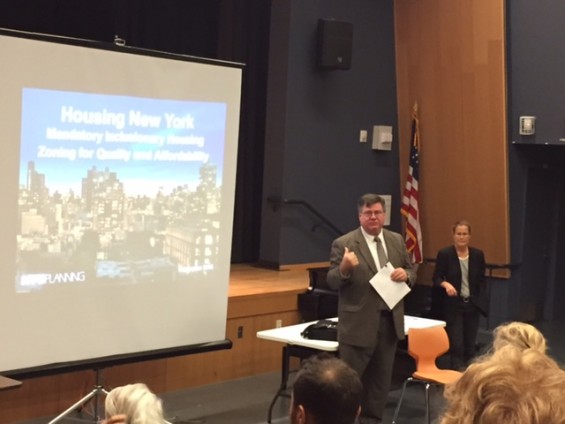
At an information session with the Department of City Planning and the Department of Housing Preservation and Development on Wednesday night, attendees bristled at the potential for developers to build required affordable housing units in separate buildings from market-rate units.
Developers can choose either to build affordable units on the same property as market-rate, but in a separate building, or on an entirely separate property within the same Community Board or within a half-mile, DCP and HPD representatives said.
The crowd responded with skepticism.
“Separate but equal?” one shouted. Another mumbled sarcastically, “[affordable] over there.”
DCP created these options to “maximize flexibility” for developers, representative Penny Lee said.
“We want to make sure we get the affordable housing, so we want to make sure to create enough economic opportunities to make it happen,” she continued.
HPD project manager Michael LoStocco noted that, for separate affordable buildings on the same property, the proposed MIH zoning text includes language intended to prevent “poor door” back entrances and stigmatization.
However, the proposal does not address the quality of the buildings themselves – for example, building materials – because that is not a zoning function, Lee said.
Another element of MIH that raised concerns on Wednesday is the ability to waive affordable housing requirements if the Board of Standards and Appeals finds it would create “unnecessary hardship” for the developer on a particular site.
This option is not exclusive to MIH; developers’ ability to skirt zoning regulations through the BSA has long been controversial. CB 2 Chair Pat O’Brien said Long Island City has already suffered from it, and he wants the BSA exemption removed from the MIH proposal.
“That is a real problem for us,” he said. “[The BSA] often act with a nodding head and a pen that has real negative effects on the people that know exactly what’s going on in the community.”
A study conducted by the office of Councilman Jimmy Van Bramer – who cosponsored Wednesday’s meeting with CB 2 – found that of all appeals brought to the BSA citywide between 2005 and 2011, 87 percent were granted. Three percent were denied and the rest were withdrawn.
Van Bramer has introduced several pieces of legislation intended to reform the BSA, which he noted at Wednesday’s meeting.
However, the DCP appeared adamant that the BSA option be included in MIH.
“There has to be an out,” Lee said. “BSA applies to development throughout the City – there needs to be an out based on unique conditions associated with specific sites.”
A public hearing on MIH – as well as another major proposed zoning amendment called Zoning for Quality and Affordability – will take pace at an upcoming CB 2 meeting, after which the Board will vote on the proposals.
That meeting will take place on Nov. 5 at 7 p.m. at Sunnyside Community Services, 43-31 39th St.
Reach reporter Jackie Strawbridge at jackie.strawbridge@queenspost.com