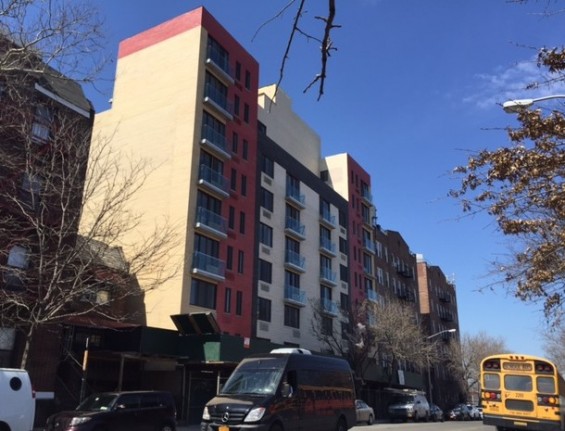
Development on 43rd Street (QueensPost)
Nov. 30, 2016 By Hannah Wulkan
More than half of Sunnyside and Woodside residents are finding it difficult to pay their rent each month and lack the funds to cover their living expenses for three months should an emergency strike, according to a new report.
The Association for Neighborhood and Housing Development recently released a detailed study of the economic well being that residents in different parts of city face. The study is broken down by neighborhoods.
The study concluded that 59 percent of Sunnyside and Woodside residents are rent-burdened, or pay more than 30 percent of their income towards rent.
The study also shows that 57 percent of residents have inadequate emergency savings, meaning they could not cover three months of rent and living expenses out of their savings.
“Without sufficient emergency savings that cover at least three months’ worth of household expenses, families are at risk of eviction, foreclosure, and damaged credit,” the study points out.
The report compiled data from several censuses and city databases to analyze 20 different economic factors—from health insurance coverage to high school graduation rate–by neighborhood. It then ranked the economic well being of residents based on each factor and put together a chart.
Poor scores were “deemed high risk” while good scores were called “low risk.”
“This chart helps residents, community groups, and officials learn about what’s happening in their neighborhoods, build power with other neighborhoods across the city to mobilize for change and get resources, and make informed decisions about equitable development in their local economy,” according to the authors behind the study.
According to the report, there are several areas that are especially concerning to Sunnyside and Woodside, but in general the area is actually doing quite well.
The categories marked as “high risk” on the chart point out that 23 percent of Sunnyside/Woodside residents do not have health insurance and 27 percent of households have limited English spoken.
However Sunnyside and Woodside do better in several categories than neighboring areas. Only 12 percent of residents live below the poverty line, compared to 17 percent in both Astoria and Jackson Heights.
The neighborhood also only has a 4.7 percent unemployment rate, compared to 6.1 percent in Astoria and 5 percent in Jackson Heights.
The study shows a calculated score for the economic well being of residents in each neighborhood, with the best score at 24 and the worst at 76. Sunnyside and Woodside scored 36, putting it in the top quartile in the city, which the chart labels as “low risk.” It is the only area in Western Queens that scored in the top quartile.
Manhattan had the most areas scored as low-risk, or in the top quartile, while The Bronx and Brooklyn both had quite a few areas that were scored as high-risk, or in the lowest quartile, while Queens showed a wide range of economic opportunity.
Economic Well Being by Queens Post on Scribd