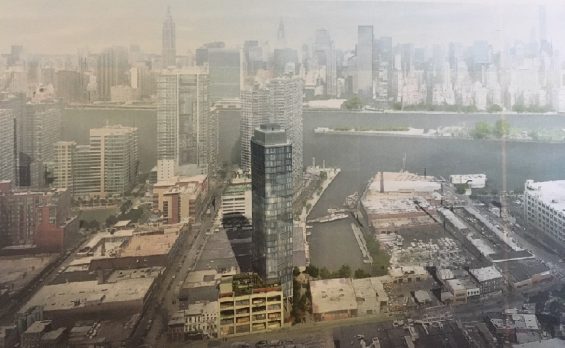
Revised Plan (SHoP Architects)
Nov. 22, 2017 By Christian Murray
The owners of the Paragon Paint building who filed plans in 2015 to develop three residential buildings alongside the paint factory are scaling back their plans following push back from the community that argued the project was too big.
The revised plans filed by Simon Baron Development still call for the construction of a residential tower at 45-40 Vernon Blvd., a site that is currently zoned for manufacturing. The new plan includes a 26-story tower, a complete overhaul of the Paragon Paint building for residential and retail use, and the addition of a one-story building on 46th Avenue on an adjoining lot.
The development would lead to the construction of 248 units of which 30 percent would be affordable at 130 percent of Area Media Income. The plan filed in 2015 called for 344 units.
Simon Baron filed the revised plans in September with the Board of Standards and Appeals as the company seeks a variance that would permit residential use. The company’s initial plans appeared to be making little headway after Community Board 2—merely an advisory body–voted against it 24 to 4 (with two abstentions) in February 2016 on the grounds that it was too big.
The BSA largely agreed with CB2’s assessment that it was out of scale given its Vernon Boulevard location—despite Simon Baron claiming that the project should be compared to waterfront properties given its proximity to Anable Basin.
“We told them from a staff point of view that they would have a difficult time making that argument,” Ryan Singer, the BSA executive director told the LICPost at the end of 2016. “There are not a lot of buildings in that area [by Vernon Boulevard] that are that height.”
The tower under the original plan was to be 28 stories and 294 feet tall. While the revised plan calls for fewer floors—26 stories—the building is only 2 feet shorter at 292 feet.
The tower, however, would be pushed back from the street, similar to the original plan.
The primary difference from the original plan is that the developer no longer intends to construct a 13-story building alongside the proposed tower on Vernon Boulevard. In addition, an eight-story building that was originally proposed to go up on 46th Avenue has been scaled back to one story that would be used for retail and connect to the tower.
The plans for the paint building remain, with loft-like units on the upper floors and retail on the ground floor.
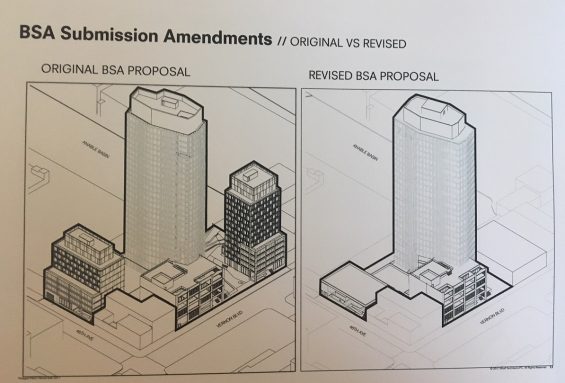
SHoP Architects
“We took a few hits last time, we understood and listened,” said Todd Sigaty, of SHoP Architects, at Community Board 2’s Land Use Committee meeting last week. “It is now smaller in scale than it used to be.”
Matthew Baron, president of Simon Baron, told the committee said that the revised proposal would still provide public access from Vernon Boulevard through to Anable Basin, which includes open space—something that his company is not required to do. The public access was included in the original proposal.
Simon Baron is likely to spend about $15 million cleaning up the contaminated site—where paint and varnish was manufactured for decades. The company is likely to recoup a portion of those remediation costs though New York State’s Brownfield Cleanup Program. The monetary amount is not yet known.
The original plan was panned mainly because it was deemed too big in comparison to other Vernon Boulevard buildings—thereby changing the character of the area. The board’s view was that large building like these should be located by the East River.
Developers in need of a zoning change have just two avenues to get it altered—through the BSA or through the City Planning’s ULURP process. Most developers go through ULURP, where the rezoning process–if successful– takes about nine months and involves a City Council vote.
The BSA track, which is a less cumbersome process, can only be taken if special criteria are met.
To meet BSA standards, developers such as Simon Baron must prove that their property has a unique physical condition that poses a financial hardship.
Simon Baron is claiming that the cost of cleaning the site has caused hardship. The company claims that it needs a zoning variance in order to build a structure where it can overcome the enormous cost of the cleanup.
The company is in the midst of a remediation program where it is clearing the contaminated soil, treating the ground water as well as replacing the timber bulkhead/seawall that touches Anable Basin.
The BSA, before it approves an application, also wants to make sure that the variance wouldn’t result in a building that would change the character of a neighborhood.
Last week, Plaxall announced its proposal to rezone nearly 15 acres of Hunters Point, which includes 12.7 acres of Plaxall property plus a handful of other sites including the Paragon Paint building.
Baron said that the tower doesn’t appear to be out of context given the plans put forward by Plaxall. He said the Plaxall proposal includes buildings that are nearly 700 feet tall.
Baron said that his project can act as a yardstick for the proposed rezoning. “We can put a stake in the ground, where you can say, this was way below [what the others are proposing via a rezoning] and they put in public space and affordable housing.”
Pat O’Brien, a CB2 committee member, said that pointing to the Plaxall proposal is not a good gauge since it has yet to be reviewed. “We don’t have a crystal ball and don’t know what the end result will be,” O’Brien said, adding that the proposal shouldn’t be used to determine neighborhood context at this point.
With the Paragon Paint building being located within the 15-acre area proposed for rezoning though ULURP, Baron’s company could wait for the property to be part of the comprehensive rezoning.
However, the firm seeks a variance via the BSA—since it could be two years before the 15-acre area is rezoned and it claims the property meets the BSA criteria.
In addition, the rezoning plan put forward by Plaxall calls for the addition of manufacturing and other mixed uses that the current Paragon Paint plans don’t include.
O’Brien argued that by going the BSA route there will be inconsistency in land use in Hunters Point. He said that Plaxall is seeking a rezoning, the Economic Development Corp is also seeking to rezone its 44th Drive site, and there is Paragon Paint’s BSA application.
O’Brien said that the three projects are so intertwined that it makes more sense for there to be one coordinated zoning process for the entire area. He said there could be three different requirements for sites that are next to one another.
Simon Baron plans to go before the BSA during the first quarter of 2018 for a decision. It no longer requires a community board vote.
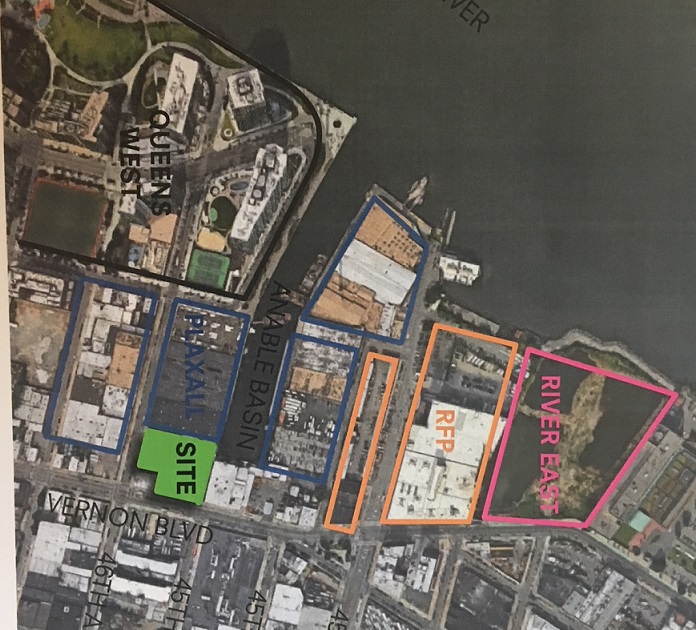
Plaxall, Paragon Paint and EDC sites (SHoP Architects)