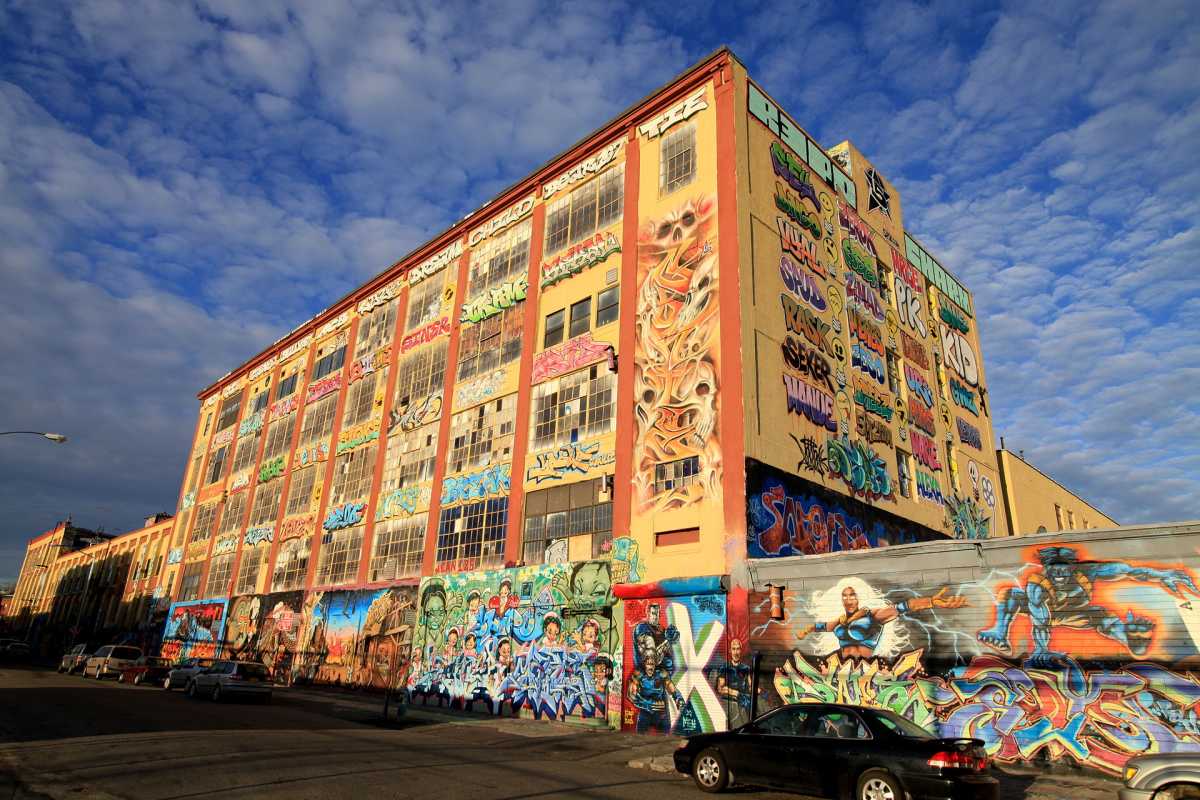
View of the front of 5 Pointz in Queens NY (2013). Photo by Ezmosis/Creative Commons)
Feb. 15, 2018 By Christian Murray and Nathaly Pesantez
The developer of the former 5Pointz site says he will appeal a federal judge’s ruling awarding $6.75 million to 21 artists whose rights were violated when he whitewashed and destroyed their works in 2013.
Jerry Wolkoff, the owner of the site where two luxury residential buildings are now rising, says the Feb. 12 ruling by Eastern District Judge Frederic Block “makes no sense.”
“The whole thing is so silly,” Wolkoff told the LIC Post. “They shouldn’t get one penny. Hopefully the judges [in appeals court] will see how ridiculous this all is.”
Wolkoff argued throughout the five-year case that the artists’ murals were not protected because of their ephemeral nature. He also said the artists were aware that the building would one day be demolished, and that as property owner, he has the right to do as he wishes with his site.
“They always knew that one day I would be taking it down,” Wolkoff said.
7-Angle Illusion by Jonathan Cohen, one of the 45 works awarded statutory damages. Each work was awarded $150,000, and Cohen, the curator of 5Pointz and the plaintiff with the most murals, was awarded over $1.35 million in the case.
In his decision, Block said that 45 of the works under question were protected under federal law. The damages assessed for each art piece was $150,000.
Wolkoff’s choice to willfully paint over them, Block added, was the leading factor in the court’s ruling to award damages.
“If not for Wolkoff’s insolence, these damages would not have been assessed,” Block wrote. “If he did not destroy 5Pointz until he received his permits and demolished it 10 months later, the Court would not have found that he had acted willfully.”
But Wolkoff said the artists had more than enough time to save their art works, since he had started to seek municipal approval for his condos well over a year before the November 2013 whitewashing of the murals. And prior to that, rumors of his plans to shut down 5Pointz first appeared in 2011, according to court documents.
“For two years there were all these hearings by the city, and [the artists] came out fighting to save it,” Wolkoff said.
Block, however, wrote that Wolkoff “could care less” about giving the artists time to salvage their works, and spoke to his “recalcitrant behavior” both in his whitewashing and in court.
“He was bent on doing it his way, and just as he ignored the artists’ rights he also ignored the many efforts the Court painstakingly made to try to have him responsively answer the questions posed to him,” Block wrote.
He added that the court could only logically infer that that Wolkoff’s whitewashing “was an act of pure pique and revenge.”
Eric Baum, the lawyer representing the artists, said the court found that Wolkoff violated federal law, and that an appeal, if actually filed, would be unsuccessful.
“We don’t see any basis on appeal for overturning any part of the court’s decision,” Baum said.
The lawyer added that Wolkoff did not respect the rights of the artists he allowed to have paint over the warehouse, and that he could have given them a 90 day notice under VARA to protect and record their works.
“It could have limited his responsibility,” Baum said. “Coupled with showing dignity and respect, and a proper goodbye to their artwork.”
Baum said that the litigation concerned the competing rights of Wolkoff as owner of the site versus the intellectual property rights of the artists.
“Wolkoff owned the real estate, but he did not own the art,” the lawyer said. “Both could have lived in harmony with one another, but he took matters into his own hands.”
Wolkoff declined to say when he would be filing the appeal.