Citylights from Gantry Plaza State Park (Photo: WiredNY)
July 10, 2018 By Christian Murray
The residents of Citylights are being slammed with a tax hike and are calling on the city and state for relief.
The residents of the 522-unit building at 4-78 48th Avenue face a 60 percent hike in their monthly maintenance bills over the next five years. The jump is to cover property taxes, since the building’s 20-year tax abatement is being phased out and the building’s assessed value has almost doubled in the past two years.
“My maintenance is going from $2,600 [per month] this year– to $3,900 [per month] in 2022,” said Shelley Cohen, the treasurer of the co-op board. She said that the building has been forced to raise its maintenance 9 percent this year and will be raising it 9 percent each year for the next five years to cover taxes.
“If the city and state don’t do anything people are going to be forced out of their homes,” Cohen said. She said that many co-op owners are unable to cover the abrupt increase and will have to leave.
Residents have held rallies in recent weeks to get the message out about their financial woes. Many turned out when the ribbon was cut on phase II of Hunters Point South Park–to let city and state officials know. They also held a protest in front of the Museum of the the Moving Image when the LIC Summit was held.
“Save Citylights” and “No Longer Affordable,” the protest signs read at both events. Banners have also gone up on 49th Avenue and Center Boulevard to get the word out.
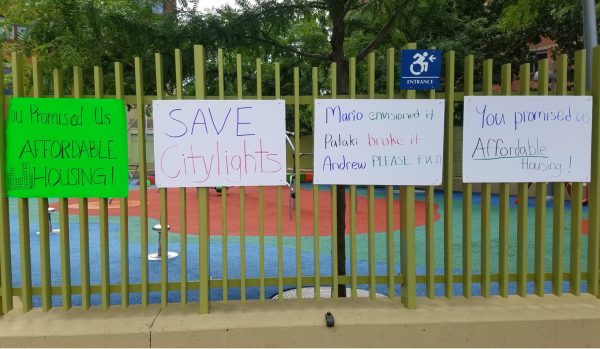
Banner at 49th Avenue and Center Boulevard on July 4(Photo: Shelley Cohen)
The 42-story cooperative is a well-known Hunters Point building, since it was the first high-rise residential development to go up on the waterfront when it opened in 1997. At the time the area was desolate, undeveloped and industrial.
The state, which owns the land that Citylights sits on, wanted to develop the area and worked with developers to get middle-income people to move to the neighborhood.
The state devised a plan where it would attract people through low purchase prices. Studios could be bought for as low as $10,000 and 3 bedrooms for $65,000. The concept was to attract pioneers and middle-income buyers to the area by offering affordable prices, with the trade off being higher maintenance.
The co-op owners were collectively responsible for an $86 million mortgage that covered a large chunk of the development costs. That mortgage kept purchase prices low but inflated maintenance payments in order to service the debt.
For some the deal paid off, with co-op units fetching sizable sums over the years. The average price paid for a unit was $645,000 in 2017, according to a report released earlier this year by Patrick W. Smith, a broker with Stribling and Long Island City resident.
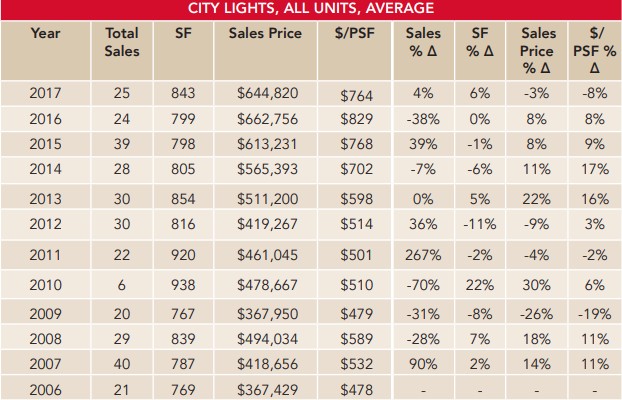
The Citylights Market Report by Patrick W Smith, broker with Stribling
But property values are starting to drop as the maintenance increases, Cohen said.
In March 2018, a 700-square-foot one bedroom sold for $570,000 and a 1,200-square foot 2 bedroom unit sold for $800,000, according to real estate records.
“Why would someone want to pay $6,700 per month to carry a mortgage and maintenance on a 2-bedroom unit here when they can rent a luxury unit nearby for $4,800,” Cohen said.
Despite the increase in property values over the years, residents argue that the spike in maintenance will force many of them out. Cohen said about 40 percent of the owners are the same middle-income people who bought back in the 1990s and can’t afford the jump.
They argue that they were the people who took a chance on Long Island City and helped make the area what it is today and should not be pushed out.
They claim that they bought their units because the state promised them that the units would be affordable–and now they are not. Cohen said if they were forced to sell their units, many would struggle to find another property since real estate has become so expensive.
Residents who purchased units in later years are also victims, Cohen said, since they had no idea that the city would almost double the building’s assessed value leading to a big hike in taxes.
In 1997 when the co-op was launched the state provided a 20-year property tax abatement to co-op owners as part of the payments in lieu of taxes (PILOT) program. Under the program–similar to the 421a tax exemption program—the owners didn’t have to pay property taxes until June 30, 2018.
The tax is now being phased in at 20 percent per year until 100 percent of the taxes are payable starting July 1, 2023.
The tax bill, however, is dependent on the assessment determined by the City’s Department of Finance. The city assessed the building at $51.7 million in 2016, $96.9 million in 2017 and $101.6 million in 2018.
Starting July 1, 2018, the building is on the hook for $800,000. By the end of phase out it will be $5.8 million, assuming that the assessed value isn’t hiked, Cohen said.
Joanna Rock, who is the president of the board for Citylights, said the co-op is different from condos and other buildings with 421a tax benefits. She said Citylights was marketed as middle income housing by the state and is on state land.
Additionally, she said the state and city are partly to blame for their conundrum. “We are victims of a broken NYC tax system as well as mistakes by the agency that conceived and built Citylights, Empire State Development Corp.”
She said that Citylights has always struggled with maintenance, since the initial $85 million debt placed on the co-op owners was so high that they had almost no chance to pay it back. Furthermore, the building was so poorly constructed, she said, that they have spent more than $10 million in repairs on it with an additional $6 million projected over the next five years to replace elevators and HVAC units.
The annual maintenance to cover the building in 2017 was $10 million—which covers about $4.5 million in debt servicing on the approximately $85 million loan, $470,000 in ground rent to the state and operating costs. The annual maintenance will be $16 million in 2022 when the abatement phases out.
State Sen. Mike Gianaris said that given the tax hike the state needs to renegotiate the phase in period to give the coop owners more time. “It’s not that these people don’t want to pay, it’s just they need more time to be prepared.”
He said the abatement should be extended to 35 years to allow them more time.
“These are the people who have made this community what it is. These are the people who have made it so desirable for others to come here, and the last thing we want to do is drive them out of the neighborhood because it has become too expensive,” Gianaris said last month.
He said that the state is prepared to negotiate the tax rebate period but it needs the city to give its approval. A negotiation can’t take place unless the city gives it the OK.
“New York State stands ready and willing with a workable solution to address the needs of residents of Citylights and we are waiting on the city’s mandated written consent to move forward,” according to the Empire State Development Corp.in an e-mail.
The State cannot legally move forward without city action. The PILOT agreement requires the city’s express “written consent to amend or modify any lease provision relating to or effecting PILOT payments,” according to ESDC.
The city did not say whether it would provide such consent.
“We are aware of the issues surrounding the Citylights building and will continue to work with the property owners and board to the extent we legally can,” according to city spokesperson.
The New York City Tax Commission is reviewing Citylights’ appeal for the property’s 2018-19 tax assessment, and while the appeal is pending, the Department of Finance does not have the authority to make any changes or adjustments to the property’s valuation.”
Councilmember Van Bramer is calling on the city and state for a solution.
“The increased assessment and tax increases for the residents of Citylights puts an extreme burden on many residents who will have to move if the city and state don’t come together with a solution,” Van Bramer said in a statement.
“Many Citylights residents are middle to low income,” he said.