Outside Sunnyside Point at 47-16 Greenpoint Ave. (Photo: Nathaly Pesantez)
Sept. 6, 2018 By Nathaly Pesantez
A new housing lottery at an upcoming building in Sunnyside has left many bewildered over its eligibility guidelines, with claims that the available units are anything but affordable, and indicative of an unfolding crisis in the city.
The city opened up a housing lottery last week for three middle-income units at “Sunnyside Point,” the 10-unit, four-story building still under construction at 47-16 Greenpoint Ave.
The affordable units—one one-bedroom and two two-bedrooms—have a monthly rent of $2,251 and $2,714, respectively.
As for income requirements, one person, for instance, would need a salary between $77,178 and $95,030 to qualify for the one-bedroom apartment offered in the lottery.
Reactions to the housing lottery, in a neighborhood with a median income of around $57,000 and still unaccustomed to seeing even average market-rate rents at those prices (a sizable one-bedroom typically goes up to $2,150), were swift.
“None of this is affordable,” one Facebook user wrote on the Sunnyside Post’s article on the lottery.
“My one bedroom is nearly half of this in Sunnyside and I split!” another Facebook user wrote. “That is absolutely not affordable.”
Brent O’Leary, president of the Hunters Point Civic Association and City Council candidate, slammed the “so-called” affordable housing lottery during a last-minute press conference a week ago.

A press conference organized by City Council candidate Brent O’Leary against the affordable housing lottery at the building pictured left. (Photo: Nathaly Pesantez)
“Right now, there are thousands of Sunnyside and Woodside residents who are deeply afraid of being priced out of their own neighborhood, and by claiming that $2,300 a month should be considered affordable is a slap in the face to all the people who call this neighborhood home,” O’Leary said.
Yet the three available units have been labeled as such, with the developer to receive an as-of-right tax exemption through the state’s 421a program, administered by the city’s Department of Housing Preservation and Development. The three units will also be rent stabilized and subject to rent stabilization laws.
The 421a program grants partial tax breaks for a period of about 10 to 15 years to developers who provide a percentage of affordable units in newly-constructed buildings.
The developer, AB Capstone, chose an affordability option that sets aside 30 percent of units to households making 130 percent of the Area Median Income (AMI) in order to get to tax break.
While AMI is set by the federal government, the city is required to use these figures when dealing with affordable housing.
When asked about the backlash to the housing lottery in Sunnyside, the HPD said units around the city are made available to people in several income tiers.
“The Housing New York plan builds and preserves affordable housing for a wide range of New Yorkers, with the majority of the homes serving low income residents,” said Matthew Creegan, HPD spokesperson.
For Lisa Deller, chair of Community Board 2’s Land Use committee with a deep background in affordable housing, the Sunnyside Point housing lottery shows issues with the 421a program and affordable housing in the city.
“They’re getting a lot of tax benefits for three units. I mean, really?” Deller said. “That’s pretty unconscionable, to just get a large tax abatement for three units. We can do better.”
Deller said the 421a program should require more affordable units and at deeper income levels to truly be considered a public investment in exchange for tax breaks. She pointed to the existing struggles residents within Community Board 2 are going through, where 45 percent of households are considered rent burdened as they are spending more than 35 percent of their income on rent.
Additionally, Deller questions whether the 421a program in a city continuously growing ever skyward is actually needed.
“421a used to be for very distressed neighborhoods to incentivize developers to work there,” she said. “These aren’t distressed neighborhoods. Do we really need to incentivize them here? I don’t think we do.”
While the area has yet to see many developments and affordable housing lotteries spring up compared to neighborhoods like Greenpoint and Long Island City, several are already in the pipeline, and the neighborhood’s growing profile will likely bring more of these developments—with similar prices and affordable units—soon.
Sunnyside Point is expected to open its residential portion in March 2019. It’s market-rate units, based on listings on apartments.com, range from $2,400 for a studio and $4,000 for a two-bed, two bath.
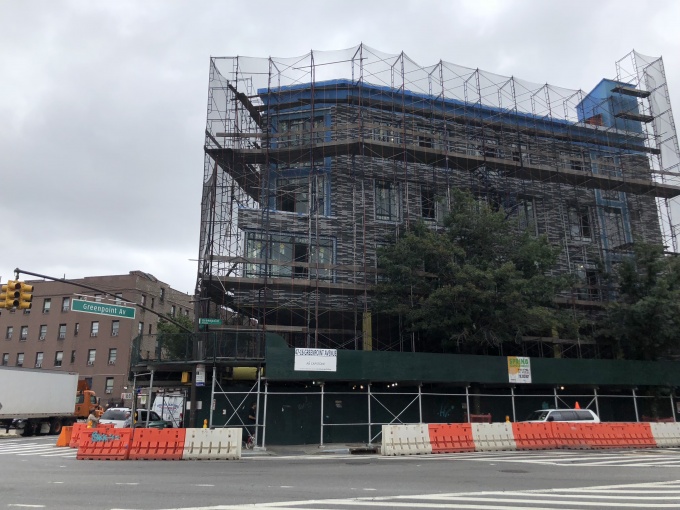
Sunnyside Point, at 47-16 Greenpoint Ave., seen from Queens Boulevard (Photo: Nathaly Pesantez)