Queens Community Board 1 Meeting Thursday at Astoria World Manor
Oct. 14, 2019 By Christian Murray
The Astoria World Manor was filled to capacity Thursday night as residents went to weigh in on a proposed 8-story development that would rise on 46th Street near Ditmars Boulevard.
Mega Realty Holding, an Astoria-based real estate company, is seeking to rezone 22-60 46th St. in order to construct an 88-unit apartment complex that would include a 250-seat community theater and 6,500 square feet of retail space. The site is currently zoned for manufacturing.
The theater would be leased and operated by the Pancyprian Association, a group founded by Cypriots in 1975 that focuses on culture, dance, theater and sports.
Community Board 1 voted on the proposal at the end of the night, rejecting it by a vote of 21 to 12 unless Mega modifies the plans to meets a number of conditions. These conditions include reducing the height of the building and providing units at more affordable income levels. The vote is advisory and is part of the public review process.
The vote, however, followed an impassioned public hearing where about 20 people spoke on the project, with many for and against it. Most of the supporters were members of the Greek/Cypriot community touting the benefits of the theater.
The naysayers were largely long-time Astoria homeowners.
“Piece by piece developers are destroying neighborhoods. It begins with one project and others follow,” said Al Rizzo, a member of the Astoria Homeowners Association. “Quiet residential neighborhoods are now being overpopulated by big developers.”
Tony Mazzara, president of the Astoria Homeowners, Tenants and Business Civic Association said that the project is too large, since it is near one-and two-story houses. He said that his fellow members believe it would overwhelm the infrastructure, such as the bus network.
But supporters such as Philip Christopher, president of the Pancyprian Association, said the development is good for the community. He said that 80 percent of the association’s members live in Astoria and that a cultural center/theater is good for bringing communities together. The center would also be available for other groups.
Marie Torniali, the chair of Community Board 1, asked the crowd whether they supported the project. The majority of the attendees raised their hand in opposition to it.
Mega did a presentation of the plans before the public and the board weighed in.
Emanuel Kokinakis, Mega’s development manager, said that the company had addressed many of the concerns presented by the board’s Land Use Committee in recent months.
He said that the original plan was for 136 units, with 78 of them being studios. However, he said, in response to the board’s request to build larger, family-sized units Mega reduced the number to 88, with 60 percent of the units being 2-and 3-bedroom units.
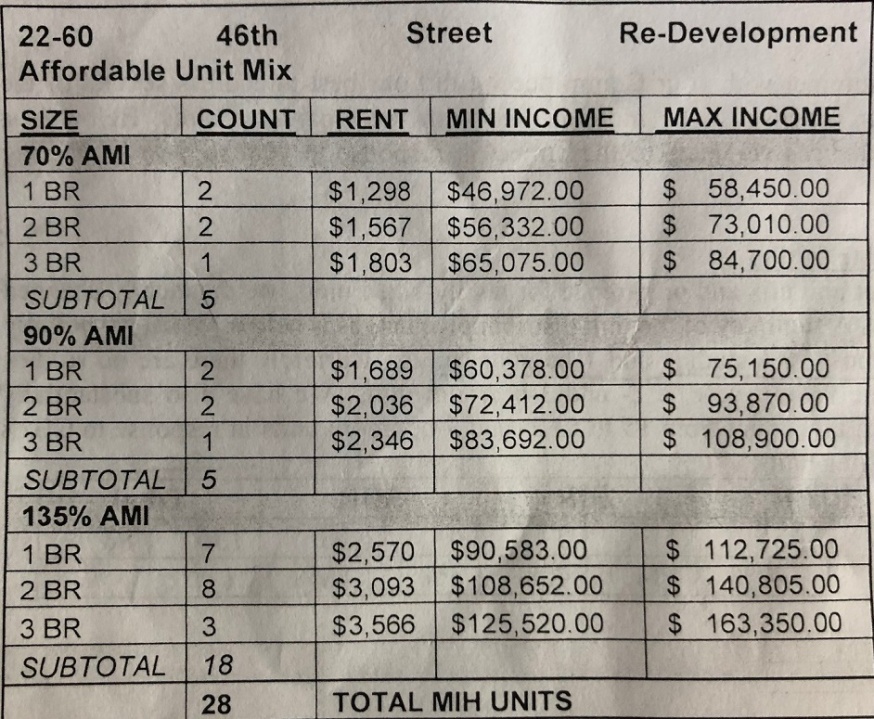
Proposed Affordable Housing Mix at Mega 22-60 46th St. Development
Mega is required to provide an affordable housing component as part of the rezoning under the City’s Mandatory Inclusionary Housing program. The company has elected to provide the “workforce housing” option under the program–where 30 percent of the total residential floor area must be for housing units for residents with incomes averaging 115 percent of the Area Median Income.
Mega plans to build 28 affordable units to meet the MIH requirement, with 18 of those units being for households earning up to 135 percent of the AMI. A one bedroom at these income levels would be $2,570, 2 bedroom $3,093 and a 3 bedroom $3,566.
The 10 other units would be at lower price levels, with five units at 90 percent AMI and five at 70 percent AMI.
Board member Nancy Silverman said that the income levels for the affordable units are too high for many residents and asked Kokinakis to offer “Option One” under the MIH program.
Option One requires at least 25 percent of the total residential floor area to households at an average of 60 percent of the AMI.
“The real need in Astoria is affordable housing—not luxury housing so why can’t you do better,” Silverman said.

Kokinaskis said that it was not financially feasible to do so. He said that since there are only 88 units and 11,000 square feet is being allocated to a theater Option One was not doable.
Mega aims to complete the rezoning process early next year and break ground in spring of 2020. The company anticipates that it will take two year to construct the building.
The affordable housing would be managed by Astoria-based HANAC and the lottery process would begin about 6 months before the completion of the project. There would be a 50 percent preference for residents of Queens Community Board 1.
The rezoning application also dealt with parcels beyond the specific development site, such as some of the nearby houses that do not conform to current zoning. These parcels would be rezoned R4 to put them in compliance.
The board voted against the project unless about 10 conditions are met. Some of the items the developer has already agreed to do.
The conditions included:
- 1) Reducing the height of the building to reflect the surrounding residential context, excluding the Pistilli building from being considered as contextual.
- 2) Making sure that the height in the setback of the front wall does not exceed six stories.
- 3) Choosing Option 1 of the MIH to reduce the affordable housing income levels. The board does not support the “workforce housing” option.
- 4) Limiting the number of units to 88.
- 5) Making sure there are no studio apartments, with 40 percent of the units being one-bedroom, 42 percent two-bedroom and 18 percent three-bedroom.
- 6) Providing landscaped areas for public use.
- 7) Increasing the number of parking spaces (from the proposed 70 spaces) and offering parking discounts to tenants
- 8) Limiting theater use to nonprofit community and cultural groups
The plans will now be reviewed by the Queens Borough President who will provide an advisory opinion before the proposal goes on to the City Planning Commission and the City Council to be reviewed. The City Planning Commission and the City Council’s decisions are binding.