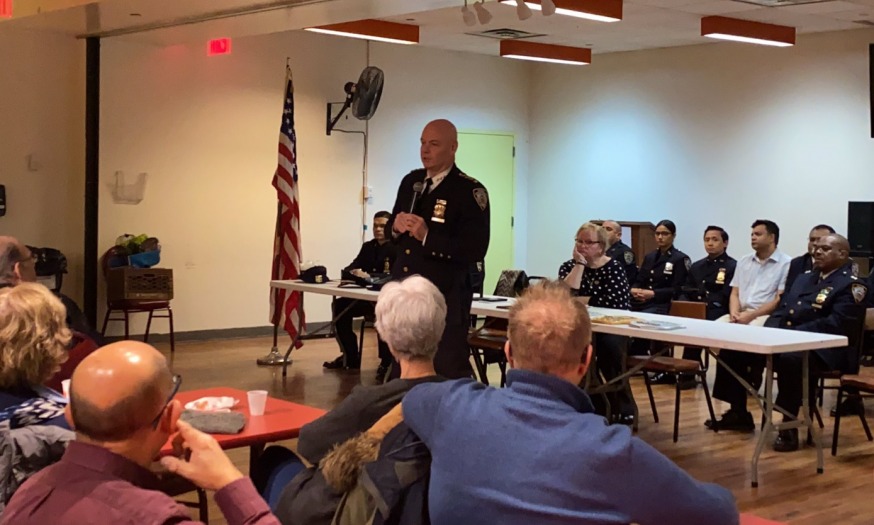
NYPD Chief of the Department Terence Monahan speaking the 108 Precinct Council Meeting in Sunnyside Tuesday (Photo: @nypd108)
Jan. 30, 2020 By Christian Murray
The state’s new bail reform law is putting public safety at risk and is making it harder for the NYPD to combat crime, according to a high-ranking NYPD officer who spoke at the 108 Police Precinct Council meeting in Sunnyside on Tuesday.
Terence Monahan, NYPD Chief of the Department, said that the new law has already led to an uptick in crime this year. Across the city, major crime is up 11 percent for the year through Jan. 19 and in the 108 Police Precinct there were 49 crimes reported vs. 34 for the same period in 2019.
“We are going to see the numbers rising and more people getting victimized,” Monahan said, who has been a cop for 38 years and is the highest-ranking NYPD officer in uniform. “These aren’t just numbers but these are people.”
Monahan is urging residents to reach out to their state representatives to put pressure on them to modify the law. He said he is going to precinct meetings across the city advocating for change.
“2020 is going to be a challenging year for us—you see it already,” Monahan said. “You have all heard about bail reform. Well, we are feeling the effects of it and make no doubt about it—a lot of what is going on out there can be related to bail reform.”
Under the law, people charged with most misdemeanors and non-violent felonies are no longer required to post bail and have to be released. A judge has no discretion to keep them in custody.
Crimes subject to the new bail reform laws include stalking, assault without serious injury, burglary, many drug offences and certain robberies. Individuals facing these charges remain free until their cases move through the courts.
Under the previous rules, judges could only set bail based on whether a defendant was likely to show up in court—and not whether he or she posed a risk to public safety. However, over time, judges used bail as a means to keep individuals with long criminal records behind bars.
Advocates for reform say that people are innocent until proven guilty and that the previous policy favored the wealthy, who have the cash to afford bail. They say that the old policy unfairly led to the poor–and particularly people of color– being incarcerated due to a lack of funds.
Furthermore, supporters of the bail law say the police are being alarmist—and that judges are still able to set bail for violent felonies.
Monahan, however, gave examples of recent cases dealing with bank robberies and car thefts, where convicted felons were arrested—then let go—only to do the same crime soon after.
Deputy Inspector Michael Gibbs, the 108 Precinct Commander, said that he was concerned that a career burglar who has been targeting homes in the area will be released upon arrest.
But Monahan said that state legislators don’t need to repeal the law, just amend it to protect public safety. He said much of the reform was needed.
“Cash bail for someone who can’t pay $100 to get out of jail is not fair—I completely agree,” Monahan said. “But no bail and out on the street for a 5-time convicted burglar who burglarizes houses is not fair to the public.”
He said that judges should be given discretion to set bail on the basis of public safety, and the judges should be held accountable to the public. He said that judges are elected and that the public should monitor their decisions.
“If a judge lets everyone walk it should be made public—and if they throw away the key for someone who is trying to feed their family that too should be public,” Monahan said.
Monahan said that NYPD Commissioner Dermot Shea spent time up in Albany last week trying to convince legislators that the law needs changing.
“We don’t need it repealed—just adjusted,” Monahan said. “It can make all the difference in the world to public safety.”
Bail Reform by Queens Post on Scribd