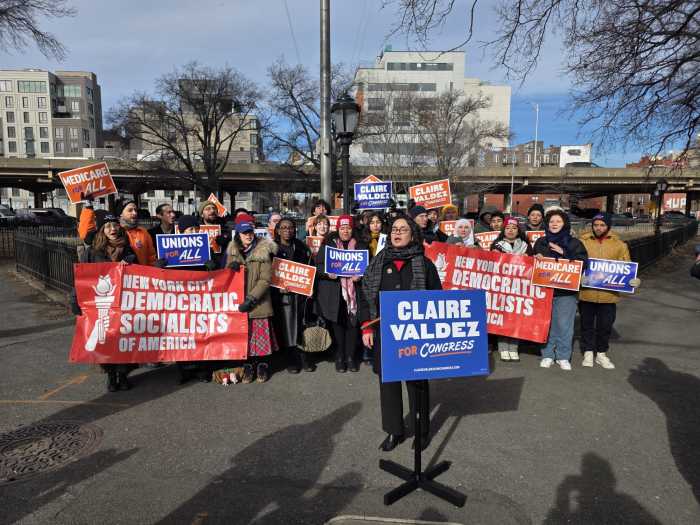

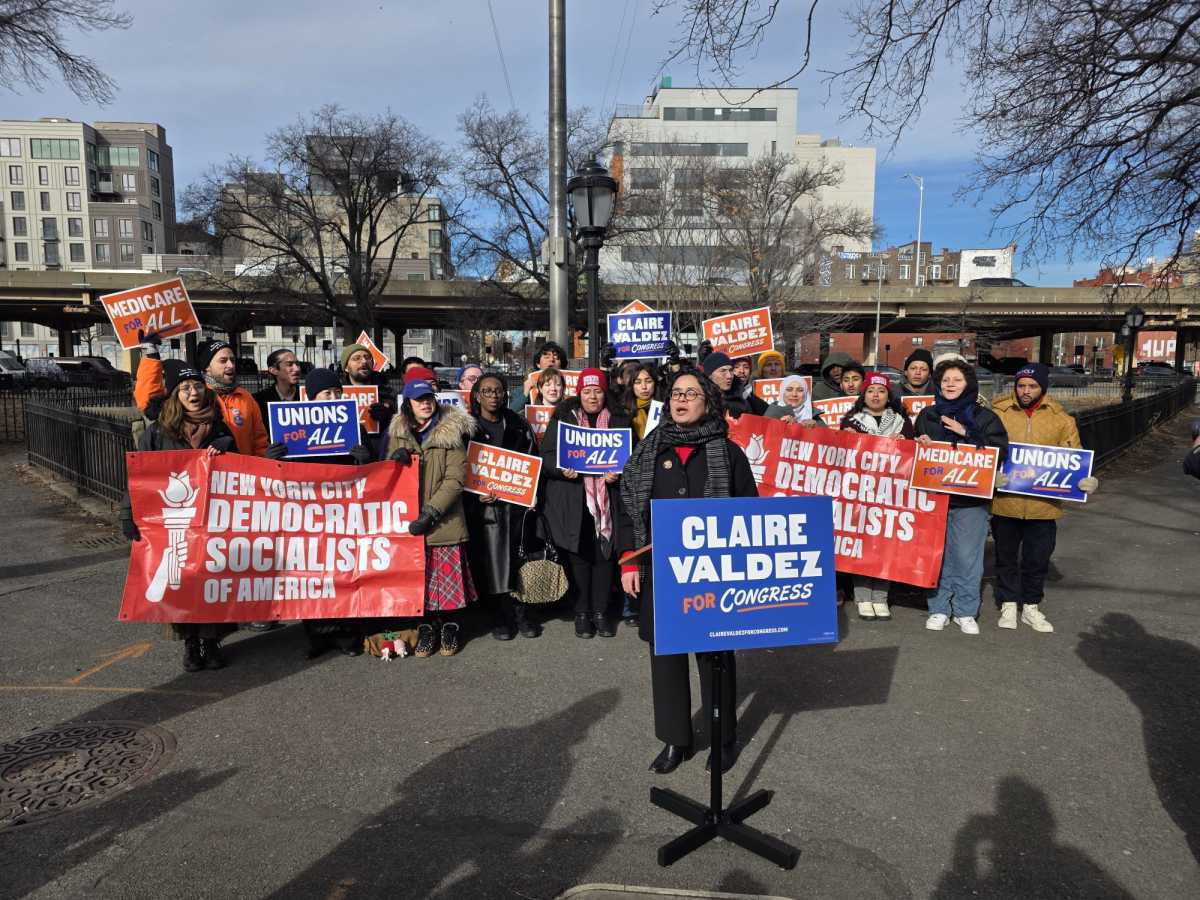
When Assemblymember Claire Valdez joined the race to succeed U.S. Rep. Nydia Velázquez in the 7th Congressional District, she did so out of a desire to increase union representation in Congress.
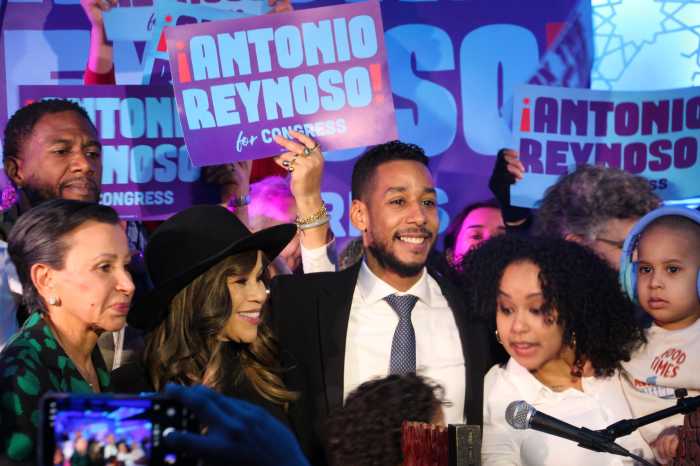
Valdez, a member of the New York City chapter of the Democratic Socialists of America (DSA), is running against Brooklyn Borough President Antonio Reynoso — a fellow progressive lawmaker – to succeed Velázquez in one of the most left-leaning congressional districts in the entire country, which straddles Western Queens and North Brooklyn.
The two candidates are closely aligned on a number of campaign policies, pledging to tax the rich, abolish ICE and introduce measures to address the housing crisis if they are elected. Both are also prominent labor organizers and appeared alongside one another outside an Amazon warehouse in Woodside last month in support of workers’ efforts to unionize.
However, like many other races in western Queens, the race to succeed Velázquez pits a DSA-backed candidate against a traditional progressive candidate in a part of the city often dubbed the “Commie Corridor” due to the support that Mayor Zohran Mamdani enjoyed during the 2025 mayoral election.
Reynoso is a traditional lawmaker molded by Velázquez and has received an endorsement from the veteran lawmaker, with Velázquez citing his more than a decade of experience in elected office.
Valdez, on the other hand, is a close Mamdani ally and picked up an endorsement from the mayor within 24 hours of launching her campaign earlier in January. Valdez has represented the 37th Assembly District for a year but has a strong background in the labor movement with UAW Local 2110.
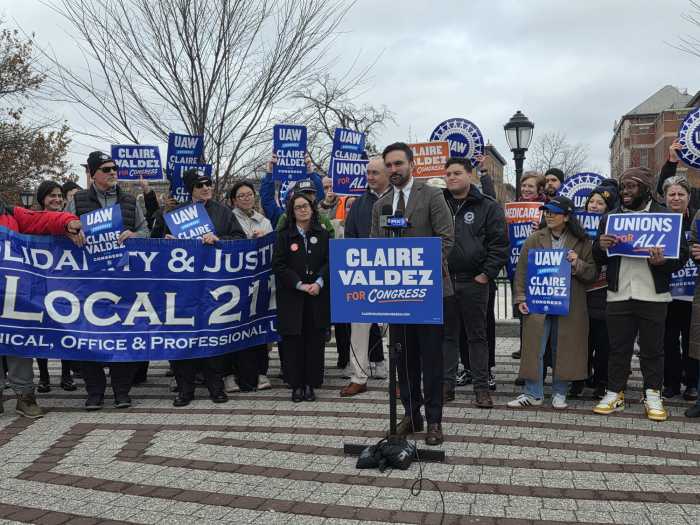
She believes that her experience working minimum-wage jobs and fighting against multi-billion-dollar institutions will resonate with voters on the campaign trail.
Among Valdez’s campaign priorities is the Protecting the Right to Organize (PRO) Act, which would strengthen workers’ rights to join and form unions, collectively bargain and strike for better working conditions.
She also signaled her support for U.S. Rep. Alexandria Ocasio-Cortez’s Homes Act, which would establish a new federal housing development authority that would build millions of permanently affordable homes across the country.
QNS spoke to Valdez about a range of campaign issues in a conversation last week. The interview has been edited for length and clarity.
When the Congress member announced that she wasn’t seeking re-election, what made you decide to run for Congress?
It was a very difficult decision. I initially did not want to do it. I had many conversations with colleagues within New York City, DSA, in the legislature, in my union – UAW.
Ultimately, the reason I decided to run was the same reason I ran for state Assembly – because I was asked to. I think this is a moment when unions have never been more popular in the United States, when energy around the labor movement has never been higher, but we do not see that energy reflected in Congress. There’s only a handful of members who have any direct experience with labor movement, and I think it’s really essential that experience goes to Washington.
This district straddles two boroughs. You’re familiar to voters in Queens, but not so much to voters in Brooklyn. How do you plan to bridge that gap and reach voters who might not know much about you?
This is the work of the campaign. Thanks to the New York City DSA endorsement, we’ll be marshaling many thousands of volunteers to go out and knock on doors.
I’ve been taking meetings with community leaders and activists all over Brooklyn, and the goal right now, really is to hear directly from the people who live in New York-7 across Newtown Creek about the challenges in their lives.
Truly, our struggles are the same in Brooklyn and Queens. Our rent is too high, childcare is too expensive – although we are now seeing some improvement there – utilities are unaffordable.
This is a district with many, many immigrant neighborhoods and communities that are feeling terrified by ICE and by this administration’s insistence on trampling our constitutional rights.
This race features two left-leaning candidates who are ideologically very similar on a lot of issues. How do you differentiate yourself from someone who, on the surface, is very similar to you in terms of policy?
In a sense, it’s a good thing that there’s a broad consensus on the main policy platforms – Medicare For All, abolishing ICE, taxing the rich. Those are very good things. We want to see consensus in this district.
The experience I’m bringing really is as a union organizer, as somebody who has defended my co-workers against Columbia University, a multi-billion-dollar institution. I’m someone who has walked dozens and dozens of picket lines, who was at the Amazon facility in Woodside last month, but was also at their Maspeth facility and their Staten Island facility when they were on strike at the end of 2024.
I have also had a very clear and consistent record on speaking out against the genocide in Gaza. I’ve been naming the US complicity in it over the last two years, organizing around it, marching in the streets.
That is going to be something that will speak to people.
What do you say to people – like Nydia Velázquez – who say you lack the experience for Congress?
I have the experience of having to pay rent every month, of having to work low-wage, minimum-wage jobs, of having to work multiple jobs at the same time and still overdrafting my bank account. Those are the experiences that most working people have had, and I think that’s going to resonate at the doors.
I’ve had the experience of defending my co-workers against a multi-billion dollar institution in Columbia University, and winning real things in our contract. I think those are the experiences that people are hungry for.
I come out of DSA, but truly my politics are that everyday working people can do incredible things when we organize together. I think people are tired of being told that they can’t participate in politics because they don’t have experience.
It seemed like the Congress member was firing almost a warning shot at the Mayor over his endorsement of you and kind of stepping into this election before she did. Were you surprised by that? And are you surprised that there seems to be a coalition of traditional progressives forming behind certain candidates in certain races?
I have the world of respect for the Congress member. I really do. Her track record on Palestine and standing up for Puerto Rico are incredibly important. She has every right to make a decision in this race, and I absolutely respect that. I have the right to take my vision and my experience to the voters to see what they say in the primary.
What will you do if you are elected to amplify the voice of unions and what did it mean to pick up the UAW endorsement?
UAW is my union. It’s my first endorsement. I’m really proud. It was really meaningful to have Shawn Fain, the president of UAW, come out and speak on my behalf at a presser a couple weeks ago. UAW is a union that’s been championing workers’ rights and a labor movement that is for everyone…
I intend to walk as many picket lines as I can, to stand with workers who are organizing their shops, to pass the PRO Act so even more workers can organize, to give federal support to new organizing, and to really grow a vibrant and militant labor movement.
You’ve spoken about your desire to abolish ICE… Can you talk a little bit about that and if, elected, what would your first acts be to achieve that if you were elected?
I think as a Congress member, you have an immense platform to speak about injustices. We do have to abolish ICE. At this point, it serves no purpose. It has been funded with billions and billions of dollars, it has been militarized to the gills.
It is now murdering US citizens on American streets in broad daylight on film. For over a year now, since the beginning of Trump’s second administration, we’ve been ringing the alarm bells in New York State about the need to protect our immigrant neighbors.
We have tools at our disposal, funding for immigration services and for legal protections and defense. We have the ability to do more know your rights trainings, to do bystander trainings, to make people feel comfortable and brave and standing up against ICE in our neighborhoods. But ultimately, the agency itself just has to be abolished. It serves no purpose and it’s destroying the fabric of our country.
(Your fellow DSA member) Diana Moreno spoke of the importance of non-legislative acts that elected officials can take to protect communities from ICE, do you hold the same view?
I think they’re incredibly important. Legislation can move very slowly. Certainly, under the Trump administration, we’re going to have a lot of difficulty moving progressive legislation.
So it’s going to be movements of people that will protect our neighbors, that are going to be standing in the breach… I think seeing people on the streets, seeing people stand up for their neighbors, gives everyone a lot of bravery and courage in a moment when so many people are unable to even go outside.
Where do you see the federal government’s role in addressing the housing crisis? What are some of the first policies you would pursue?
We have to protect Section 8. We have to fully fund NYCHA. We have to repeal the Faircloth Amendment that prohibits building additional public housing. Congresswoman Ocasio-Cortez carries the Homes Act around social housing. I’ve been very supportive of the sister version in the New York State Legislature carried by Emily Gallagher.
There’s a lot of federal investment that can be been done in housing that is permanently affordable and can be democratically controlled by the tenants who live in it, so that tenants have the same stability and protections as homeowners.
NY-7 is hitting 77% tenants, who deserve stable housing and the federal government should absolutely have responsibility in making sure that is what’s available.
You’re obviously in favor of taxing the rich, but that has proved difficult even in a left-leaning state like New York. If you’re elected to Congress, you will have to work with more Republicans, more moderate Democrats. How would you work with them to bring in those kind of tax reforms?
It’ll be a challenge. But what I’m learning in my congressional campaign is that so much of what we do is fundraise because there are immense corporate interests in our federal government that are very active in defending a corporate class and a billionaire class who absolutely do not want to see their taxes raised.
What we know is that there is broad support, at least in New York State, for taxing the wealthiest among us, for taxing very profitable corporations. What we’ll need is a real movement across the country.
I felt a lot of inspiration from Bernie Sanders Fight the Oligarchy Tour where thousands of people are coming out acknowledging that this crushing oligarchy has to be confronted. And so taking on corporate greed is something we’ll be doing in this campaign and, if I win, that’ll be the first step toward taxing the rich.
What is your day-one legislative priority?
Abolishing ICE, passing the PRO Act and Medicare for All.