
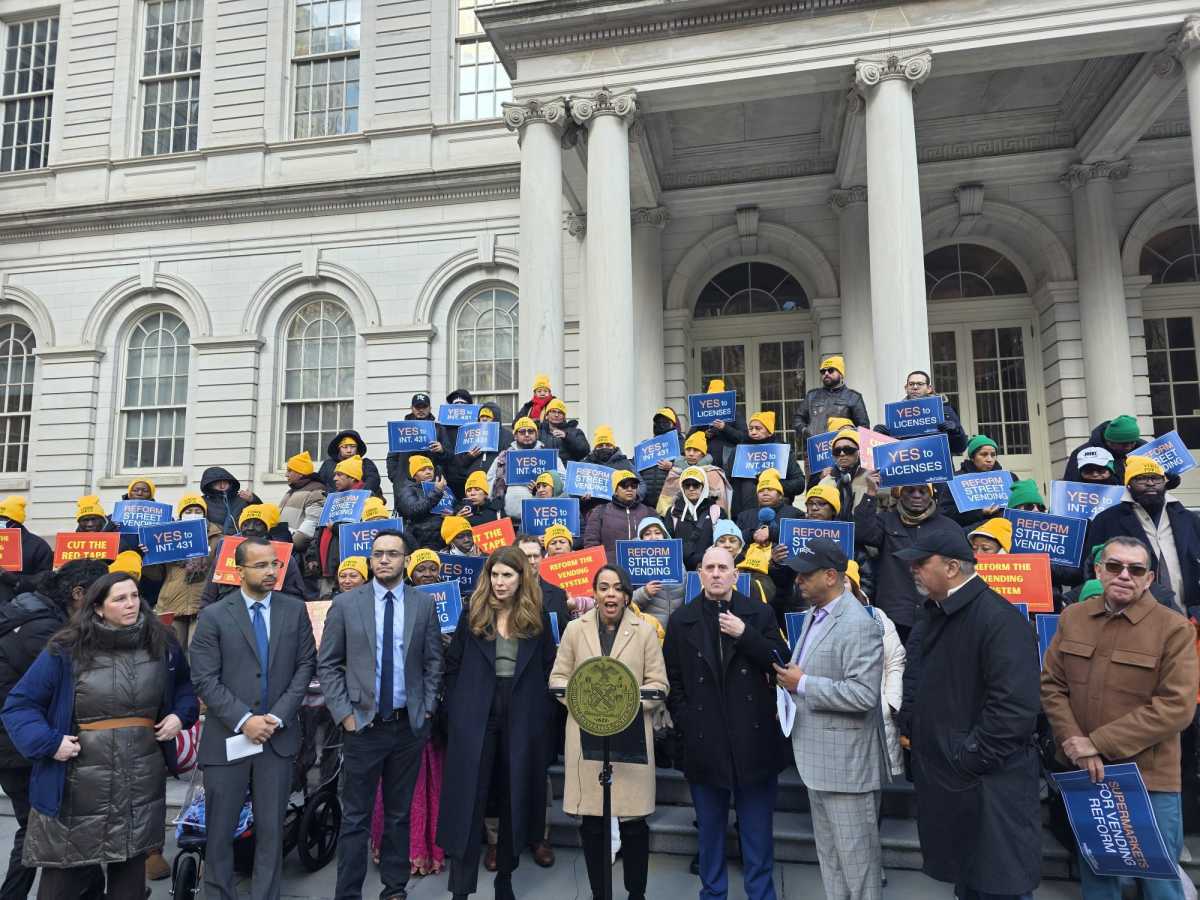
A coalition of street vendors, elected officials and brick-and-mortar groups rallied on the steps of City Hall on Dec. 4 to call on the City Council to vote on a piece of legislation that would reform New York’s vending scene by significantly increasing the number of street vending licenses.
Bronx Council Member Pierina Ana Sanchez, the prime sponsor of Intro 431A, was joined on the steps of City Hall by Council Members Julie Menin, Shaun Abreu, Oswald Feliz and Harvey Epstein to call on Council Speaker Adrienne Adams to hold a vote on the legislation in the final stated meeting of the 2025 legislative session on Dec. 18.
The Street Vendor Project, which advocates for street vendors throughout the city, also joined the rally alongside brick-and-mortar groups such as the National Supermarket Association, the Queens Economic Development Corporation and the Bodega and Small Business Group.
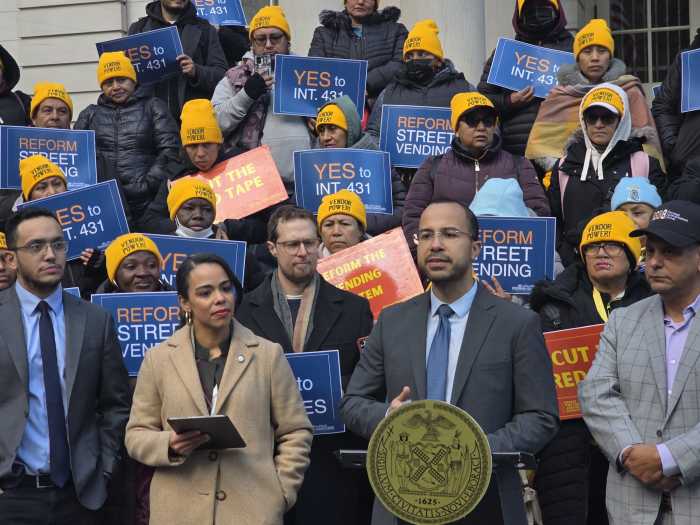
Intro 431A would make 2,000 additional supervisory license applications and 2,100 additional general vendor license applications available to prospective vendors every year between 2026 and 2031 in a bid to clear a legal pathway for prospective vendors.
Advocates say the legislation, which now boasts 32 co-sponsors, would help combat a significant backlog that has forced vendors to “operate in the shadows” because they cannot legally obtain a license from the city.
Vendors have repeatedly stated that it is currently impossible to obtain a permit from the city because they cannot join the lengthy and closed waitlist to secure a permit.
That backlog has made it impossible for new vendors to legally start a business, advocates say, leaving small business owners at risk of fines or of having their merchandise confiscated and destroyed.
Intro 431A has been significantly amended since Sanchez first introduced the bill last year to help address concerns raised in a marathon public hearing in May. The amended legislation also requires the city to increase the number of enforcement personnel to ensure that licensed street vendors are operating safely.
Vendors found to be committing serious or persistent violations would risk losing their license under the terms of the legislation.
Sanchez also touted “many, many conversations” with representatives of brick-and-mortar businesses to ease fears that the legislation would hand street vendors an unfair advantage over brick-and-mortar locations. Amendments to the legislation have introduced a cap on the number of licenses issued each year to ease such concerns.
Sanchez said she had been talking to representatives until 11 p.m. Wednesday to secure their support before Thursday’s rally and said the support of a brick-and-mortar coalition leaves Intro 431A in the strongest position that the bill has ever been.
“These stakeholders bring along council members,” Sanchez said.
Sanchez previously stated that Intro 431A would also ensure that more vendors comply with existing city laws. At present, she said, unlicensed vendors often operate in a manner that allows them to “pick up and run” if they suspect a crackdown by law enforcement, leading to congestion of sidewalks and stalls erected in front of fire hydrants.
By creating a pathway to a permit, the city would ensure that more vendors comply with existing laws because vendors would want to protect their legal ability to sell on the sidewalk, Sanchez said.
She said negotiations will continue before a final version of the bill is submitted to the Council on Dec. 10 and urged Adams to hold a vote in the final stated meeting of the year on Dec. 18.
A spokesperson for the Council Speaker noted that reforming the street vendor system is complex and requires balancing the priorities of vendors with those of brick-and-mortar businesses and the neighborhoods they operate in.
“The Council remains committed to ensuring sound policies and best practices that support street vendors and our local economy,” a Council spokesperson said.
The Health Department stated in October that it has issued permits to 1,107 vendors since the introduction of Local Law 445 in 2022, which mandated that the city must make up to 445 permits available annually. The Health Department said it has made 4,822 permits available since the introduction of the law, more than double than what is legally required.
However, supporters of the legislation argued that the city is issuing permits in “name only,” stating that the waitlist for permits remains closed to new vendors. They also said the law is “not sufficient” to cope with the extensive wait list, which stood above 10,000 in 2024.
The Urban Justice Center, which oversees the Street Vendor Project, said most of the city’s 23,000 vendors are prohibited from obtaining a license due to a “decades-old” cap on the number of permits in circulation within New York City. Urban Justice Center added that only one-quarter of that number have been able to obtain a permit, leaving thousands of vendors without formal recognition and subject to fines.
Menin, who is the apparent victor in the race for Council Speaker and would be set to take over on Jan. 1, said it is “very important” that the bill gets over the finish line, adding that vendors are currently forced to wait “years and years and years” to obtain a license. Menin praised Sanchez for working with a broad range of stakeholders and small business owners to amend the legislation.
Menin, who was one of the most recent lawmakers to co-sponsor the legislation, said she is “very proud” to support it.
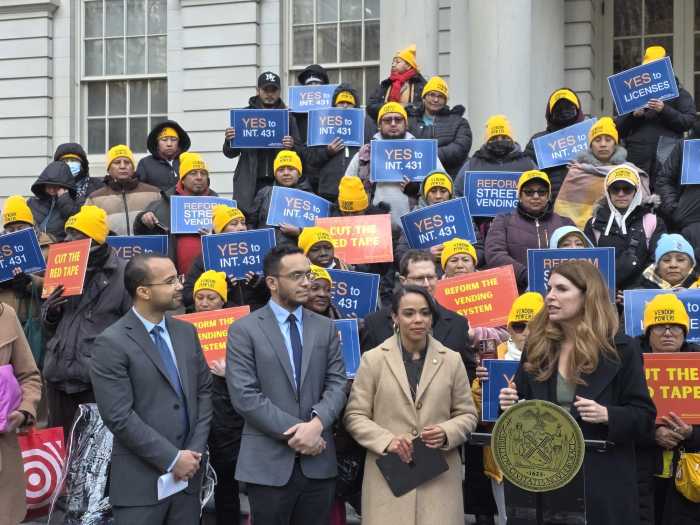
Sanchez said it is a “good sign” that the incoming Council Speaker is supporting the bill but added that it is imperative that the bill passes before Adams leaves office at the end of the year. Failing to pass the bill by the end of the legislative session would require another lengthy hearing and negotiating process, indefinitely delaying the bill, Sanchez said.
A number of small business advocates also touted the significance of the legislation, including Ben Guttmann, executive director of the Queens Economic Development Corporation (QEDC).
Guttmann said QEDC has surveyed vendors in Corona Plaza and the nearby Jackson Heights, reporting that 79% of vendors have lost revenue in the last year. Of those vendors, 84% have reported a loss of over $1,000, Guttmann added, pointing to uncertainty surrounding licenses and fears over ICE raids.
He said the legislation would remove some of the uncertainty facing vendors by addressing some of their fears. Although the legislation would not ease fears surrounding immigration enforcement, it would address concerns surrounding local law enforcement, Guttmann said, removing some of the uncertainty facing vendors.
He said vendors play an integral role in the Queens economy, making the borough’s food scene the envy of the rest of the city.
“There are thousands of street vendors who call Queens home, and they are the type of entrepreneurs that make our neighborhoods the envy of the world,” Guttmann said. “They add eyes on the street, which make it a safer and more family friendly place to be. They make some of the most delicious, amazing food, which makes our neighborhoods the world class tourist destinations.
“These proposed reforms are the kind of things that will help them fully realize the American dream.”
Guttmann described the legislation as a “win-win” for vendors and brick-and-mortar businesses by placing vendors in a more regulated environment while also providing more access to licenses.
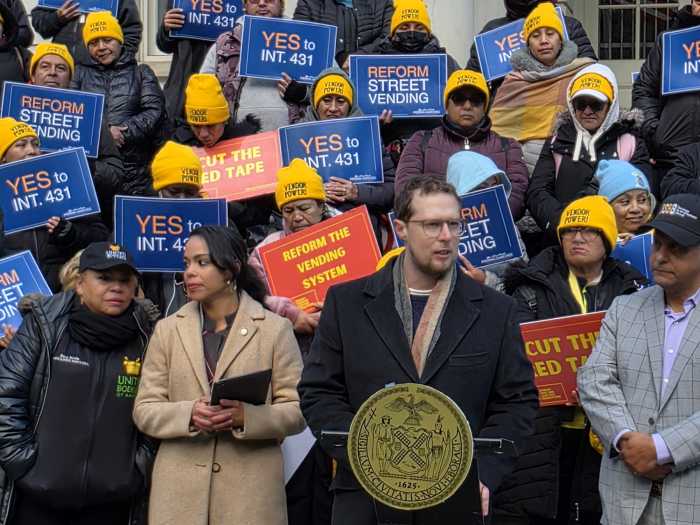
“I think vendors bring more street life to an area, which ultimately creates a rising tide for brick-and-mortars.”
Rosario, who operates a food cart in Corona Plaza and declined to give her full name, said she has seen many vendors in the area have their merchandise or food confiscated or destroyed by local law enforcement.
“It has a very strong impact because people lose their merchandise and lose their way to support themselves and pay their bills,” Rosario said. “I’ve seen people crying. It’s very ugly to see.”
She added that the legislation would improve food safety in carts and food trucks across the city by ensuring that all licensed vendors are in compliance with city regulations.