Aug. 25, 2016 By Hannah Wulkan (Updated: Aug. 26)
Homeowners living beside the Amtrak train tracks in Astoria are facing rent hikes up to 100,000 percent higher than they currently pay to rent the land adjacent to their properties under the trestles, and several local politicians are fighting back on their behalf.
Property under train tracks has long been a magnet for graffiti, trash, and crime, but in the 1940s Amtrak and Astoria residents came up with a mutually beneficial solution: Amtrak rents the property to neighboring families for a token rent price, and residents steward the land, maintaining and upgrading the property over the years.
The residents of these homes, who maintain the property, pay around $25 to $50 per year to rent the land, building yards, gardens, decks and driveways in the space.
However on August 9, six families received a letter notifying them that their rent on the land would increase to between $25,000 and $45,000 per year, depending on the property, and they would have to respond by September 8.
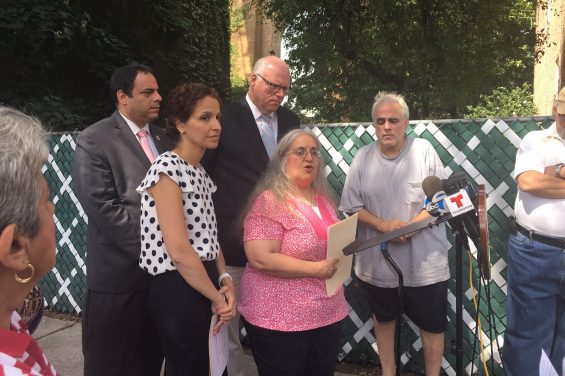
“What they’re trying to do is intimidate our constituents … and they’re trying to railroad them in to paying more money,” said Congressman Joseph Crowley. “It’s a money grab on behalf of Amtrak.”
Many of the residents of these homes have used the land for generations.
“I was born at the house I live in 73 years ago, this was my grandparents’ home and it went on to my parents, to my sister and I, my son and I and my grandson now,” said Loretta Csikortis, whose rent is set to increase from $50 to $40,000 per year.
“I was born here, I would like to die here,” she said, though she noted that if her rent does increase that much she will likely have to move, given how integral the property is to her home. Over the years she has built a driveway, a deck with a pool, and a yard on the property.
“I want to thank congressman Crowley for standing with us and helping us stop this atrocity, stop this unfairness, stop really what Amtrak is trying to do, which is fleece our residents, fleece hard working middle class Astorians who are the reason why this community is one of the most desirable places to live,” said Assembly Member Aravella Simotas.
“It’s because they spent their time, their money, but mostly their time because that’s the most precious thing we have in this life, to clean up Amtrak properties and make them places where people want to come to,” she added.
Councilman Constantinides said he couldn’t imagine how residents felt receiving the letter from Amtrak. “This has been their life work, your home is the largest investment you are ever going to make, and they’re taking care of their homes and taking care of their yards, year after year, decade after decade, raising their families building memories, building a community around this particular home, and for Amtrak to come and try to take that away is unconscionable,” he said.
Amtrak defended itself in a statement, saying, “As good business practice, Amtrak’s Real Estate Department reviews all leases in its asset portfolio. During a recent review, Amtrak identified several lease holders (in the Hell Gate Line Right-of-Way) who had not seen property increases in more than 70 years.
To ensure reasonable leases at fair market value, these lease holders, who currently pay approximately $25 a year, can expect to be charged a fraction (less than 1%) of the fair market rental rates. Those lease holders who are using the property for commercial purposes, will be notified that Amtrak is requesting rates equivalent to the commercial fair market value. Amtrak has been, and will continue, to work with all lease holders on an individual basis.”
“Aside from the sentimental value which is a big issue for us, we have maintained the property in good faith for Amtrak,” said Mary Brown, who was the first resident to get in touch with Simotas’ office. She added that Amtrak gave her no reasons as to why it was raising the rent so much.
The residents on the Amtrak property signed open-ended leases as early as 1946, and their families have resided there ever since. In 1973 rents were raised from a token $1 to between $25 to $50, maintaining the mutually beneficial relationship between Amtrak and residents.
Rose Nagy, another affected resident, spoke to the risks associated with living under the train tracks. She said she remembered fires on the bridge that dropped embers on to her roof in the 70s and 80s, a metal beam that fell off of the bridge and crushed her fathers car in the 90s, and more recently, rocks and bolts that fell from the bridge in to her yard.
“We didn’t get rocks this year, but we got letters,” said Csikortis, noting that this year was worse.
“This is a quintessential Queens story of success,” said Crowley. “Of hard working middleclass Americans who care about the community.”
“We’re calling upon Amtrak once again to rescind these letters, and if they want to enter in to a discussion about a nominal increase in rent, we’ll talk to them about it,” Crowley added. “Though I’m not even interested in that at this point, but we’ll talk to them about it.”
“These letters are obscene,” Crowley concluded.