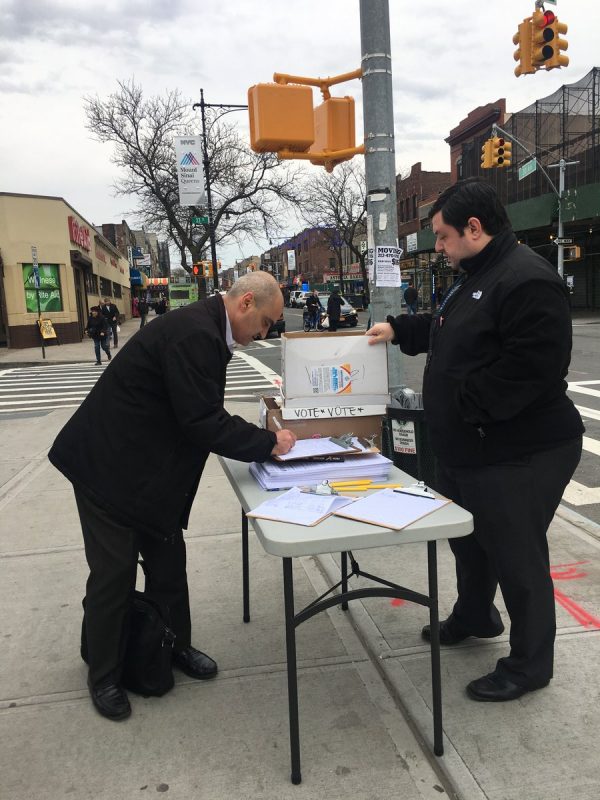
A participatory budgeting voter and volunteer (Photo: Costa Constantinides/Twitter)
April 25, 2018 By Tara Law
Residents voted to spend $250,000 on road repairs and install a new STEM lab at a local school, along with two other projects, when they went to the polls last month to determine how $1 million of city capital should be spent in the district through a process called participatory budgeting.
Councilmember Costa Constantinides announced the four winning projects that will be funded at a thank-you party for volunteers last night.
Participatory budgeting allows residents to decide how to spend a portion of the city council’s budget for the district.
About 3,300 residents of the 22nd Council District— which encompasses Astoria, East Elmhurst, and parts of Long Island City and Woodside— voted on 12 participatory budgeting proposals between April 7 and 15.
The proposal which received the most votes—1,667 in all— was $250,000 for road repair and resurfacing. The NYC Department of Transportation will decide exact locations based on roadway needs.
The second most popular project was a new STEM lab at I.S. 141, which is located at 37-11 21st Ave. A total of 1,658 voters chose to provide the school–at a cost approaching $300,000– with tools for chemistry, biology and math, robotics equipment, circuitry, engineering, 3D printing, programming and design.
A total of 1,637 voters also decided to dedicate $300,000 to improving children’s rooms in District 22 libraries.
Finally, 1,395 voters decided to designate $150,000 to install lighting at Astoria Houses Community Center. Lighting will be installed at the center’s entrance and extra lighting will be added to its entryways, hallways and stairwells.
Constantinides said that funding for the four projects will be allocated this June, and then they will go through a scoping, procurement and construction process over the following two years.
The councilmember said that he was pleased the community turned out to vote despite the chilly weather.
“For me it’s never about what wins, it’s about making the process as robust as possible,” said Constantinides.
For those who feel dissatisfied with the results, he said, there is still hope.
“If somebody is unhappy with the options, they should come out next year,” Constantinides said.